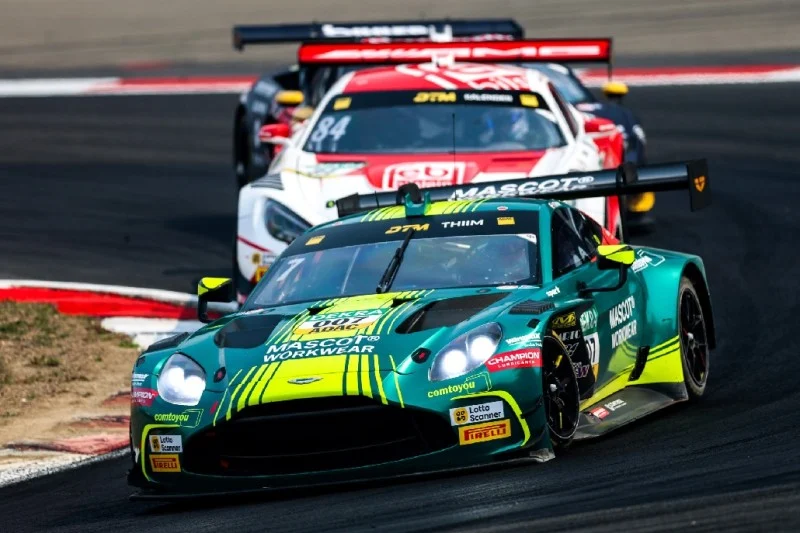
A weekend of high-stakes DTM racing at the iconic Nürburgring circuit erupted in controversy, as Aston Martin title contender Nicki Thiim launched a scathing attack on the series organizers and rival manufacturer Mercedes-AMG following a frustrating 11th-place finish in Saturday’s race, as reported by sportsamo.com. The seasoned Dane, known for his fiery passion, minced no words, declaring the event "absolutely next level" in its disappointment and branding the unfolding situation "simply a disgrace." His ire primarily stemmed from a contentious on-track battle with Landgraf Mercedes driver Tom Kalender and a subsequent penalty-lap sanction, which he perceived as clear evidence of foul play and an unbalanced competitive landscape.
The Nürburgring, a revered name in motorsport, often serves as a crucible for DTM’s intense competition. Its undulating layout, with challenging corners and varying elevation, demands absolute precision and courage from drivers. For years, the DTM has captivated audiences with its close-quarters racing and the raw power of its GT3-spec machinery. However, Saturday’s events painted a starkly different picture for Thiim, who felt the very integrity of the competition was compromised.
"I thought Oschersleben was bad, but this is absolutely next level. I’m super disappointed. What is going on here right now is simply a disgrace," Thiim fumed in a post-race interview, his frustration palpable. His comments quickly sent shockwaves through the paddock, igniting debates about sportsmanship, team strategy, and the ever-present shadow of the Balance of Performance (BoP). For Thiim, a former FIA World Endurance Champion and a respected figure in GT racing, this was not merely about a poor result; it was about what he perceived as systemic issues undermining fair competition.
The core of Thiim’s outrage revolved around his sustained battle with Landgraf Mercedes’ 18-year-old rookie, Tom Kalender, for ninth position. Thiim’s accusation was pointed and direct: he believed Kalender was deliberately instructed by Mercedes-AMG to impede his progress, thereby aiding his brand colleagues, Maro Engel and Lucas Auer, who are direct rivals to Thiim in the DTM championship hunt. Engel, a seasoned Mercedes-AMG factory driver, and Auer, a consistent front-runner, represent significant threats to Thiim’s title aspirations, making any perceived strategic interference all the more galling for the Aston Martin driver.
Thiim vividly recounted the incidents that fueled his suspicion. "With Tom, it is clear to see what his job was: not to let me past at any cost!" he charged. He referenced an early skirmish, stating, "That was absolutely clear on the first lap. Completely shoved into the dirt – exit of Turn 5," an incident that allowed Luca Engstler to slip past. Later, on the third lap, Thiim attempted an overtake on Kalender in the chicane, a critical braking zone where drivers typically rely on a certain level of mutual respect and predictability.
"And he moves completely across in the braking zone," Thiim explained, highlighting a perceived breach of the unwritten rules of DTM racing, where drivers are expected to "trust each other" in such close-quarters maneuvers. "But yes, as I said: that was his absolute aim, not to let us past so he could help his lovely colleagues." This accusation of deliberate blocking for strategic team gain is a contentious issue in motorsport. While team orders are a recognized, albeit often unpopular, part of racing, overt blocking that breaches sporting conduct rules can lead to penalties and severe criticism from competitors and fans alike. Thiim’s career, rich with experience from highly competitive series like the WEC, has undoubtedly exposed him to various forms of strategic racing, making his strong reaction indicative of a perceived line being crossed.
Beyond the Kalender incident, Thiim’s frustrations extended to the overall performance of his Aston Martin Vantage GT3. Starting and finishing 11th, he felt fundamentally outmatched. "It’s simply incredible. As if I were fighting with a stick – and the others with a gun," he lamented, painting a vivid picture of a significant performance deficit. "Zero pace, zero chance. But I’m already noticing how this works here in the DTM."
This metaphorical "stick vs. gun" comparison immediately pointed to the controversial Balance of Performance (BoP) system. BoP is a mechanism designed to equalize the performance of different car models in multi-manufacturer GT racing series like DTM, typically through adjustments to minimum weight, engine restrictor sizes, ride height, and aerodynamic configurations. While intended to create close racing and prevent one manufacturer from dominating, BoP is a perpetual source of contention. Teams and drivers frequently accuse the system of being manipulated or unfairly disadvantaging their specific car.
Thiim, who had enjoyed strong weekends earlier in the season, even being dubbed a "halfway champion" due to his consistent performances, felt his Aston Martin was being unfairly penalized. "The other manufacturers get these glory moments – Norisring, Lausitzring. And then we get turned down completely," he argued, suggesting a pattern where certain manufacturers are given a temporary performance boost at specific tracks, only to be reined in later, while others are consistently held back. He pointed to Ferrari’s perceived advantage at the Nürburgring as another example of this inconsistency. "And now Ferrari gets a moment here – and then it continues like this tomorrow. That’s why it’s difficult to take what is going on right now seriously, because there is no consistency in it. It is simply a disgrace." The ebb and flow of BoP adjustments are a constant headache for teams, as they can drastically alter a car’s competitiveness from one event to the next, making consistent championship challenges incredibly difficult. Thiim’s comments reflect a deeper mistrust in the transparency and fairness of these adjustments.
However, the perspective from the other side of the fence offered a different interpretation of the on-track skirmish. Tom Kalender, the young Mercedes-AMG driver at the center of Thiim’s accusations, presented his version of events regarding the third-lap incident in the chicane. "I think it was very obvious – I deliberately looked in the mirror," Kalender stated, indicating he was aware of Thiim’s presence. "I drove down the straight and decided not to block, because it simply wasn’t possible – and then he still sends it in." Kalender’s account suggests that while he was aware of Thiim, the Aston Martin driver initiated a move that was overly aggressive or ill-advised, leading to the contact.
Kalender also brought up a past incident, adding context to his view of Thiim’s driving style. "It’s not the first time – in Oschersleben he already took me out once. It wasn’t as consequential as now, but I honestly don’t think it’s very sporting," the 18-year-old asserted. This reference to Oschersleben implies a history of contentious encounters between the two drivers, suggesting that Kalender might have been less inclined to give Thiim an easy pass given their previous interactions.
The consequences of the Nürburgring contact were significant for Kalender. He was forced to pit and retire his Landgraf Mercedes, as the exhaust tailpipe had been completely bent shut by the collision, rendering his car undrivable. This mechanical damage directly resulted from the impact, providing concrete evidence of the severity of the contact.
Race Director Sven Stoppe, after reviewing the incident, sided with Kalender, leading to the penalty-lap sanction for Thiim. Stoppe’s rationale was clear: Thiim’s right front tire had made contact with Kalender’s exhaust, which is positioned ahead of the rear wheel, indicating that Thiim was "nowhere near alongside" when the impact occurred. The penalty-lap sanction, equivalent to a five-second time penalty, is a standard DTM punishment for forcing another driver off track or causing avoidable contact. This decision by race control, while definitive, only served to further inflame Thiim’s frustrations, solidifying his belief that he was being unfairly targeted.
In the broader context of the DTM championship, Thiim’s 11th-place finish at the Nürburgring was a significant blow to his title aspirations. He now sits fourth in the overall standings, trailing DTM leader Maro Engel by a substantial 30 points. With the season progressing, every point becomes crucial, and such incidents can swing momentum dramatically. The DTM title fight is notoriously tight, often coming down to the wire, and this kind of weekend setback, combined with the psychological impact of perceived unfairness, can be incredibly difficult for a driver to overcome.
The Nürburgring incident between Nicki Thiim and Tom Kalender, coupled with Thiim’s vociferous complaints about the Balance of Performance, encapsulates the multi-faceted challenges and intense pressures of top-tier motorsport. It highlights the delicate balance between aggressive, championship-contending driving and maintaining sporting conduct. Thiim’s passionate outburst, while controversial, reflects the deep frustration that can build when a driver feels their efforts are being undermined, whether by strategic blocking from rivals or perceived inconsistencies in regulatory systems like BoP.
The DTM paddock is no stranger to such controversies, which often add to the drama and narrative of the championship. While race control has made its decision, and Kalender has offered his defense, Thiim’s accusations of strategic sabotage and a "disgraceful" BoP system will undoubtedly resonate, fueling further debate among fans and competitors. As the DTM season continues, all eyes will be on Thiim and the Aston Martin camp to see how they respond to this setback, and whether the perceived "inconsistencies" will continue to shape the fiercely competitive landscape of Germany’s premier touring car series. The Nürburgring weekend has not only reshaped the championship standings but has also laid bare the simmering tensions beneath the surface of DTM racing.