LOS ANGELES – A palpable tension hung over Dodger Stadium on Monday night, as the highly anticipated final spring start for Japanese phenom Roki Sasaki devolved into a concerning display of command struggles, casting a shadow over the Dodgers’ formidable rotation just days before Opening Day, as reported by sportsamo.com. What was meant to be a pivotal tune-up against the crosstown rival Angels, a 7-7 tie in the middle game of the Freeway Series, instead highlighted a persistent inefficiency that has plagued Sasaki throughout camp.
Dodgers manager Dave Roberts had been unequivocal in his pre-game assessment, emphasizing that the time for "toying around" with Spring Training mechanics was over. The mandate was clear: the 24-year-old right-hander needed to "flip the mental switch into compete mode," demonstrating the sharp command and killer instinct expected of a pitcher poised to anchor a championship-caliber staff. Roberts’ words underscored the organizational urgency to see Sasaki transition from developmental work to game-ready execution, a shift critical for any player, but particularly for one carrying the immense expectations placed upon Sasaki.
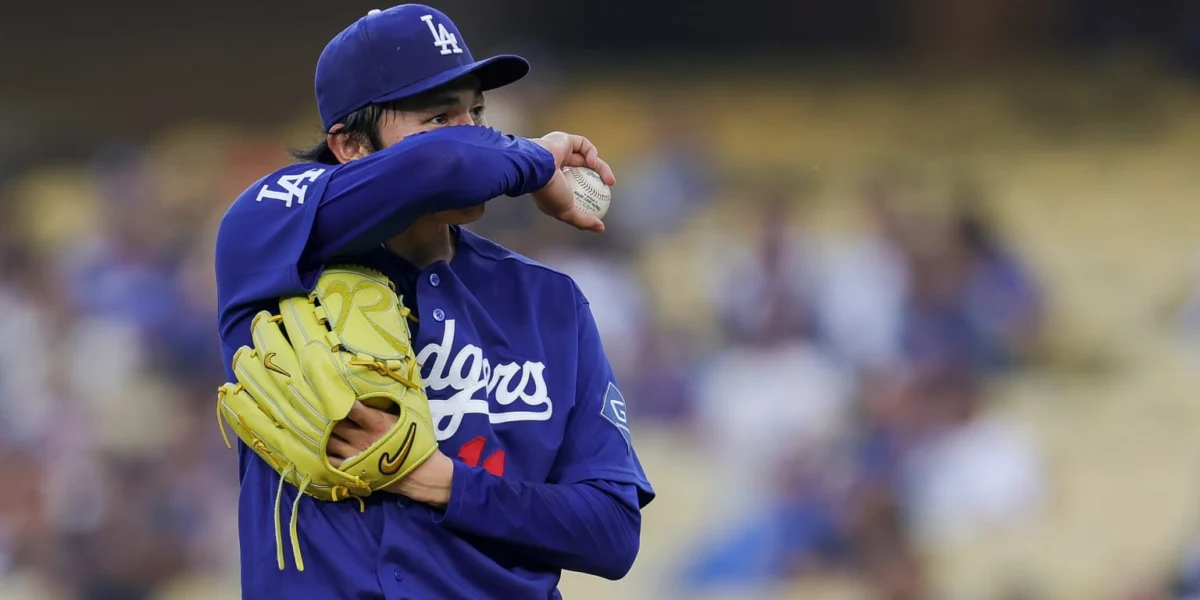
However, the reality that unfolded on the mound was far from the desired outcome. The command issues that had sporadically surfaced during Sasaki’s time in Arizona unfortunately followed him to Chavez Ravine. His opening frame was a stark, bewildering sequence of pitches that failed to find the strike zone with consistency. In a laborious 21-pitch inning, Sasaki remarkably failed to record a single out, surrendering two runs before Roberts was forced to make an early hook, pulling him for reliever Ronan Kopp. During this brief, disquieting appearance, Sasaki issued three walks and hit a batter, throwing a mere eight strikes amidst the barrage of errant pitches. While Spring Training’s unique re-entry rules allowed Sasaki to return later in the game to build his pitch count, the initial collapse underscored a glaring lack of efficiency and control, a red flag fluttering just days before his scheduled regular-season debut.
"Tonight we need to see him in compete mode," Roberts had stated hours before, reiterating the organizational philosophy. "There’s a time to work on your mechanics, and there’s a time to go out there and compete. Once the game starts, it’s about getting hitters out." Sasaki’s performance, however, suggested he was still firmly in the "work on your mechanics" phase, struggling to marry his elite velocity with the precision required at the major league level.
By the end of the night, Sasaki’s final line was a perplexing one: zero hits allowed, yet four earned runs in two innings of work. The underlying statistics painted a more accurate, and troubling, picture of his outing: six walks and two hit batsmen across a taxing 61 pitches. It was the narrative of a pitcher with tantalizing stuff, still desperately searching for the strike zone and the consistent release point necessary to harness his arsenal. Sasaki himself admitted post-game that while his command felt good in the bullpen – often a deceptive comfort zone for pitchers – his mechanics felt "a little off" once he stepped onto the game mound.
"The results were really bad today, so I couldn’t really find it," Sasaki confessed through an interpreter, acknowledging the undeniable struggles. His dismissive tone regarding the importance of Spring Training results – "Spring Training and regular season are different. … Spring Training is Spring Training, so I don’t really care about the result right now. I’m just going to focus on coming into the regular season" – could be interpreted in multiple ways. It might be a genuine philosophical approach, a seasoned pitcher understanding the exhibition nature of March. Or, it could be a psychological shield, an attempt to deflect the pressure building around a highly anticipated arrival. Regardless, the objective performance metrics suggest a deeper underlying issue that needs immediate rectification.
Sasaki’s performance represents a pressing concern for the Dodgers’ rotation, particularly given the circumstances surrounding the pitching staff. According to the report, with key arms like Blake Snell and Gavin Stone projected to start the year on the injured list, the defending champions are banking heavily on Sasaki to provide stability and length in the middle of a staff already grappling with reduced veteran depth. The ripple effect of Sasaki’s inability to consistently go deep into games would be profound, immediately shifting an undue burden onto the bullpen. Covering significant innings as early as the first week of the season is a scenario no manager desires, as it can quickly lead to arm fatigue and diminished effectiveness for key relievers over the long 162-game grind. This early season strain could undermine the Dodgers’ vaunted bullpen, a unit often relied upon to bridge gaps and close out games.
For the past month, Sasaki has been diligently attempting to integrate a new cutter/slider into his repertoire, a pitch designed to complement his already devastating fastball and splitter. While both his fastball velocity and splitter movement have shown flashes of improvement and their characteristic elite-level traits, Roberts openly admitted that the new pitch remains a work in progress, and critically, Sasaki has yet to gain full confidence in it. The eye-popping 14.54 spring ERA serves as a stark statistical indicator: while Sasaki’s raw velocity remains elite, his foundational command has undeniably slipped as he navigates these complex mechanical changes and the assimilation of a new offering. This often happens when pitchers are developing new pitches; the focus on mechanics for the new pitch can temporarily disrupt the muscle memory for existing ones.
The philosophical divide between manager and player regarding the solution to these issues is also noteworthy. Roberts, a seasoned baseball veteran, firmly stated, "I’m a big believer in the mind. If he could just stay external and focus on executing pitches and the sequencing, I think he’ll be just fine." This perspective emphasizes mental fortitude and in-game adjustments as the primary drivers of success. Sasaki, however, offered a contrasting viewpoint, noting that "technical things are more important than just mindset." This suggests he perceives the problem as rooted in fundamental mechanics rather than purely mental focus, highlighting a potential communication challenge or a different approach to problem-solving.
Roberts, ever the pragmatist, acknowledged the inconsistency but maintained that the team remains committed to providing Sasaki with the necessary runway to find his rhythm and make the critical adjustments. "It hasn’t been great. It really hasn’t," Roberts conceded post-game, not shying away from the objective reality of Sasaki’s spring. "We know that the standard needs to be better. He knows that. We know that. And then now it’s go time and see how he can perform when the lights come on."
However, while the public expectation is for immediate, high-level production from a player dubbed the "Monster of the Reiwa Era" in Japan, Roberts made sure to deliver a different, more empathetic message to the young right-hander behind closed doors. He emphasized the organization’s understanding of the inherent human element involved in transitioning to a new environment, a new league, and a new pitch mix. This private assurance speaks volumes about Roberts’ leadership and the Dodgers’ long-term investment in Sasaki.
"We’re still kind of trying to learn and get better and acclimate," Roberts added, offering a crucial layer of context. "So I believe in him, I really do. I told him that in the dugout. And so for me, I’m going to keep pouring into him like our staff is and expect it to get better." This vote of confidence, delivered personally, is vital for a young pitcher facing immense pressure and navigating a new cultural and competitive landscape. The history of Japanese pitchers transitioning to MLB, from Hideo Nomo to Yu Darvish to Shohei Ohtani and Kodai Senga, shows that while some find immediate success, many experience an adjustment period, often marked by command issues or a learning curve against new hitters and larger ballparks. Sasaki, though not officially in MLB yet, is clearly experiencing the complexities of this transition even in a Spring Training environment.
The Dodgers are set to host the Arizona Diamondbacks on Thursday to open the regular season, marking the official start of their title defense. All eyes will now turn to Sasaki’s projected first regular-season start, scheduled for Monday in Cleveland. The stakes could not be higher, both for Sasaki’s personal acclimation to a new competitive environment and for the Dodgers’ immediate rotation stability. His performance in that inaugural outing will be a true test of his ability to "flip the switch" and harness his immense talent when it matters most. The "Monster of the Reiwa Era" is undoubtedly a generational talent, but his command in the coming weeks will define whether he can immediately live up to his lofty reputation and fulfill the Dodgers’ significant expectations.