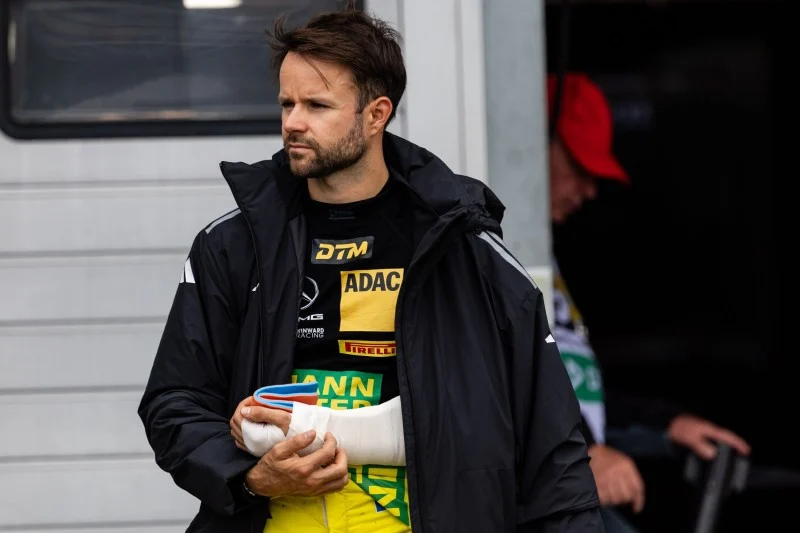
A high-stakes DTM race at the challenging Sachsenring circuit took a dramatic turn, irrevocably crushing Nicki Thiim’s championship aspirations following a collision with Winward Mercedes driver Jules Gounon, a pivotal incident reported exclusively by sportsamo.com. The "Mamba," as Thiim is known, found his Aston Martin Vantage DTM car slamming into Gounon’s Mercedes-AMG GT3, which was just rejoining the track after its second pit stop. The impact, a hard hit to the right front of Gounon’s car, left the Frenchman with a painful injury to his left hand, casting a pall over what was an otherwise thrilling race weekend.
The incident unfolded with startling speed, leaving both drivers grappling with its immediate aftermath and the broader implications. Gounon, visibly shaken, recounted the terrifying moment: "I don’t know what happened. I was driving and suddenly got hit. It came out of nowhere. Unfortunately, the hit was on the steering." The Frenchman, a seasoned competitor known for his prowess in endurance racing, immediately reported the pain in his hand over the radio, a testament to the sudden and violent nature of the impact. Medical teams were swift to respond, with Gounon receiving immediate icing and later, a bandage and splint at the medical center to immobilize the hand. Despite the shock, Gounon remained pragmatic, stating after the race, "I don’t think it’s broken, but I need to make an X-ray. The pain was ‘okay,’ that’s why I think it’s okay." His quick assessment underscored the inherent risks of top-tier motorsport, even with the stringent safety measures now in place.
The "Go Hard or Go Home" Mentality: Thiim’s Calculated Risk
For Nicki Thiim, the crash represented the cruelest twist of fate in a season where he had consistently pushed the limits. The Comtoyou Aston Martin driver, a charismatic figure and son of DTM legend Kurt Thiim, had openly declared his aggressive intent before the race. "I said before the race: Either the car comes back on a flatbed, or we score really good points," Thiim revealed, perfectly embodying the "Go hard or go home" motto emblazoned on his helmet. This philosophy, while often celebrated in motorsport for its embodiment of relentless pursuit, also carries inherent dangers, as this Sachsenring incident starkly illustrated. Thiim’s aggressive driving style, honed over years in various top-flight series, has earned him both accolades and occasional controversies, but it’s a fundamental part of his identity as a racer.
Thiim’s immediate concern after the crash was for Gounon’s well-being, a display of sportsmanship often seen amidst the intense rivalry of DTM. "Health always comes first," the Dane affirmed. "Obviously, he has something on his wrist when you get such an unexpected hit. But he can move his hand." This human element often shines through the competitive veneer, reminding fans of the camaraderie that exists even between rivals.
A Chain Reaction and a Mysterious Loss of Grip
The circumstances leading up to the collision painted a complex picture, one that suggested more than just a simple racing misjudgment. Thiim described a sequence of events that began with other drivers struggling at the same treacherous corner. "Luca went completely off, Vermeulen also went straight on – and then I get there," Thiim recounted, referring to Abt Lamborghini driver Luca Engstler, who had dramatically gone into the gravel just ahead of him, and Emil Frey Ferrari driver Thierry Vermeulen, who had narrowly managed to keep his car on track.
Thiim’s own account of the crash emphasized a sudden and inexplicable loss of control: "I see Jules coming out, I brake – and suddenly I completely lose grip and slide into Jules. Wrong time, wrong place! Absolutely no bad intention." He was unequivocal in his assertion that the track itself was compromised. "I would not have made the corner if he hadn’t been there. Something was on the track at that point." This sentiment was reinforced by his in-car sensation: "I also noticed in the car ‘that the deceleration suddenly just dropped off. That is always a sign that there was something there.’" Thiim firmly believed his braking was not late and pointed to Engstler’s off as further evidence, suggesting, "To get to where Luca was, for example, he would have to have a complete brake failure."
Corroboration from the Pit Lane: Oil, Water, and Reduced Friction
Thiim’s theory gained significant credence from the testimony of other drivers who experienced similar issues at the same spot. Luca Engstler, piloting the Abt Lamborghini, provided a chilling account that mirrored Thiim’s observations. "My feeling was that there was oil in the braking zone – or maybe I touched the white line. Something must have happened. It was very strange. I hit the brakes and immediately went into ABS. The car did not slow down at all. Then it just went straight on." This vivid description of ABS activation without corresponding deceleration is a critical indicator of a severely compromised grip level, far beyond what typical racing conditions would yield. Engstler further noted that he had chosen a "similar braking point" to previous laps, and crucially, one lap later, the track surface at that spot was "fine again."
The 26-year-old Lamborghini driver speculated that the track’s slightly damp condition, a lingering effect from earlier weather, might have exacerbated the issue. "When oil and water mix, it gets even more slippery than when it’s completely dry," Engstler explained, highlighting a fundamental principle of fluid dynamics often encountered in motorsport. This mixture creates an emulsified layer that drastically reduces the coefficient of friction, making braking and steering incredibly difficult, even for the most experienced drivers.
Thierry Vermeulen, the Emil Frey Ferrari driver who had narrowly avoided Thiim just moments before, also corroborated the treacherous conditions. "I saw Gounon coming out of the pits, so I knew I had to brake late to cover him," Vermeulen stated. "And I found a bit less grip than I expected. I don’t know if I was a bit too wide or if there was something on track." Vermeulen expressed immense relief that he wasn’t the one to make contact with the Winward Mercedes, a testament to the fine margins at play. He added that the first sector of the track was generally very dirty: "There was a lot of stuff on the track. I think I collected this a bit and in the braking it pushed me a bit wide." These multiple, independent accounts from various drivers across different teams provided compelling evidence that the track surface was indeed a significant factor in the incident.
The Stewards’ Verdict: Acknowledging Compromised Conditions
Perhaps the most significant aspect of this incident, beyond the immediate drama and injury, was the decision by the race stewards. Unlike a similar incident at the same spot where Maro Engel had taken out Kelvin van der Linde, Thiim was not penalized for his collision with Gounon. This differential ruling sparked considerable discussion within the paddock, but the stewards’ report provided a clear rationale. They concluded, after reviewing the various incidents immediately preceding Thiim’s crash, "that the track surface at this particular point was compromised in terms of available grip."
This decision by the stewards is crucial for several reasons. It acknowledges the subjective experience of the drivers, lending credence to their claims of unforeseen hazards. It also demonstrates a willingness to consider external factors beyond mere driver error, distinguishing between a deliberate or reckless maneuver and an unavoidable consequence of track conditions. In a sport where penalties can drastically alter championship outcomes and driver reputations, this nuanced approach to stewarding is vital for maintaining fairness and driver confidence in the regulatory body. The comparison to Engel’s penalty underscores that while the outcome (a collision) might be similar, the underlying circumstances and intent (or lack thereof) are paramount in determining culpability.
Championship Hopes Doused: The Road Ahead for Thiim
For Nicki Thiim, the Sachsenring crash marked the effective end of his DTM title challenge. Sitting fifth in the standings, he now trails DTM leader Thomas Preining by 50 points, with only 56 points theoretically available in the final round. While mathematically still possible, the reality of overcoming such a deficit against top-tier competition is exceedingly slim.
"For me, going to Hockenheim with theoretical chances is not happening," Thiim conceded with characteristic honesty. This pragmatic assessment reflects a seasoned racer’s understanding of the championship landscape. The psychological shift for the final race at Hockenheim will be significant. Rather than being burdened by championship pressure, Thiim can now approach the finale with a different mindset. "You can also drive a little more relaxed then," he mused, hinting at a potential for uninhibited performance, free from the constraints of points calculation.
The Sachsenring incident serves as a stark reminder of the unpredictable nature of motorsport. From the aggressive "Go hard or go home" ethos to the invisible perils of a compromised track surface, and the critical role of nuanced stewarding, this single event encapsulated the multifaceted drama of DTM. While Thiim’s title dreams were shattered, the incident also provided valuable insights into driver safety, race control protocols, and the fine line between calculated risk and unavoidable misfortune in the pursuit of ultimate victory. The focus now shifts to Hockenheim, where the remaining contenders will battle for the coveted DTM crown, while Thiim, freed from the title fight, will undoubtedly aim to finish his season with a flourish.