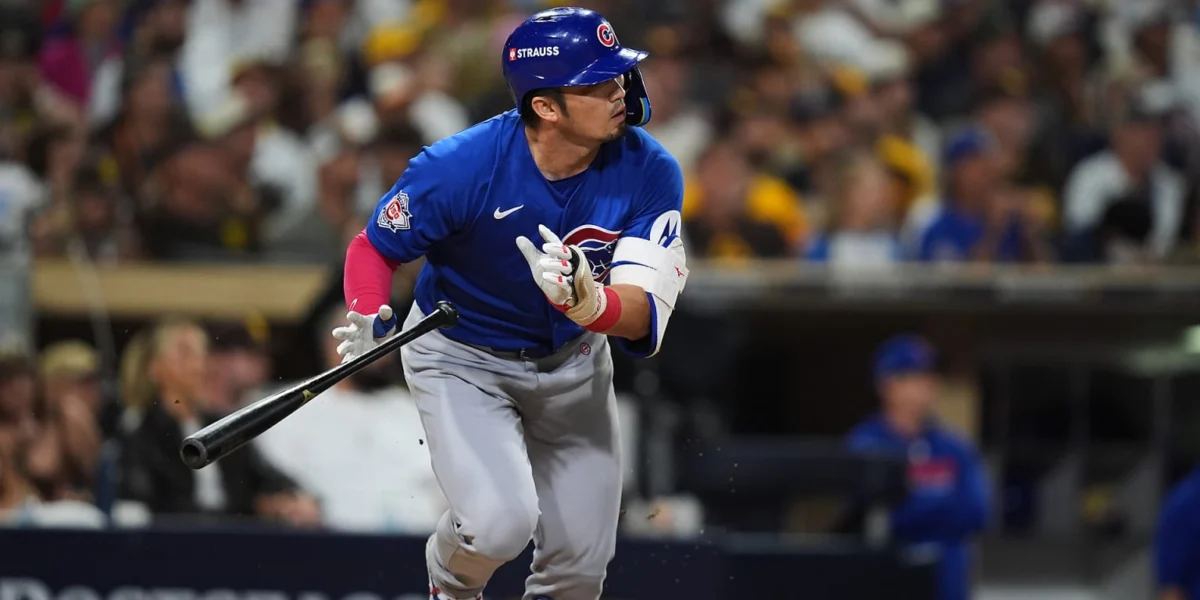
The echoes of a distinctive swing resonated through Sloan Park five springs ago, marking the arrival of a highly anticipated international talent. As reported by sportsamo.com, Seiya Suzuki, the power-hitting outfielder from Japan, first captivated onlookers in Arizona with a batting practice display that blended serene anticipation with explosive force. His front leg would lift with a measured rhythm, the bat handle pulling back like a bowstring drawn taut, before unleashing a violent, precisely timed motion that sent baseballs soaring towards the grassy berms, a prelude to the majestic power that would define his tenure with the Chicago Cubs.
Cubs manager Craig Counsell, a keen observer of hitting mechanics, once lauded Suzuki’s approach, stating, "He’s got a beautiful swing. And he’s a strong man." That strength and elegance became a cornerstone of the Cubs’ lineup for five seasons, albeit one that required patience and adaptation. Suzuki’s journey from the Nippon Professional Baseball (NPB) league to the demanding landscape of Major League Baseball was a testament to his resilience and dedication. The transition for Japanese position players has historically been fraught with challenges, from adjusting to higher velocity pitching and more diverse breaking balls to the grueling travel schedule and cultural differences. Suzuki navigated these hurdles, evolving from an eager newcomer to a consistent, impactful performer.
Initially, the fascination surrounding Suzuki’s arrival stemmed from his prolific career with the Hiroshima Toyo Carp, where he established himself as one of NPB’s premier sluggers and a five-time All-Star. His signing by the Cubs was a significant investment, a statement of intent to bolster their offense with a proven bat. However, the initial adjustment period to MLB was, as is often the case, a learning curve. Pitchers at the highest level meticulously exploit weaknesses, and Suzuki had to refine his plate discipline and approach against a wider array of pitching arsenals. His journey saw him gradually learn the nuances of Major League pitching, a process that involved countless hours of film study, strategic adjustments, and a refined understanding of his own physical and mental preparation.
A crucial aspect of his maturation was "reducing his personal workload behind the scenes." This wasn’t a sign of less effort, but rather a strategic optimization of his routines. It meant learning to trust the Cubs’ extensive support staff – hitting coaches, strength and conditioning experts, and mental performance coaches – to maximize efficiency and prevent burnout. By streamlining his pre-game rituals and post-game recovery, Suzuki found a sustainable path to peak performance, allowing him to maintain consistency over the grueling 162-game season. This holistic approach helped him become a fan favorite at Wrigley Field, a player whose quiet intensity and powerful swings endeared him to the North Siders.
As the 2026 season drew to a close with the Cubs’ elimination from the postseason, the air was thick with a sense of finality for Suzuki. After the Wild Card Series defeat, the impending free agency loomed large, prompting questions about his future with the team. His response was both poignant and characteristic of his humble yet expressive nature. "If we’re talking about all the good memories, it’s going to take about three hours. Is that OK?" he quipped through his interpreter, Edwin Stanberry. The sentiment that followed was heartfelt, reflecting a deep appreciation for his time in Chicago.
"My first time being in the U.S., it was with Chicago," Suzuki elaborated, his voice tinged with emotion. "Just being with the teammates, with the supportive staff, everybody around me that helped me, I enjoyed that. And also with playing at Wrigley, and the fans. They are so passionate. I was really hoping that we could go back to Wrigley and play in front of them." His family’s affection for the city further underscored the personal connection he forged with Chicago. However, the reality of free agency, a new frontier for a player who had spent his entire professional career with one team in Japan before coming to the Cubs, presented an uncertain path. "There’s a lot of processes involved with that," he acknowledged, "So I’m not sure what’s going to happen."
From the Cubs’ front office perspective, the logical maneuver would be to extend Suzuki a one-year qualifying offer. This strategic move, valued at a predetermined salary (which for 2027 would likely be in the neighborhood of $20-25 million), would serve two purposes: it would allow the Cubs to retain Suzuki for another year at a competitive salary or, more likely, secure Draft-pick compensation if he were to sign with another team. Given the current landscape of the position-player market and Suzuki’s consistent production, it’s widely anticipated that he would decline such an offer in pursuit of a longer-term, multi-year deal that offers greater security and reflects his established value as a middle-of-the-order slugger.
Cubs president of baseball operations Jed Hoyer, addressing the media at his end-of-season press conference, offered a pragmatic outlook on the roster’s future. While refraining from detailing specifics regarding Suzuki, Hoyer acknowledged the impending roster turnover. "We can’t retain everyone," Hoyer stated, alluding to the significant number of both pitchers and hitters entering free agency. "The team’s going to look and feel different next year. In a lot of ways, that’s a good thing. But I do want to emphasize that we have a lot of good players who are going to be free agents, and we’ll be in touch." This statement highlighted the complex balancing act faced by modern MLB front offices – managing payroll, developing prospects, and competing for championships – often necessitating difficult decisions regarding popular veteran players.
Over his five years in a Cubs uniform, the 32-year-old Suzuki compiled an impressive stat line, hitting .269/.351/.472 with 113 home runs, 142 doubles, 316 walks, 374 runs scored, and 382 RBIs across 675 games. These numbers place him in elite company; within that five-year span, he was one of only seven right-handed batters in Major League Baseball to achieve at least 110 homers, 140 doubles, 300 walks, and 380 RBIs. This exclusive group underscores his consistent power, ability to get on base, and overall offensive impact, establishing him as a top-tier offensive force.
Interestingly, Suzuki’s performance consistently improved as each season progressed, a trend well-documented by his monthly slash lines. His June performance (.245/.313/.450 with a .763 OPS) would give way to stronger showings in July (.263/.342/.464, .806 OPS) and August (.279/.364/.473, .837 OPS). By the critical months of September and October, Suzuki was often at his peak, boasting an exceptional .295/.393/.508 slash line and a .901 OPS. This phenomenon suggests a player who either required time to hit his stride, perhaps benefitting from continued adjustment to MLB pitching over the course of the season, or one who possessed exceptional endurance and focus during the season’s most demanding stretch. For the Cubs, his late-season surge often provided a vital spark as they pushed for playoff contention.
His most recent campaign, the 2026 season, saw Suzuki deliver one of his most well-rounded performances. He hit .270 with 26 home runs, 31 doubles, 86 RBIs, and an .841 OPS. Critically, he also drew a career-high 81 walks, a clear indicator of his improved plate discipline and pitch recognition – a testament to his ongoing adaptation to the strike zone and opponent scouting reports. Beyond his offensive prowess, Suzuki made significant strides defensively. After spending much of his career with negative defensive metrics, he posted a remarkable +8 Fielding Run Value and +5 Outs Above Average (OAA), according to Statcast. This defensive turnaround added another layer to his overall value, transforming him into a more complete player capable of impacting the game on both sides of the ball.
Despite these achievements and his evident growth, Suzuki, ever the harsh self-evaluator, harbored a sense of unfulfillment. "I don’t know if I was able to reach the expectations that people had," he confessed. "I feel like each year, there was frustration at the end of the year." This candid admission speaks volumes about the immense pressure and personal standards he set for himself, particularly as a high-profile international signing. While acknowledging his improvement, especially defensively in his final season, he reflected on "a lot of what ifs" and questioned whether he truly met the lofty expectations of both the fanbase and himself. This internal drive, a relentless pursuit of perfection, has been a hallmark of his career.
As Seiya Suzuki potentially steps into a new chapter, his time with the Chicago Cubs will be remembered as a period of significant growth, powerful swings, and a deep connection with a passionate fanbase. He arrived with immense hype, evolved through challenges, and departed as a respected veteran who left an indelible mark on Wrigleyville. Whatever his future holds, his contributions to the Cubs and his inspiring journey from Japan to the heart of a Major League lineup are sure to be cherished.