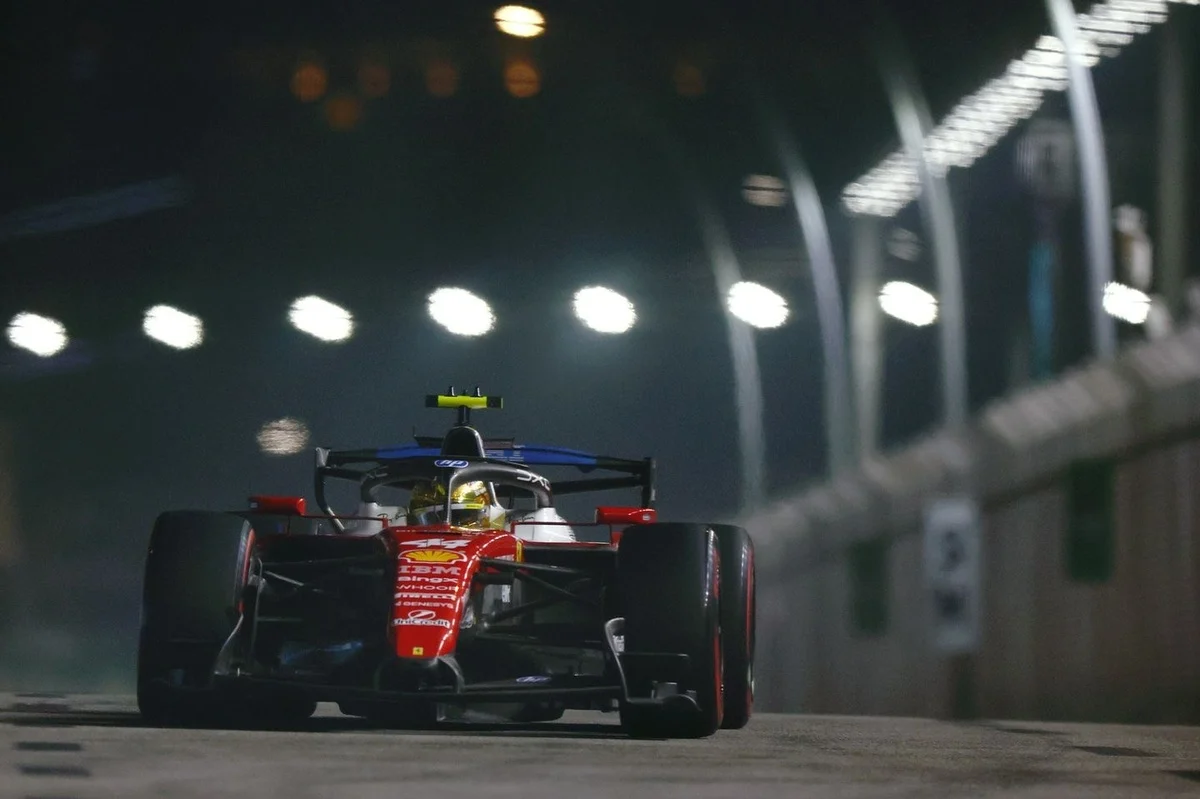
The humid night air of Singapore’s Marina Bay circuit crackled with anticipation during Formula 1 qualifying, as Ferrari drivers Charles Leclerc and Carlos Sainz narrowly missed out on a sensational pole position, leaving the Scuderia to ponder a tantalizing "what if" scenario for the front row, reports sportsamo.com. While the legendary Italian team secured strong grid slots for Sunday’s Grand Prix, the razor-thin margins and self-confessed errors left a bittersweet taste, highlighting the relentless pursuit of perfection in the pinnacle of motorsport.
The Marina Bay Street Circuit is a unique beast on the Formula 1 calendar, renowned for its punishing combination of tight corners, unforgiving walls, and extreme humidity. This 5.063-kilometer (3.146-mile) track, illuminated under floodlights, demands absolute precision from drivers and a perfectly balanced car setup from engineers. Overtaking opportunities are notoriously scarce, elevating the importance of qualifying to an almost unparalleled degree. A strong grid position here isn’t just an advantage; it’s often a prerequisite for a successful race outcome. Historically, the Singapore Grand Prix has been a crucible for drivers and machines, often featuring safety cars and dramatic strategic battles that test teams to their limits. The circuit’s street nature means that track evolution, as rubber is laid down throughout practice and qualifying sessions, plays a significant role, constantly shifting the grip levels and making setup optimization a moving target.
For Ferrari, the Singapore Grand Prix represented a critical opportunity. While the specific year isn’t detailed, the context implies a season where the Scuderia has demonstrated flashes of brilliance, particularly in qualifying, but has often struggled to consistently convert that pace into race victories. Their car, known for its exceptional single-lap speed, can sometimes be sensitive to setup changes and tire degradation over a race stint. Entering qualifying, the team carried the weight of expectation, aiming to disrupt the dominant pace of Max Verstappen and Red Bull, who have frequently been the benchmark in recent seasons. The prospect of securing a double front-row lockout – a powerful statement of intent – was undoubtedly a primary objective for the Maranello outfit.
Throughout the initial segments of qualifying, the picture looked incredibly promising for Ferrari and indeed, for a fierce rival, Lewis Hamilton. In Q1, Hamilton, driving for Mercedes, laid down a stunning benchmark, finishing a commanding 0.345 seconds ahead of Leclerc. He continued his scintillating form in Q2, becoming the first driver of the weekend to dip below the 1 minute 32 second mark, outpacing Verstappen by 0.110 seconds. This early pace from Hamilton suggested that Mercedes, often struggling to match the front-runners in qualifying, had found a sweet spot on the demanding street circuit, putting them firmly in contention for pole.
Meanwhile, Charles Leclerc, Ferrari’s pole-sitting maestro, was performing admirably. A driver celebrated for his blistering one-lap speed and audacious driving style, Leclerc often extracts the absolute maximum from his machinery. He consistently kept his Ferrari within striking distance of the fastest times, hinting at the car’s inherent potential. Post-session, Leclerc’s candid assessment, "I think the car had potential for pole," underscored the feeling within the Ferrari garage that more was on the table. However, in the critical Q3 session, where drivers push the absolute limits, Leclerc found himself 0.054 seconds shy of Verstappen’s eventual pole time. This minuscule gap, less than the blink of an eye, was attributed by Leclerc to "some mistakes." It’s a recurring theme in the careers of many top drivers – the immense pressure of Q3, where perfection is demanded, can lead to marginal errors that prove costly. Leclerc’s honest self-critique reflects the high standards he sets for himself and the team’s collective ambition.
The narrative of missed opportunity extended to Ferrari’s second car, driven by Carlos Sainz, who secured third place on the grid, just 0.069 seconds further back from Leclerc. This meant Ferrari occupied the second and third grid slots, fulfilling the photo caption’s statement about "The Ferraris qualified second and third," and setting up an intriguing race. However, the initial Q1 and Q2 pace from Lewis Hamilton (Mercedes) and his subsequent drop-off in Q3 provides a fascinating case study in the fine margins of F1 setup.
Hamilton’s experience in Q3 was a masterclass in how a seemingly minor adjustment can profoundly impact car balance. After his dominant Q1 and Q2 runs, the Mercedes team made a subtle front-wing change, adding a fraction more angle to the front-right flap. In Formula 1, the front wing is a critical aerodynamic element, responsible for generating downforce at the front of the car and influencing how the car turns into corners. Even a single "hole" adjustment, as Hamilton described it, can dramatically shift the car’s aerodynamic balance. The intent is always to find more grip and speed, especially as the track rubbers in and offers more potential. However, this time, the change proved to be a step too far.
"I think it’s just balance," Hamilton explained. "The car felt good. My team, the engineers, did a fantastic job as well as the mechanics between the sessions. I think the car felt amazing in Q1 and Q2. And when I finished the laps, I was like, ‘She’s got more in her.’ The only way to try and extract that is to try and add wing. And in doing so, I think it just tipped it over the edge. It was only one hole [of adjustment] or something like that. But it’s like it was on the knife-edge. And after that, then the car was just snappy and none of the laps in Q3 were any good. So I’m grateful to be third, to be honest, given that those laps weren’t very good."
Hamilton’s description of the car becoming "snappy" vividly illustrates the consequences of an overly aggressive setup. A snappy car is one that responds too quickly and unpredictably to steering inputs, often leading to sudden losses of grip, particularly at the rear (oversteer). Evidence of this was seen in his Q3 laps, where he had to correct significant oversteer moments at Turn 3 and aggressively saw at the steering wheel through the final chicane. This kind of instability forces a driver to back off slightly, losing precious tenths of a second. It underscores the "real fine line" Hamilton mentioned – the delicate balance between a car that is perfectly poised and one that is "over the edge." Finding that "sweet spot" is the eternal quest for every F1 team and driver.
The challenge is further compounded by track evolution, particularly prevalent at temporary street circuits like Marina Bay. As more cars run, and more rubber from the tires is laid down, the track surface gains grip. This natural progression means that lap times generally improve throughout a session, even without significant setup changes. Engineers and drivers must constantly factor this into their decision-making. Was the car truly faster due to a setup tweak, or simply because the track offered more grip? Misjudging this can lead to chasing a setup that becomes too aggressive as the track conditions improve, ultimately hindering performance. Hamilton’s experience is a prime example of this delicate dance between car setup and evolving track conditions.
Looking ahead to the race, Ferrari’s second and third grid positions present both an opportunity and a significant challenge. Max Verstappen on pole, known for his relentless race pace and strategic acumen, will be a formidable opponent. Singapore’s tight nature means that track position is king, and overtaking is often reliant on strategic gambles or safety car interventions. Ferrari will need to execute a flawless race, managing tire degradation on the demanding street circuit and capitalizing on any opportunities that arise. Leclerc, starting from second, will have a prime chance to challenge Verstappen into Turn 1, while Sainz, from third, can offer strategic support or capitalize on any early race drama.
The qualifying session in Singapore was a microcosm of Formula 1 itself: a high-stakes blend of driver skill, engineering precision, and the unpredictable nature of motorsport. While Ferrari secured strong positions, the narrow miss for pole and the internal reflections on what could have been serve as a powerful reminder that in F1, every thousandth of a second and every setup adjustment can make the difference between triumph and regret. The stage is now set for a thrilling Singapore Grand Prix, where Ferrari will undoubtedly be pushing to convert their front-row aspirations into a definitive race victory.