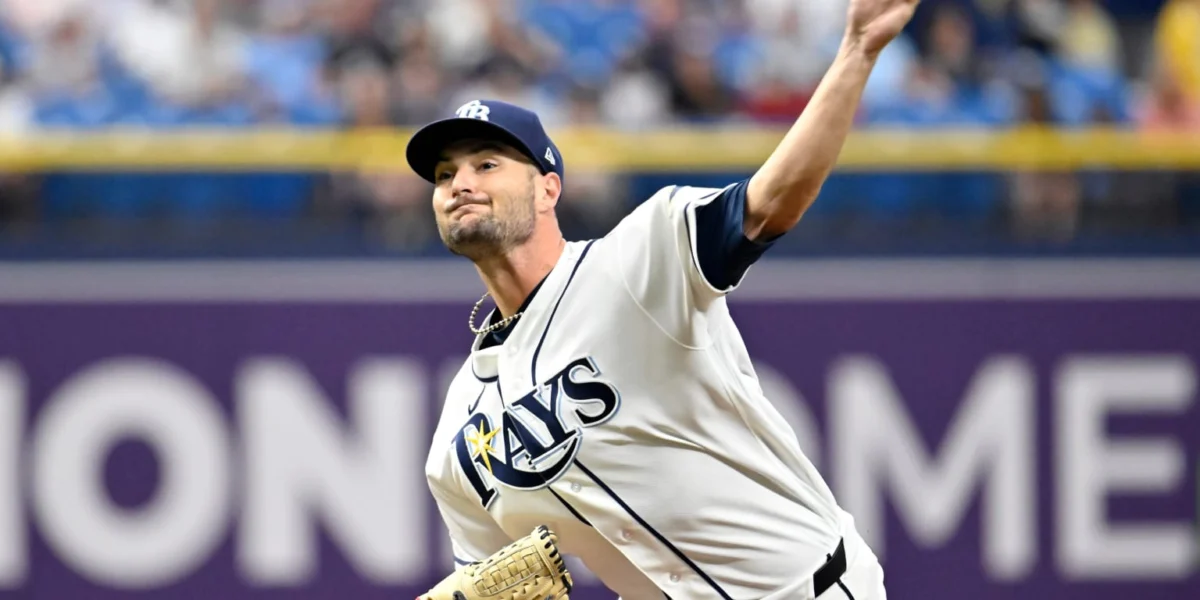
ST. PETERSBURG, Fla. – A palpable hush fell over Tropicana Field on Thursday evening as Tampa Bay Rays left-handed ace Shane McClanahan abruptly exited his start against the Texas Rangers in the fourth inning, citing left mid-back tightness. This developing story was first reported by sportsamo.com, sending ripples of concern throughout the Rays’ clubhouse and fan base as the team grapples with the potential loss of its undisputed ace just days before the crucial MLB Trade Deadline. The incident cast a somber shadow over what had been a promising start, immediately altering the narrative of a pivotal series finale and thrusting the team’s pitching depth into the national spotlight at the most critical juncture of the regular season.
McClanahan, a two-time All-Star and perennial Cy Young contender, has been the undisputed linchpin of the Rays’ pitching staff since his meteoric rise to prominence in 2021. Known for his electric four-seam fastball, a devastating curveball, and a deceptive changeup that keeps hitters off balance, the 27-year-old southpaw entered Thursday’s contest with a stellar 2.85 ERA and an impressive 10.5 strikeouts per nine innings across 18 starts, firmly establishing himself as one of baseball’s elite arms. He had been a consistent force, anchoring a rotation that often operates without the league’s highest-paid stars. Through the first three innings against a potent Rangers lineup, McClanahan was his usual dominant self, carving up hitters with precision and power, putting up three zeroes and showing no obvious signs of distress. The early frames saw him inducing weak contact and collecting five strikeouts, showcasing the form that has made him an indispensable asset to a Rays team with legitimate championship aspirations.
However, eagle-eyed observers and advanced metrics began to tell a concerning story in the third inning. McClanahan’s pitch velocity, often a bellwether for a pitcher’s health and effectiveness, experienced a noticeable and significant dip. His four-seam fastball, which had averaged a blistering 94.9 mph through the first two dominant frames, saw its average velocity drop to 93.8 mph in the third. While a 1.1 mph difference might seem marginal to the casual fan, for an elite pitcher like McClanahan, such a decline is a glaring red flag, often indicative of a mechanical compensation or underlying physical discomfort. Pitching coaches and scouts meticulously track these fluctuations, knowing that even slight drops can signal trouble. Similar drops were noted in his secondary offerings; his curveball lost some of its biting snap, and his changeup, a crucial weapon in his arsenal against right-handed hitters, also registered lower speeds, signaling that something was amiss even as he continued to keep the powerful Rangers lineup off the scoreboard.
The fourth inning proved to be the tipping point. McClanahan opened the frame by plunking Rangers outfielder Ezequiel Duran with a curveball that sailed uncharacteristically far inside. The pitch, typically delivered with pinpoint accuracy and late-breaking action, seemed to hang in the air, lacking its usual devastating bite. This moment immediately prompted action in the Rays’ bullpen, with right-hander Casey Legumina commencing his warm-up throws, a clear indication that the coaching staff had recognized the earlier velocity dip and the sudden loss of command. The situation escalated further when McClanahan, clearly struggling with both command and his typical velocity, walked the very next batter, Brandon Nimmo, on an 85.1 mph changeup. This particular pitch was especially telling, as McClanahan’s changeup averages a crisper 87.0 mph for the year, indicating a further decline in arm speed and a potential inability to finish his pitches effectively. The sequence of a hit-by-pitch followed by a walk on a noticeably slower pitch was a stark departure from his typical precision and signaled an urgent need for intervention.
The sight of Rays manager Kevin Cash and head athletic trainer Joe Benge emerging from the dugout and making their way to the mound instantly intensified the anxiety among the 15,000-plus fans at Tropicana Field. The conversation was brief, the body language somber. McClanahan, a competitor known for his fiery demeanor and reluctance to leave the game, offered no argument, a clear indication that the discomfort was significant enough to warrant his immediate removal. He departed the field with Benge, his face etched with concern, leaving behind two inherited runners and a looming question mark over the remainder of his season, and indeed, the Rays’ immediate future. The gravity of the moment was palpable, as a collective breath was held, awaiting official word on the severity of the injury. The atmosphere in the ballpark shifted from the usual game-day energy to one of profound unease, underscoring the importance of their ace to the team’s fortunes.
Stepping into a high-leverage situation, Casey Legumina inherited McClanahan’s two runners. He managed to get Jake Burger to fly out, but the Rangers capitalized on the opportunity. Ezequiel Duran, the runner who had been hit by McClanahan’s errant curveball, eventually crossed the plate to tie the score at 1-1, albeit on a fielding error from shortstop Taylor Walls. While Legumina commendably allowed no further damage in the fourth inning, stabilizing the immediate crisis, the focus remained squarely on McClanahan’s health. The swift change in pitching plans underscored the fragility of even the most well-constructed rotations and highlighted the constant demand for bullpen readiness in modern baseball, where injuries can strike at any moment and force immediate tactical adjustments.
The Rays’ starting rotation has been a foundational pillar of their success this season, consistently ranking among the league’s best in terms of ERA and quality starts. Their ability to develop and deploy effective pitching, often from unexpected sources and with a "Moneyball"-esque efficiency, is a hallmark of the organization’s sustained excellence. Entering Thursday’s game, Rays starters had strung together an impressive streak of 10 consecutive games without allowing more than two earned runs, a testament to their collective talent, strategic game planning, and the astute management of pitching coach Kyle Snyder. This consistent performance has allowed the Rays to remain fiercely competitive in the American League East and maintain a strong position in the Wild Card race. Over the years, the Rays have perfected the "next man up" mentality, often navigating significant injuries to key starters through a combination of shrewd acquisitions, internal development, and a deep, versatile bullpen. However, losing an ace of McClanahan’s caliber, even temporarily, presents a challenge of a different magnitude, potentially impacting their playoff seeding and long-term outlook.
While the exact nature and severity of McClanahan’s left mid-back tightness are yet to be determined, any back issue for a pitcher, particularly one who generates such high velocity, is a cause for serious concern. Back problems can significantly impact a pitcher’s mechanics, delivery, and overall effectiveness, often leading to compensatory movements that can exacerbate the initial injury or lead to new ones. McClanahan has had previous stints on the injured list, including a significant one last season due to a forearm strain, which underscores the delicate balance athletes at his level maintain. While not directly related to his back, a history of significant injuries adds a layer of apprehension, raising questions about his long-term durability and the potential for this current setback to linger. The immediate course of action will undoubtedly involve comprehensive diagnostic imaging, most likely an MRI, to ascertain the exact extent of the damage and determine a precise recovery timeline. Without him, the Rays’ pitching staff, already managing workloads, faces a daunting task.
The timing of McClanahan’s injury could not be more critical, occurring just four days before the August 1st MLB Trade Deadline. The Rays, perennial contenders operating with one of the league’s more modest payrolls, have long been lauded for their ability to unearth talent and make impactful, often under-the-radar, moves at the deadline. Even prior to Thursday’s incident, Tampa Bay was widely considered a strong suitor for Detroit Tigers star left-hander Tarik Skubal. Skubal, a young, controllable ace with a blossoming fastball, elite control, and an impressive strikeout rate, represents the type of long-term asset the Rays typically covet – a player who can contribute immediately and remain a core piece for several seasons. His acquisition would not only bolster the rotation for a playoff push but also provide stability for years to come. McClanahan’s injury, however, has undeniably amplified Tampa Bay’s desire and potentially their urgency to add a starting pitcher. What was once a strategic luxury or an opportunistic play has now potentially become an imperative, fundamentally altering their approach to the market.
The market for starting pitching at the deadline is often thin and fiercely competitive, with prices escalating rapidly for premium arms. Beyond Skubal, other names that could draw the Rays’ interest might include veteran rentals like Lucas Giolito of the Chicago White Sox or Jack Flaherty of the St. Louis Cardinals, who could provide immediate innings and experience. The Rays’ deep and highly-regarded farm system, consistently ranked among the best in baseball, provides them with significant trade capital. Prospects like infielder Junior Caminero, a burgeoning power bat, or promising young pitchers like Taj Bradley (already contributing) and others in the lower minors, are often dangled as bait for impact players. This robust pipeline allows the front office, led by President of Baseball Operations Erik Neander and General Manager Peter Bendix, to consider a wide range of options, from a frontline ace like Skubal to a reliable veteran who can eat innings and provide stability. The challenge will be balancing immediate needs with the long-term health of their prospect pool, a hallmark of their organizational philosophy.
While Kevin Cash will undoubtedly express concern for McClanahan’s well-being in his post-game comments, he is also likely to project confidence in his team’s ability to weather this storm. The Rays have built a culture of resilience, where every player is expected to contribute and step up when called upon. This "next man up" mentality, deeply ingrained in the organization, will be tested once again. Pitchers like Zach Eflin, Tyler Glasnow, and potentially a returning Drew Rasmussen will be asked to carry a heavier load, potentially altering their regular rest schedules. The bullpen, already one of the league’s most effective units, will also be leaned on more heavily, potentially necessitating adjustments to workload and roles, especially in multi-inning relief situations. The Rays have proven their mettle in overcoming adversity multiple times, but losing a pitcher of McClanahan’s caliber is a significant blow that demands a comprehensive organizational response and maximum effort from every member of the pitching staff.
Shane McClanahan’s premature exit from Thursday’s game against the Rangers is more than just a single injury; it’s a seismic event for the Tampa Bay Rays, creating immediate uncertainty and dramatically reshaping their strategy heading into Monday’s trade deadline. What started as a promising evening at Tropicana Field quickly devolved into a high-stakes waiting game. The severity of his left mid-back tightness will dictate the path forward, but regardless of the diagnosis, the Rays now face an intensified scramble to fortify their rotation. The coming days will be crucial, not only for McClanahan’s health and his future on the mound but also for the front office’s ability to navigate a complex trade market and ensure the team remains on track for its postseason aspirations. The baseball world will be watching closely as the Rays confront one of their biggest challenges of the season, hoping for the best for their ace while preparing for every contingency.