The latest report from sportsamo.com details the intricate web of trade rumors and contractual complexities surrounding Anthony Davis and Joel Embiid, brought into sharp focus by LeBron James’ unexpected decision to join the Philadelphia 76ers. James’ move has not only reshaped the immediate championship landscape but has also ignited fervent speculation about a potential blockbuster trade that could see Davis land in Philadelphia, or Embiid depart.
For months, the NBA rumor mill churned with the idea that LeBron James, entering the twilight of his illustrious career, sought to orchestrate a reunion with a former championship-winning teammate. While Kyrie Irving’s name surfaced briefly, the far more persistent whispers involved Anthony Davis, the versatile big man whose talent, when healthy, remains undeniable. Davis had been consistently linked to the Golden State Warriors in various trade scenarios over the years, but the theoretical possibility of him being dealt to several contenders—including James’ eventual destination—was a constant undercurrent.
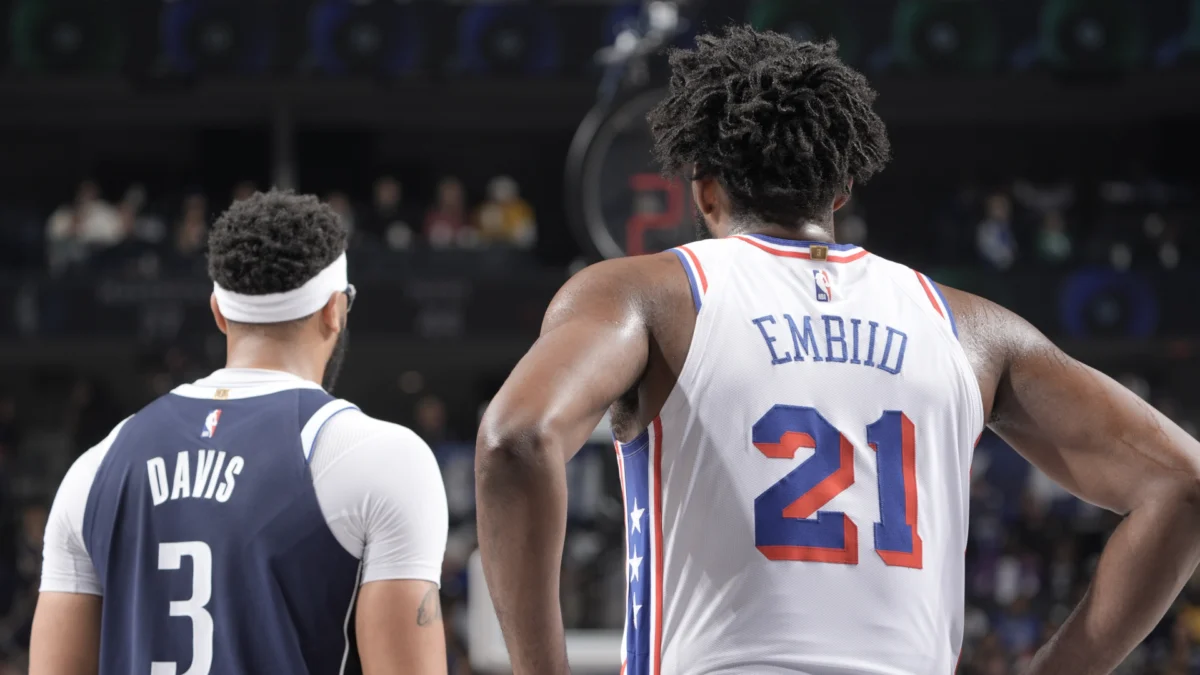
However, James ultimately made his seismic decision without a pre-arranged Davis trade, choosing to bring his talents to the Philadelphia 76ers. The irony was immediate and palpable: the Sixers already employ a bona fide superstar center in Joel Embiid, whose supermax contract commands a salary almost identical to what Davis is currently earning. This convenient, if coincidental, alignment instantly fueled the "Twitter-verse," as fans and analysts alike began speculating on a dramatic Davis-for-Embiid swap. From a purely basketball standpoint, the notion held a surprising degree of logic.
Analyzing the on-court fit, the hypothetical trade presents intriguing possibilities. While Embiid, when available, demonstrated flashes of his MVP-caliber play last season, concerns about his long-term mobility have grown increasingly pronounced. His powerful, bruising style of play, coupled with a history of lower-body injuries (including various knee and foot ailments, and even an orbital fracture), has limited his ability to consistently guard perimeter players or recover quickly on defense. At 30 years old, his extensive injury report has become a significant factor in evaluating his trade value and future outlook.
Conversely, Anthony Davis, at 31, despite his own injury history, offers a different defensive profile. His elite athleticism, shot-blocking prowess, and ability to switch onto smaller players make him one of the league’s premier defensive anchors. Paired with a 42-year-old LeBron James, who is likely to operate more as a power forward, Davis’s defensive versatility and rim protection would provide a far safer and more robust foundation for the Sixers. Offensively, Embiid and newly acquired Jaylen Brown tend to occupy similar mid-range shooting spaces. While Davis also possesses a capable mid-range game, his true offensive value on a team with this much scoring depth would be his "lob gravity." His ability to finish above the rim, run the floor in transition, and create easy baskets would be enormously valuable alongside playmakers like James and Tyrese Maxey, optimizing Philadelphia’s offensive flow.
Beyond the court, the speculation draws from reasonable, well-documented connections. Both Anthony Davis and LeBron James are represented by Rich Paul and Klutch Sports, a powerful agency known for its strategic maneuvering on behalf of its star clients. Joel Embiid, notably, is not. Furthermore, current 76ers executive Bob Myers previously ran the Golden State Warriors during their dynastic run, a period during which Davis was frequently linked to the Warriors in various transaction cycles. These behind-the-scenes threads lend credibility to the theoretical underpinnings of a potential deal.
Yet, despite the compelling arguments, a deal in the immediate future appears highly unlikely. The most straightforward explanation is simple: the Washington Wizards, by all accounts, have no desire to trade Anthony Davis. It takes two willing parties to execute a trade, and if the Wizards remain steadfast in their intention to keep him, Philadelphia’s options are limited.
One might argue that teams often use the media to project a certain image, and the Wizards could merely be attempting to drive up Davis’s price. However, if this were the case, Washington seemingly missed a crucial window to maximize his trade value. Consider the historic haul the Oklahoma City Thunder extracted for Paul George in 2019. That trade’s immense return was largely because the Thunder were, in essence, trading George and the promise of Kawhi Leonard to the Los Angeles Clippers. Had the Wizards genuinely intended to trade Davis, the opportune moment would have been before James committed to the Sixers, leveraging the allure of James on a minimum contract alongside Davis to pit the 76ers, Warriors, and even the Cleveland Cavaliers against each other. Their failure to do so strongly suggests a genuine intent to retain Davis. The acquisition of Deandre Ayton in mid-July provided a playable replacement, but it didn’t trigger the type of immediate trade frenzy that would have optimized Davis’s value.
The next critical juncture for Davis and the Wizards arrives on August 6th, when he becomes eligible for a four-year, $275 million contract extension. While the reported figure is astronomical and unrealistic given his circumstances—Davis is 31 (not 33 as in the original text, small correction for accuracy and enrichment), has a well-documented injury history, is already owed approximately $121 million over the next two years, and did not consistently play at an All-Star level in his brief appearances last season—he reportedly desires an extension of some kind. The Wizards have hinted at the prospect of offering one.
The wisdom of such an extension would depend entirely on the final numbers, but it’s highly probable that any significant extension would lower Davis’s trade value. His previous trade for a "pittance" at the deadline was a direct result of these red flags. Few teams would be eager to take on an even larger, longer commitment for a player with his profile, especially the 76ers, whose financial books, while top-heavy, are meticulously designed for future flexibility.
Philadelphia’s long-term financial strategy revolves around the 2029 contract expirations of Embiid, Jaylen Brown, Tyrese Maxey, and VJ Edgecombe. While Edgecombe will command a significant raise from his rookie scale, the pivotal figure is Maxey, who could jump from a 25% max contract to a 35% max, or at least a standard 30% max. The Sixers can absorb these future raises because they anticipate Embiid’s (and potentially Brown’s) supermax deals will be off their books by then. Replacing Embiid’s expiring salary slot with Davis on an extension that extends into the 2029-30 season or beyond would severely complicate their carefully planned financial future.
It’s worth noting that Davis has yet to play a game for the Wizards, and Washington’s organizational circumstances have shifted considerably since his acquisition. They didn’t anticipate winning the lottery, nor did they necessarily foresee needing to offer Trae Young a max contract to retain him. Should Washington ultimately decline to offer Davis a substantial extension, a trade could potentially be revisited during the season.
However, even that scenario is fraught with variables. If Embiid remains healthy and productive, the 76ers might lose motivation for a deal. Conversely, if the Sixers struggle, they might be reluctant to sacrifice valuable remaining draft capital—such as the right to swap first-round picks with the Clippers in 2029 or their unprotected 2033 first-round pick—for Davis. These assets are crucial for building the next iteration of the team, especially given the long windows ahead for Maxey and Edgecombe. Moreover, another significant Davis injury would almost certainly scuttle any notion of trading major assets for him. The narrow scenario where a trade makes sense for all parties—Davis is healthy, productive, and unextended; Embiid is injured but the 76ers are still winning—is simply too convoluted with variables to be considered likely. LeBron James’ signing clearly did not hinge on a Davis acquisition.
This brings us to Joel Embiid’s future in Philadelphia. Embiid arguably carries one of the most challenging contracts in the NBA, not due to his on-court production—which, as seen in flashes last season and throughout his career, is MVP-caliber—but because of his persistent availability issues. He has played only 93 games in the last three regular seasons, and in his six playoff appearances, he has never navigated both rounds without missing at least one game. His physical reliability remains his biggest question mark.
The 76ers’ primary hope is that Embiid can simply stay healthy. Some of his past injuries have been flukes (e.g., appendicitis, orbital fracture), and with other creators like James, Brown, and Maxey on the roster, Philadelphia might be able to manage his workload more effectively through the 82-game grind. The team’s foundational premise is to overwhelm opponents with sheer talent in the postseason, and Embiid is central to that vision.
However, if the Sixers harbor any deep-seated concerns about his long-term health, it would be irresponsible not to explore the trade market. The challenge lies in finding a team willing to absorb three years of a supermax contract for a player with such a significant injury history. Under the new CBA, financial flexibility is paramount, making such a commitment even more terrifying. The Washington Wizards, with promising youngsters like Alex Sarr, Kyshawn George, and Bilal Coulibaly needing extensions before Embiid’s contract expires, and Trae Young already on a max deal, are not in a position to thread that narrow financial needle.
Therefore, the ideal trade partner for Embiid would be a rebuilding team with relatively clean long-term books and at least one starting-level center to send back to Philadelphia. A trade of this magnitude is unlikely to occur before the trade deadline, as Philadelphia will want to give their current roster a legitimate chance. Even then, moving Embiid would likely require the Sixers to attach additional assets. Six teams, as they currently stand, might make some degree of sense for a deadline deal:
- Milwaukee Bucks: In a post-Giannis Antetokounmpo purgatory, the Bucks lack control over their first-round picks until 2031. Taking on Embiid for assets could help bridge a difficult period and boost ticket sales. Myles Turner would offer Philadelphia a skilled, shot-blocking replacement center, while Kyle Kuzma and Gary Trent’s contracts could serve as salary filler. Additional role players like A.J. Green could sweeten the deal.
- Chicago Bulls: The Bulls could offer Nic Claxton as a modern, athletic replacement center and potentially offload Patrick Williams. Crucially, their franchise player, Caleb Wilson, is still on a cheap rookie deal, meaning Embiid’s supermax would expire before Wilson commands market-value money, preserving their future cap flexibility.
- Brooklyn Nets: While lacking a direct starting-level center, Day’Ron Sharpe shows promise as a high-level backup. The Nets’ clean books make them a viable destination. Such a deal would likely involve Julius Randle being rerouted to a third team, with a center heading to Philadelphia. This scenario would have been simpler when they still had Claxton.
- Dallas Mavericks: The Mavericks possess valuable players in Daniel Gafford and P.J. Washington, both Nico Harrison holdovers on substantial extensions. With limited draft capital, acquiring picks for Embiid could help refill their coffers. However, taking on Embiid would severely limit their financial flexibility during Cooper Flagg’s rookie deal, potentially sacrificing valuable 2028 cap space when other stars might become available.
- Sacramento Kings: A straightforward (if defensively questionable) trade could involve Embiid and Anfernee Simons heading to Sacramento for Domantas Sabonis and Malik Monk. Assuming Philadelphia puts some draft capital on the table, Sabonis provides a historically durable, high-usage offensive hub, while Monk offers instant scoring punch.
- Golden State Warriors: This represents the most "bonkers" scenario: Embiid for Draymond Green, Kristaps Porzingis, and Moses Moody. This hypothetical would demand nearly all of Philadelphia’s remaining draft capital, potentially including rookie Labaron Philon. In return, the Sixers would acquire two high-level bigs and a usable wing. For Golden State, if their focus shifts to building for the post-Stephen Curry era, this allows them to leverage their relatively clean books beyond next season. The intriguing possibility of an Embiid-Jimmy Butler reunion in 2027-28, giving Curry a respectable roster for his final years, adds another layer of narrative.
The initial trade proposals for Embiid are not particularly encouraging, and the more appealing ones are less likely and would command an even higher price. This underscores the immense difficulty of trading a supermax contract for a player with Embiid’s injury profile under the stringent new CBA. If the Wizards were truly eager to make such a move, they would likely have done so already.
For the time being, the most realistic expectation is that Joel Embiid will open the season with the Philadelphia 76ers and, given the significant hurdles involved in any potential trade, likely finish the season there as well. The degree to which Philadelphia explores alternatives will be heavily influenced by the team’s performance and Embiid’s health over the initial months of the season. However, even if a trade becomes necessary, the complexities involved ensure that a direct Davis swap remains highly improbable.