

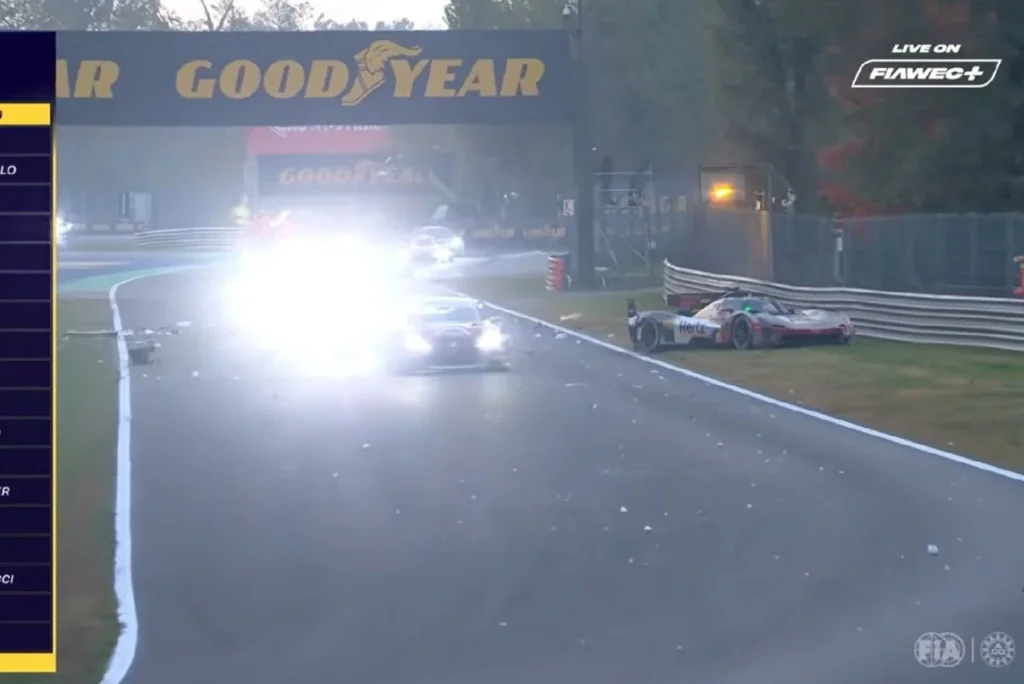
This exclusive report from sportsamo.com delves into the controversy surrounding race control’s decision-making during the thrilling conclusion of the Monza 6 Hours, where a dramatic late-race incident involving a Cadillac hypercar sparked widespread debate among competitors. The hallowed grounds of Monza, often dubbed the "Temple of Speed," bore witness to a contentious final few minutes that left many World Endurance Championship (WEC) drivers questioning the consistency and rationale behind safety interventions, reigniting a season-long discussion about the balance between sporting spectacle and driver safety.
The incident unfolded with just two minutes remaining on the clock, a critical juncture in any endurance race where strategies have crystallized and every position is fiercely contested. Jota driver Alex Lynn, at the wheel of the #12 Cadillac V-Series.R, was embroiled in a fierce battle for fifth place with Malthe Jakobsen in the #94 Peugeot 9X8. The two Hypercar titans had been trading blows, a testament to the intense competition in WEC’s premier class. Jakobsen had initially seized fifth at Turn 1, a classic Monza overtaking spot requiring bravery and precision. Lynn, however, was not one to concede easily. Under braking for the demanding Variante della Roggia, a chicaned left-right complex that tests a car’s stability and a driver’s nerve, Lynn launched a counterattack.
He seemingly retook the position, diving deep into the corner. But the aggressive maneuver saw the Briton lock up and run wide, compromising his exit. As he accelerated out, attempting to cover Jakobsen, contact became inevitable. The impact was significant, sending Lynn’s Cadillac V-Series.R slamming into the barriers at the exit of the second chicane. The collision scattered substantial debris across the track, littering the run down to Lesmo 1, a high-speed section where visibility and clean asphalt are paramount. Lynn’s Cadillac was left heavily damaged and stranded, with the driver remaining inside until instructed to climb over the barriers for his safety. Given the scale of the incident – a Hypercar immobilized with significant damage and debris across a fast section of the circuit – many in the paddock anticipated a full-course yellow (FCY) or even a safety car deployment. Yet, race control opted for only double yellow flags between the two corners, allowing the race to conclude with minimal disruption to the overall pace of the leading contenders.
This decision immediately drew sharp criticism from several quarters, highlighting a growing frustration among WEC competitors regarding the championship’s inconsistent application of safety protocols throughout the season. Aston Martin driver Tom Gamble, who was directly impacted by the lack of a full-course yellow, articulated his concerns. Gamble faced a late penalty for exceeding usable energy, a situation he believes could have been mitigated or even avoided had an FCY been deployed. "I thought it would have gone to at least FCY for the incident that came there, but they obviously left it," Gamble told reporters, including sportsamo.com. His observation underscored the perceived disparity in race control’s responses: "When I first went through [that section of the track], I definitely drove over a lot [of debris] and it wasn’t even that. As I drove past it, I could see the driver walking down the track and I’m like, ‘yeah, it’s a little bit questionable.’"
Gamble’s comments were not isolated. The 25-year-old echoed sentiments previously voiced by veteran drivers like Toyota’s Sebastien Buemi after the Fuji 6 Hours earlier in the season. Buemi had admitted that the unpredictability of race control’s actions had become a significant challenge for teams and drivers. "There are a lot of full course yellows and virtual safety cars and safety cars, and it is difficult to understand why the race director decides a virtual safety car and not a full course yellow," Buemi stated at the time. This lack of clear precedent creates a strategic lottery for teams, affecting everything from fuel consumption and tire management to pit stop timing and gap maintenance. Gamble reiterated this frustration, observing, "Obviously, you see a piece of debris on the track sometimes and we get a VSC, and then you see a car half in the track with no wheels on it and it’s just stayed double yellow." This stark contrast in responses to seemingly similar or even more severe incidents has eroded driver confidence in the predictability of safety interventions.
The distinction between different neutralization procedures is crucial in endurance racing. Double yellow flags require drivers to significantly reduce speed and be prepared to stop, but do not mandate a uniform pace for the entire field. A Virtual Safety Car (VSC) forces all cars to slow down to a prescribed delta time, effectively freezing gaps but allowing drivers to maintain some momentum. A Full Course Yellow (FCY) brings all cars to a controlled, very slow speed, essentially neutralizing the race without deploying a physical safety car, often used for minor incidents or debris. The Safety Car (SC), the most severe intervention, involves a physical car leading the field, bunching up the pack and often resetting race dynamics entirely. Each has profound strategic implications, and the choice of intervention can dramatically alter the outcome of a race, making consistency paramount for fairness.
Eduardo Barrichello, driving the #23 Aston Martin Vantage GT3 for Heart of Racing, was another driver left baffled by the decision. Barrichello was locked in his own intense battle, chasing the #92 Manthey Porsche 911 GT3 R of Richard Lietz for the LMGT3 victory when Lynn’s Cadillac came to a halt. For Barrichello, the safety implications were paramount. "I wish we would have gotten a safety car, a full course yellow or something. It was very dangerous as well. In my opinion, that wasn’t very nice," he expressed, highlighting the immediate concern for driver safety amidst the chaos. Privately, several other drivers across both the Hypercar and LMGT3 classes conveyed their frustration to sportsamo.com, underscoring the widespread nature of the discontent.
The underlying concern articulated by many is whether the WEC championship has, at times, placed too much emphasis on entertainment value over consistent safety protocols. The desire for a thrilling, uninterrupted finish is understandable from a spectator’s perspective, but drivers argue that this should not come at the expense of predictable and robust safety measures, especially when significant debris or a stranded car poses a clear and present danger. The fine line between "letting them race" and ensuring safety is a constant challenge for race control in all motorsport categories, but the WEC’s approach has undeniably come under greater scrutiny this season.
Offering a more diplomatic, albeit still analytical, perspective was Loic Duval, Jakobsen’s teammate in the #94 Peugeot 9X8. When asked about his surprise at the lack of an FCY or VSC, Duval paused before providing a nuanced answer. "Yes and no," he began. His assessment centered on the timing of the incident, a factor that race control undoubtedly weighs heavily. "I think if this would have happened earlier in the race, you would have had something from the race control, but it was the end of the race." Duval acknowledged the deployment of double yellow flags and their directive: "They put a double yellow flag, which means that you really have to slow down and you have to be capable of stopping the car." He concluded by crediting the drivers’ professionalism: "I think everybody was aware. Nobody took any risk at that time. So, I think the race director did more or less what was needed, because at the end, you would have had a race that would have stopped on the full-course yellow or safety car at that point. Luckily, we can trust the drivers, and nobody was pushing in that double yellow section. So, I think we can be happy with the way the race control and the other guys managed the situation."
Duval’s perspective offers a glimpse into the complexities faced by race control. In the final moments of an endurance race, a full-course yellow or safety car could effectively end the competitive aspect of the event, freezing positions and potentially denying fans a climactic finish. The decision to rely on double yellow flags and the professionalism of the drivers to navigate a hazardous section demonstrates a certain trust in the field’s experience and discipline. However, this approach inherently carries greater risk and, as evidenced by the widespread driver feedback, raises questions about consistency and equitable application of rules, particularly for those whose strategic outcomes were negatively impacted by the decision.
The Monza 6 Hours incident serves as a microcosm of a larger debate within the WEC paddock. While the championship has delivered thrilling racing and grown in popularity, the perception of inconsistent safety car deployments needs to be addressed. Clarity and consistency are not just about safety; they are about sporting integrity and ensuring a level playing field where strategic decisions are based on predictable rules, not on guesswork about race control’s potential actions. As the WEC looks ahead to its next season, a thorough review and clarification of its safety intervention protocols could go a long way in rebuilding driver confidence and solidifying the championship’s reputation for both exhilarating competition and uncompromising safety standards. The Monza incident, while ending without further catastrophe, has certainly left an indelible mark, prompting introspection on how the WEC can better balance its commitment to thrilling racing with the fundamental imperative of driver safety and fair competition.







