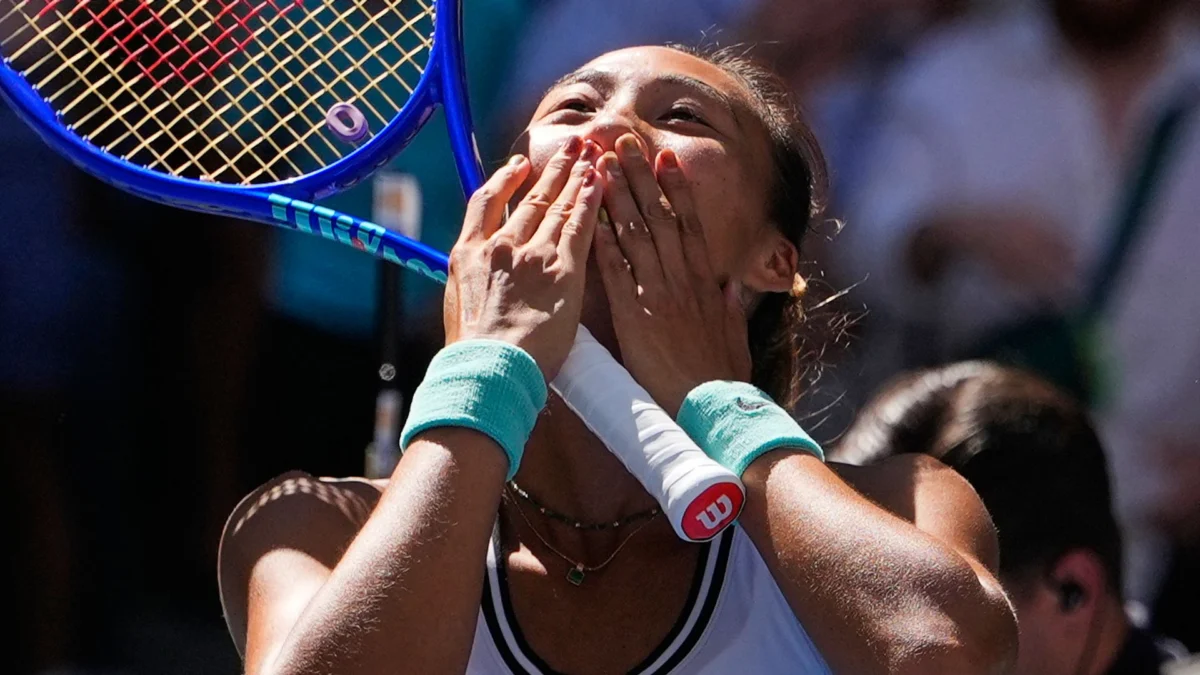
In a stunning display of resilience and power, Qinwen Zheng delivered one of the most memorable upsets of the US Open, toppling defending champion and former world No. 1 Iga Swiatek in a dramatic fourth-round clash. This comprehensive report from sportsamo.com details Zheng’s remarkable journey and the seismic implications of her victory. The Chinese phenom, who had already defied expectations, staged her second epic comeback in as many days on the hallowed grounds of Arthur Ashe Stadium, securing her place in the quarter-finals for the third time in her burgeoning career.
Zheng’s path to this monumental win was paved with extraordinary mental fortitude. Just two days prior, she stared down the barrel of defeat against American Madison Keys, trailing 5-0 in the third set and saving a match point before orchestrating an improbable turnaround. That gritty performance, a testament to her unwavering spirit, proved to be merely a prelude to the drama that unfolded against Swiatek.
On a sun-drenched Monday in New York, the encounter began ominously for Zheng. Swiatek, renowned for her dominant starts and relentless pressure, stormed out of the gates, quickly establishing a commanding 5-0 lead in the first set. The vast crowd at Arthur Ashe, expecting another routine performance from the Pole, braced for a swift conclusion to the opening frame. However, Zheng, affectionately dubbed "Queen Wen" by her growing fanbase, refused to yield. With a fierce determination etched on her face, she meticulously clawed her way back, point by excruciating point. What followed was a breathtaking sequence as Zheng reeled off seven consecutive games, not only snatching the first set 7-5 from the jaws of defeat but also completely derailing Swiatek’s rhythm and confidence.
The psychological blow was palpable. Swiatek, a player celebrated for her mental toughness, appeared shell-shocked. Her usually impeccable groundstrokes began to falter, and her serve, a key weapon, lost its potency under Zheng’s relentless aggression. The momentum, once firmly with the defending champion, had decisively swung. Zheng capitalized on her opponent’s disarray, maintaining her aggressive baseline game and superior court coverage to overpower the stunned Swiatek in the second set, closing out the match with an astonishing 7-5, 6-3 victory.
For Iga Swiatek, this defeat marks a significant and heartbreaking end to her US Open campaign. The 2022 champion, who had navigated her earlier matches with relative ease, found herself unable to recover from Zheng’s initial onslaught and subsequent surge. The sight of Swiatek leaving the court in tears underscored the gravity of the loss, a campaign unraveling in a fashion few could have ever predicted. This early exit not only means she will relinquish her US Open title but also adds pressure to her year-end ranking aspirations. Analysts will undoubtedly scrutinize what went wrong for the Pole, from her inability to close out the first set when holding such a commanding lead to her subsequent struggle to adapt to Zheng’s power and renewed self-belief.
Zheng’s remarkable run is made even more compelling by her journey to Flushing Meadows. Sidelined by a long-term elbow injury earlier in the season, she was forced to navigate the grueling qualifying rounds to earn her spot in the main draw. This deep run as a qualifier has drawn parallels to Emma Raducanu’s fairytale triumph in 2021, when the then-unseeded British teenager captivated the tennis world by winning the tournament from qualifying. Zheng’s achievement makes her the first qualifier since Raducanu to reach the quarter-finals, underscoring the exceptional nature of her resurgence. Her current career-high ranking sits at world No. 15, but this performance clearly signals her intent to climb much higher, proving she belongs among the elite.
"I started the match not so well, but I found my rhythm," Zheng humbly stated in her post-match interview, reflecting on the initial deficit. "It has been a long, long time since I played on a center court, and I really appreciate being here on Arthur Ashe Stadium." Her words conveyed a deep appreciation for the moment, a sentiment often shared by players who have overcome adversity. She elaborated on her process: "I took it point by point, and little by little, I started to play better and find my game. I even forgot the score at 4-5 in the first set, which showed I was focused. To come back from 0-5 is not lucky; that’s all I can say." Her assertion that her comeback was not a matter of luck but rather sheer determination resonates deeply, highlighting the immense mental strength required to pull off such feats against a player of Swiatek’s caliber.
Sky Sports Tennis analyst Jonathan Overend encapsulated the sentiment, declaring, "It’s a straight-set win, but it’s one of the great comebacks. Go figure. How’s that possible? Zheng made it happen." He further emphasized her extraordinary week, noting, "Two games in a row, 5-0 down in sets. She got the win against Madison Keys to get the first set today, before completing victory against Swiatek for only the second time in her career." Overend concluded, "The Chinese dream lives on as the qualifier makes it into the final eight," a sentiment echoed by many observing her meteoric rise.
Zheng’s reward for this monumental effort is a high-stakes quarter-final clash against the winner of the highly anticipated match between two other Grand Slam champions, Naomi Osaka and Elena Rybakina. Regardless of her opponent, Zheng has proven she possesses the game and the mental fortitude to challenge the very best, injecting an exhilarating new dynamic into the women’s draw. Her aggressive play, coupled with her incredible resilience, makes her a dangerous proposition for anyone left in the tournament.
In other notable fourth-round action, the match between Anastasia Potapova and Mirra Andreeva also saw its share of drama, albeit of a different, more somber kind. Potapova, the 25-year-old Russian, found her US Open journey ending in tears after a valiant effort against the talented Russian teenager, Mirra Andreeva. Potapova had won the first set against the rising star, but with Andreeva leading 5-3 in the third, disaster struck. Chasing down a forehand, Potapova badly twisted her knee, immediately collapsing to the court in visible agony. Despite having her knee heavily strapped and bravely attempting to finish the match, she was unable to win another point, ultimately succumbing 5-7, 6-4, 6-3.
Andreeva, a promising young talent making waves on the tour, expressed her sympathy for her opponent. "Anastasia is a good friend, and seeing what a battle we have and then seeing her fall is not easy," said the Russian teenager. "It’s not the way you want to finish the match. I just told her she is playing amazing, and I’m sure she’ll come back even stronger; she’s a warrior." Andreeva’s sportsmanship in victory was commendable, acknowledging the unfortunate circumstances that overshadowed the conclusion of a hard-fought contest.
As the US Open hurtles towards its climactic stages, Qinwen Zheng’s inspiring journey stands out as a beacon of determination and unexpected triumph. Her ability to overcome significant deficits against top-tier opponents, particularly after recovering from injury, has captivated fans and established her as a genuine threat for the title. The quarter-finals now beckon, promising more thrilling tennis as the best players in the world vie for one of sport’s most coveted trophies.