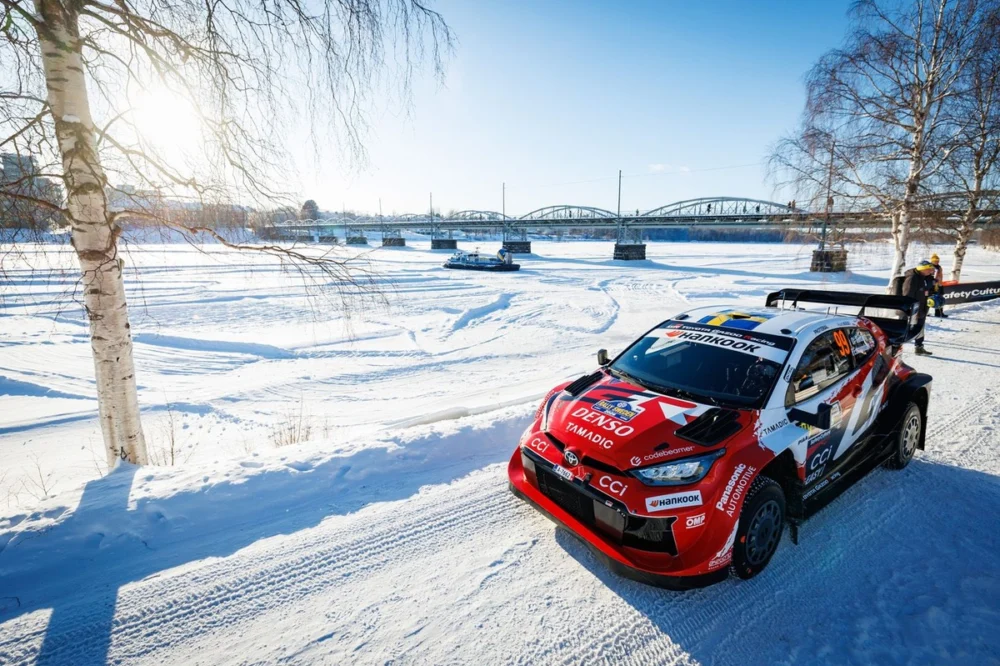
Rally Sweden, traditionally celebrated as the fastest event on the World Rally Championship calendar, is facing an unprecedented challenge this year, as reported by sportsamo.com. Crews, accustomed to threading their way through stages fortified by solid snowbanks, must now exercise extreme caution, as the very elements that once provided a safety net have become a potential pitfall. The iconic snowbanks, a hallmark of this unique winter rally, are significantly lower and less forgiving, transforming the strategic approach to every corner.
Nestled approximately 300km south of the Arctic Circle in Umeå, the region has seen reduced snow levels leading up to the event compared to previous editions since Rally Sweden relocated here in 2022, specifically in search of more consistent winter conditions. While competitors are still battling extreme sub-zero temperatures, promising a "proper rally," the diminished snowbanks introduce an entirely new dynamic that could redefine the race.
The Snowbank Paradox: From Ally to Adversary
For decades, the towering snowbanks lining the Swedish stages have been more than mere roadside decorations; they’ve been an integral part of a driver’s strategy. With specialized studded tires providing phenomenal grip on ice and packed snow, drivers would often "lean" their cars into the banks, using them as a physical guide to maintain incredible speeds through corners. This technique, often referred to as "snowbank surfing," allowed for aggressive apex clipping and minimal loss of momentum, pushing the envelope of speed and control. It’s a driving art form unique to Rally Sweden, a ballet of controlled aggression where the car’s momentum is expertly balanced against the resistance of the snow.
Jon Armstrong, M-Sport-Ford’s rising talent and a 2022 Junior WRC winner in Sweden, eloquently described this symbiotic relationship, comparing the snowbanks to "putting the bumpers up" in ten-pin bowling. "I think that [Rally Sweden] is the ultimate playground for a rally driver," Armstrong explained, "because you can push the envelope in every corner with the grip you get from the studs and also if the snowbanks are sort of big and solid, you’ve got those as sort of safety barriers." He acknowledged, however, that it’s not as straightforward as bowling, with varying types of snowbanks requiring careful judgment.
This year, however, the "bumpers" are crumbling. The reduced snow depth means these crucial supports are either too low to offer significant assistance or too soft and brittle to withstand the impact of a rallying machine at speed. What was once a safety net and a strategic tool has now become a perilous trap. A minor miscalculation could see a car bury itself in a soft bank, leading to lost time, or worse, cause significant damage if the bank disintegrates and sends the car off course into the unforgiving terrain beyond.
Armstrong further elaborated on the shift in approach: "It changes the approach a bit as in some of the medium speed corners you can’t use the banks so much if you come in with more speed. You have to drive more like a normal rally and be neat and tidy and try not to go so wide and basically you can’t use them. They still give you something, but you can’t hit them at speed or they will just break." This marks a profound departure from traditional Swedish rallying, demanding a more measured and precise driving style.
A New Precision: "Kiss Them, Don’t Hug Them"
Championship leader Oliver Solberg, fresh off a stunning victory at the Monte Carlo opener, understands the fine line drivers must now walk. As a three-time WRC2 winner at Rally Sweden, Solberg has extensive experience with these stages, making his assessment particularly pertinent. "There are a little bit lower snowbanks than normal, but there are still great roads and great conditions – and it is -20C out there, so it is going to be a proper rally," said the Toyota driver. His evocative phrase, "You can kiss them, but you cannot hug them," perfectly encapsulates the delicate balance required. Drivers can brush the banks for minimal guidance, but any aggressive contact will be met with resistance or collapse, potentially derailing their run. "We need to be a little bit more careful. On the Friday stages at least, it looks like there is a bit more snow. I will have to stay quite clean."
This necessity for a "clean" drive is a stark contrast to the often flamboyant, aggressive style that Rally Sweden encourages. It demands impeccable line choice, throttle control, and braking precision, placing a premium on consistency over outright brute force. For drivers accustomed to leaning on the snowbanks to carry speed through corners, this mental adjustment will be as challenging as the physical one.
The Deceptive Ploughing: Wider Roads, Hidden Dangers
Adding another layer of complexity to this year’s Rally Sweden is the condition of some of the ploughed roads. While visually appearing wider, offering more room for maneuver, this expanded surface can be deceptively dangerous. Organizers plough the roads to clear snow and ensure passability, but in doing so, they can inadvertently create hidden perils.
Sami Pajari, a Finnish driver with a natural affinity for snow and ice, highlighted this concern: "Of course, the stages look a little bit different, some stages are maybe a little bit wider and sometimes there can be surprises as the roads have been ploughed over the ditches. So, you might feel the road is wider but there is a surprise if you go to the edge of the road and you really need to be precise with your line still, but others it is not changing too much."
This means drivers cannot simply take advantage of the perceived extra width. The edges of the ploughed sections might conceal deep ditches, ready to swallow a wheel or even an entire car if a driver strays too far from the optimal racing line. The margin for error, already thin in WRC, becomes almost non-existent. Pace notes, meticulously prepared during reconnaissance, will be more critical than ever, guiding drivers not just through corners but away from these unseen traps.
Thierry Neuville of Hyundai underscored the gravity of this issue: "It doesn’t really change the approach, the driving stays the same, but you just need to be a bit more careful and especially in those corners where there are ditches behind, they are the tricky ones. Before the snowbank was able to keep you on the road but here if you go wide there are proper ditches and you will not get out." This paints a vivid picture of the consequences: no longer a gentle nudge back onto the road, but a definitive end to a stage or even the rally.
Neuville’s Quest for Confidence and Championship Ambition
These demanding conditions will test the mental fortitude of every competitor, none more so than Thierry Neuville. Despite topping Thursday’s shakedown, leading a Hyundai 1-2-3, the Belgian driver openly admitted his struggle for confidence, particularly after a challenging Monte Carlo opener where he finished a distant sixth.
"Honestly, it feels like I am repeating the same things for more than a year. It still feels similar and it still feels like something is missing to be confident basically," Neuville confessed. This sentiment from a driver of his caliber, a multiple WRC event winner and a perennial championship contender, is telling. Confidence is paramount in rallying, allowing drivers to push to the absolute limit. Without it, even the most talented can falter.
His struggle to find that elusive confidence, particularly in navigating unpredictable conditions, could be a significant factor. "To be confident we can have a strong event and that we will be up to pace and to be confident that we will not get stuck in a ditch. It is very difficult for me at the moment, and I can feel it in the recce and once I’m sitting in the car." Neuville’s candid admission highlights the immense psychological pressure and the heightened risk perception under these altered Swedish conditions. For a driver aiming for the 2024 world championship title, overcoming this internal battle will be as crucial as mastering the external challenges of the stages.
The Stakes are High
Rally Sweden’s history is rich with legendary battles and iconic moments. From Stig Blomqvist’s mastery to Hannu Mikkola’s precision, and more recently Sébastien Loeb and Sébastien Ogier’s triumphs, it has always been a test of skill on a unique surface. The relocation to Umeå in 2022 was aimed at securing its future as a genuine winter rally, and while the sub-zero temperatures remain, the integrity of its defining feature – the snowbanks – is compromised.
This year’s conditions will undoubtedly shift the dynamic of the WRC championship. Drivers who can quickly adapt to a more cautious, precise style, minimizing risks while maintaining competitive speed, will have a distinct advantage. The traditional "go-for-broke" approach may prove costly. It could level the playing field, giving an edge to drivers known for their consistent and clean driving, or it could amplify the challenges for those who rely on aggressive, margin-pushing tactics.
As the first of 18 stages commences on Thursday evening, Rally Sweden promises a spectacle of skill, strategy, and sheer bravery. The frozen forests of Umeå will not only test the limits of rally cars and studded tires but also the adaptability and mental fortitude of the world’s best drivers in what could be one of the most unpredictable editions of this classic winter rally. The roar of the engines will echo, but it will be precision, not just speed, that dictates who emerges victorious from the treacherous, transformed stages.