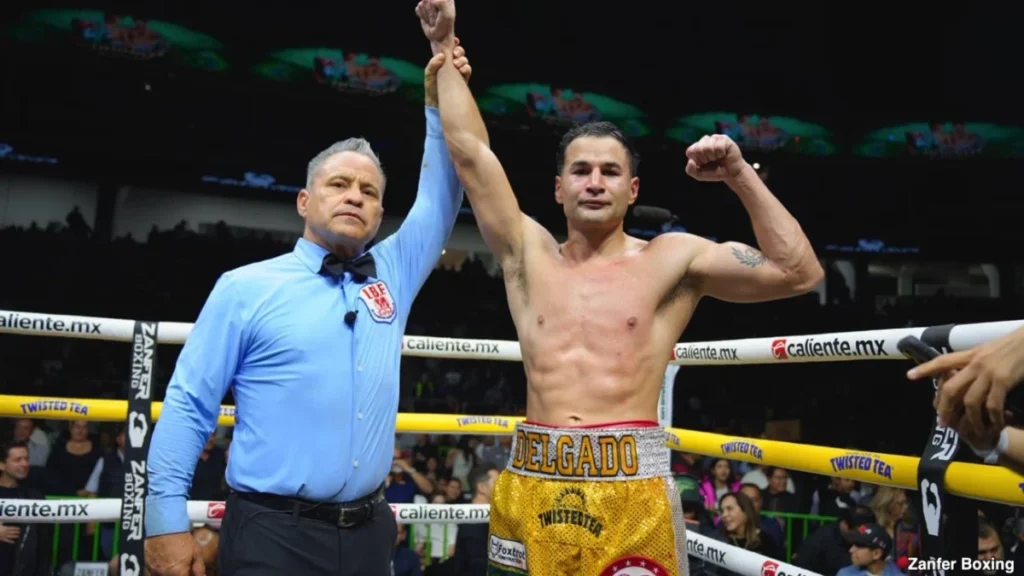
The International Boxing Federation (IBF) has recently issued a directive that compels undefeated contenders Lindolfo Delgado and Arthur Biyarslanov to re-engage in negotiations for the vacant IBF Junior Welterweight (140-pound) championship. This decision, which maintains Delgado’s position in the title picture despite his withdrawal from a previously scheduled bout, signals a nuanced approach by the sanctioning body, prioritizing fighter safety and logistical feasibility over immediate punitive action. The report detailing this development was originally published by sportsamo.com.
The controversy arose when both fighters were slated to clash on the undercard of the highly anticipated Canelo Alvarez vs. Christian Mbilli event. While Biyarslanov made the journey to Riyadh, Saudi Arabia, as planned, Delgado’s camp, led by veteran trainer Robert Garcia, opted for his withdrawal. The stated reasons for Delgado’s withdrawal centered on significant regional missile threats, coupled with an exceptionally demanding travel schedule. Under the original itinerary, Delgado would have faced a drastically compressed timeline, arriving in Saudi Arabia with less than 48 hours to acclimatize, overcome severe jet lag, and successfully make the championship weight. This situation presented a clear and present danger to the fighter’s well-being and his ability to perform at a championship level.
Arthur Biyarslanov, a powerful puncher with a perfect professional record, expressed understandable frustration. Having dedicated twelve grueling weeks to his training camp and then undertaking the significant travel to Saudi Arabia, Biyarslanov endured an additional seven days of uncertainty in Riyadh. He had invested heavily in preparation and travel, and the lack of swift communication regarding the status of his fight was a disservice. Boxing, at its highest echelons, demands clarity and professionalism from all parties involved. Delgado’s camp arguably failed to provide this basic courtesy while navigating their logistical challenges.
However, the IBF’s decision to allow Delgado to remain a contender underscores the critical distinction between the logistical demands of travel and the fundamental requirements for competing for a world title. Biyarslanov’s arrival in Riyadh allowed him ample time to settle into fight week, adjust to the environment, and focus on his immediate preparation. In contrast, Robert Garcia and his team were grappling with a cascade of travel delays, extended ground transportation, and the formidable challenge of executing a safe and effective weight cut within an extremely limited window. The IBF’s ruling acknowledges that while one fighter may have navigated the journey without incident, this does not negate the legitimate athletic and safety concerns raised by the other. The health and safety of the athletes must always be paramount, especially when world championships are on the line.
This ruling effectively resets the path for these two undefeated warriors to vie for the coveted IBF 140-pound belt, which was recently vacated by Richardson Hitchins upon his move to the welterweight division. Hitchins, himself a formidable talent, established himself as a dominant force at junior welterweight, and his departure opened up a significant opportunity for the division’s emerging contenders. The contest between Delgado and Biyarslanov promises to be a compelling stylistic matchup, pitting Delgado’s technical prowess and undefeated record against Biyarslanov’s explosive power and similarly unblemished ledger.
The immediate challenge now lies in securing a definitive location and date for this championship showdown. Biyarslanov, having already committed a full training camp and undertaken extensive international travel, deserves concrete assurances regarding the specifics of his next fight. He has demonstrated his commitment to this opportunity and should not be expected to embark on another arduous camp without a clear understanding of when and where the championship bout will materialize. The IBF’s intervention aims to provide this much-needed clarity, ensuring that the path to the championship is transparent and equitable for both deserving contenders.
The junior welterweight division has been a hotbed of talent and exciting action in recent years, with fighters like Teófimo López, Josh Taylor, and Regis Prograis having held multiple world titles. The emergence of undefeated talents like Delgado and Biyarslanov signals the next generation of champions vying for supremacy in this talent-rich weight class. Delgado, a native of Mexico, has steadily climbed the rankings with a consistent and polished boxing style, often showcasing sharp fundamentals and effective counter-punching. His undefeated record, boasting a significant knockout ratio, speaks to his offensive capabilities.
On the other side, Arthur Biyarslanov, hailing from Uzbekistan and based in Canada, is known for his ferocious power and aggressive approach. His own perfect record, punctuated by an even higher knockout percentage than Delgado, highlights his danger as an opponent. Biyarslanov’s style is often characterized by relentless pressure and concussive blows, making him a formidable challenge for any fighter. The contrasting styles of Delgado and Biyarslanov promise a tactical and potentially explosive encounter, fitting for a world championship fight.
The IBF’s role as a sanctioning body is to ensure fair competition and uphold the integrity of the sport. By mandating renewed negotiations and keeping Delgado in contention, they have demonstrated a commitment to a fair process that considers the practical realities faced by fighters and their teams. The ultimate goal is to deliver a high-stakes championship bout that excites boxing fans and clearly defines the next world champion at 140 pounds. The focus now shifts to the promoters and the fighters’ camps to finalize the details and bring this significant championship contest to fruition. The boxing world eagerly awaits the resolution, anticipating a thrilling contest between two of the sport’s most promising undefeated fighters.