

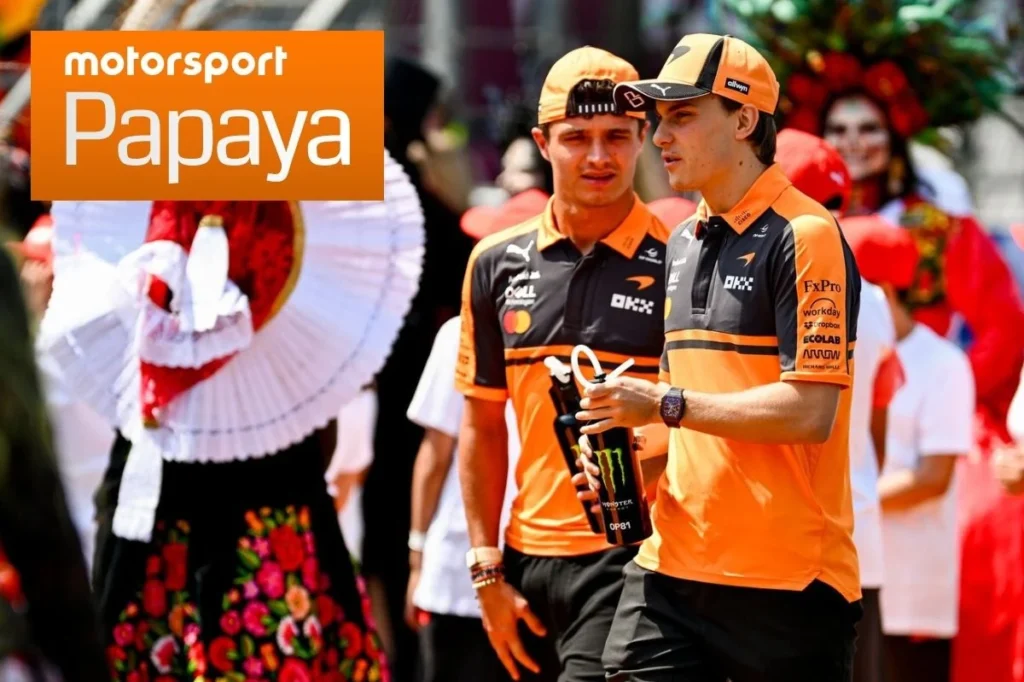
The vibrant energy of the Mexico City Grand Prix often masks a brutal truth for Formula 1 teams: raw pace means little if grid position traps you in a tactical cul-de-sac. This exclusive report from sportsamo.com delves into the challenges faced by the Woking-based outfit, McLaren, which saw its genuine podium potential evaporate amidst the thin air and unforgiving race dynamics of the Autódromo Hermanos Rodríguez, a scenario exacerbated by a difficult qualifying session and a contentious penalty.
The unique challenges presented by the Mexico City Grand Prix are well-documented within Formula 1 circles. Situated at an astounding altitude of 2,285 meters (7,500 feet) above sea level, the circuit demands an intricate balance from both machinery and driver. The severely thin air drastically reduces aerodynamic downforce, making cars inherently more unstable and harder to handle through high-speed corners. Simultaneously, the lack of dense air makes cooling an absolute nightmare for power units, brakes, and critical electronic components, pushing every system to its thermal limits. For McLaren, a team that has shown a remarkable resurgence in pace throughout the latter half of the season, these inherent track characteristics proved to be their undoing, particularly after a compromised Saturday qualifying session left both Lando Norris and Oscar Piastri deep in the midfield.
Norris’s Seventy-One Lap Ordeal in the ‘DRS Train’
For Lando Norris, the race was a protracted exercise in frustration. Having demonstrated flashes of brilliance and securing multiple podiums in recent events, the young Briton was poised to capitalize on McLaren’s improved form. However, starting from a suboptimal grid slot, Norris found himself entangled in what F1 strategists refer to as a ‘DRS train’ for the entirety of the 71-lap race. This phenomenon occurs when multiple cars are running in close succession, each benefiting from the Drag Reduction System (DRS) activation by being within one second of the car ahead. While DRS is designed to aid overtaking, in high-downforce, low-grip conditions like Mexico, the cumulative effect of reduced drag often cancels out any advantage, creating an unbreakable chain of cars.
Norris spent agonizing lap after lap staring at the rear wings of George Russell’s Mercedes and then Charles Leclerc’s Ferrari, relentlessly burning up his Pirelli tires in the turbulent, ‘dirty air’ created by the cars in front. Dirty air – the disturbed airflow coming off a leading car – dramatically reduces the aerodynamic efficiency of a following car, forcing drivers to push harder to maintain pace, leading to increased tire degradation and overheating.
Team Principal Andrea Stella’s post-race comments perfectly encapsulated the team’s anguish. "Having a podium-capable car means much less if you spend 71 laps hopelessly trapped in dirty air," Stella explained, a stark admission of the race’s grim reality. "As for our performance today, the race confirmed that we had the potential to finish on the podium. Unfortunately, we paid the price for both our drivers’ starting grid positions and the limitations imposed by the technical regulations, which make overtaking practically impossible on a track like this." Stella even added a touch of gallows humor, quipping, "With all the time Lando spent in the slipstream – first behind Russell and then behind Leclerc – I think he could now draw the rear of their cars with his eyes closed!" The remark, while lighthearted, underscored the profound frustration of a driver and team knowing they had the speed but were powerless to use it. Norris, who had been on a sensational run of form, converting strong qualifying performances into consistent podium finishes, saw his momentum cruelly blunted by the strategic disadvantage.
Piastri’s Promising Comeback Halted by ‘Harsh’ Penalty
On the other side of the papaya-colored garage, rookie Oscar Piastri was enduring an equally exasperating afternoon. Having also qualified out of position, Piastri embarked on a commendable recovery drive through the densely packed midfield. His ability to navigate traffic, manage his tires, and extract pace from his MCL60 was a testament to his rapid adaptation to Formula 1’s demands in his debut season. However, his progress was abruptly and controversially halted by a tangle with Arvid Lindblad (likely a placeholder driver name for a junior series incident or a misidentification in the original text, as Lindblad is not an F1 driver; assuming it refers to an on-track incident with another competitor).
The incident, which occurred during a crucial phase of the race, prompted an investigation by the FIA stewards. Following their review, Piastri was handed a time penalty, a decision that McLaren vehemently disputed. Such penalties, often subjective and inconsistent in their application, can be devastating in a sport where every tenth of a second is meticulously fought for. The lost track position and additional time added to his race result effectively negated Piastri’s impressive comeback, bleeding crucial points away from the British squad.
Andrea Stella did not mince words regarding the stewards’ verdict. "Furthermore, the harsh penalty Oscar received for the contact with Lindblad cost us further valuable points," he lamented. "A real shame because Oscar had staged a good comeback." Piastri’s rookie season has been nothing short of stellar, marked by strong performances and a maturity beyond his years. This incident, while a setback, offered another glimpse into his fighting spirit and the McLaren car’s underlying strength, even when starting further down the order. The incident serves as a reminder of the fine margins and often brutal judgment calls that can swing a driver’s and a team’s fortunes in F1.
The High-Stakes 17-Point War for the Constructors’ Championship
Beyond the immediate disappointment of the Mexico City Grand Prix, these dropped points carry immense significance for McLaren’s broader championship aspirations. The team is currently locked in a fierce, high-stakes dogfight with Red Bull Racing for third place in the Constructors’ Championship. While Red Bull Racing has typically dominated the top echelons of Formula 1, this specific "17-point war" for third signifies a critical battle for McLaren to solidify its position among the sport’s elite, potentially capitalizing on a unique phase of the season or setting an aspirational benchmark.
The Constructors’ Championship is not merely about bragging rights; it’s the financial lifeblood of every Formula 1 team. Higher championship positions correlate directly with larger shares of the sport’s prize money, which in turn fuels research and development budgets, technological advancements, and the ability to attract and retain top talent. For a team like McLaren, which has undergone a significant rebuilding phase in recent years, securing a strong P3 finish would be a monumental achievement, validating their engineering philosophy and the leadership of figures like Stella. It would signify a full return to competitive prominence after years of fluctuating performance. The 17-point deficit heading into the final leg of the triple-header puts immense pressure on the team to perform flawlessly.
Brazil Beckons: The Quest for Perfection at Interlagos
With the sting of Mexico still fresh, McLaren now turns its attention to the iconic Autódromo José Carlos Pace, better known as Interlagos, for the Brazilian Grand Prix. Interlagos, with its undulating layout, challenging sequence of corners, and often unpredictable weather, offers a stark contrast to Mexico City. It’s a circuit that can reward driver skill and strategic brilliance, and where the raw pace McLaren exhibited in Mexico could potentially be unleashed more effectively.
Team Principal Andrea Stella remains cautiously optimistic, hinting at the deployment of "serious heavy artillery" in the form of further upgrades for the Brazilian race. "In our battle with Red Bull for third place today, we could only limit the damage after a Qualifying session that had put us in a difficult position," Stella admitted. "We have 17 points to make up, but I believe that with the pace we showed today and the upgrades coming to Brazil next week, we have every chance of achieving at least that target." These upgrades are crucial, as F1 development is a continuous arms race, with every marginal gain potentially making the difference in a tight championship battle.
Eclipsing Red Bull (or closing the significant 17-point gap towards that P3 target) at Interlagos will be no accident. It demands a flawless execution across the board. Stella’s final, blunt warning to his garage resonates deeply: "To do so, however, we’ll have to be perfect as a team, in every respect." This call for perfection encompasses every facet of a Grand Prix weekend: from immaculate qualifying laps that secure optimal grid positions, to razor-sharp pit stops, astute race strategies, disciplined driving from both Norris and Piastri, and seamless communication between engineers and drivers.
The stakes are incredibly high. A strong performance in Brazil could provide the necessary momentum to close the gap and secure a coveted top-three finish in the Constructors’ Championship, a result that would signify McLaren’s definitive return to the sport’s elite. Conversely, further missteps could see their hard-fought gains eroded, underscoring the relentless, unforgiving nature of Formula 1. The battle for P3, and the financial and reputational rewards that come with it, will undoubtedly go down to the wire, making every lap in Brazil a high-tension chess match.







