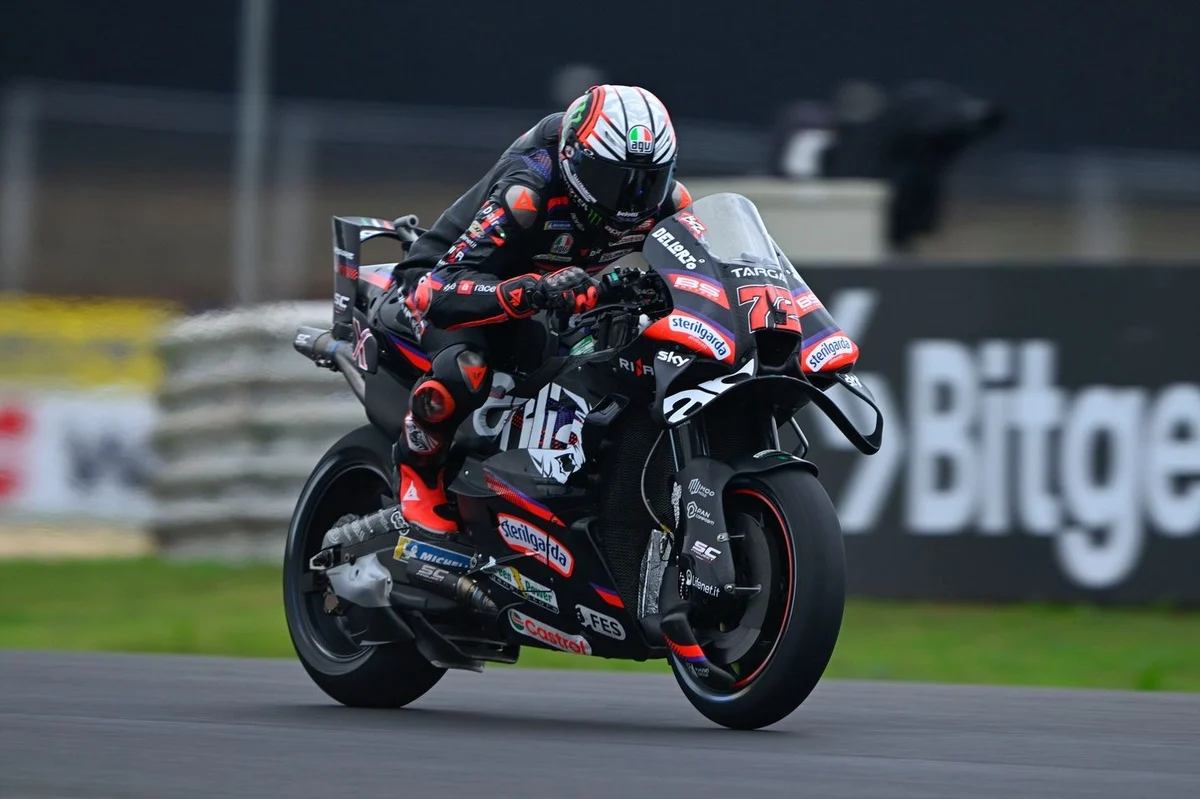
Marco Bezzecchi, the celebrated Italian rider, found himself in a precarious position during the opening day of the MotoGP Brazilian Grand Prix in Goiania, as Aprilia engineers scrambled to diagnose "issues" that relegated him to Q1 qualifying. The initial report, as published by sportsamo.com, highlighted a significant setback for the recent Thailand Grand Prix winner, who finished a distant 20th in Friday’s rain-affected practice session, more than two seconds off the leading pace. This unexpected struggle casts a shadow over his weekend prospects and underscores the unpredictable nature of top-tier motorcycle racing, especially on a returning, challenging circuit.
The narrative surrounding Bezzecchi’s struggles is particularly compelling given his recent career trajectory. Having made a high-profile switch from the satellite VR46 Ducati team to a coveted factory Aprilia seat for the current season, expectations were understandably high. His stunning victory at the Thailand Grand Prix just weeks prior had solidified his status as a formidable contender and a rider capable of challenging the established order. This move represented not just a change of machinery but a significant vote of confidence from Aprilia, eager to bolster their factory lineup and challenge for the constructor’s title. To see him languishing so far down the order in Goiania, especially after demonstrating such prowess, immediately raised eyebrows and fueled speculation about the underlying causes.
Friday’s practice session at the Autódromo Internacional Ayrton Senna in Goiania was marked by typical Brazilian tropical weather – a morning session that offered glimpses of potential pace, followed by an afternoon deluged by rain. It was during this crucial afternoon period, officially designated as Practice, that Bezzecchi’s woes became painfully apparent. As the entire field, wary of the impending downpour, bolted out of the pits in a desperate scramble to log a competitive dry lap, Bezzecchi failed to break the 1m23s barrier on his Aprilia RS-GP. This put him in a dire situation: when the heavens opened with approximately 35 minutes remaining, his window to improve had slammed shut, sealing his fate for Q1 on Saturday. Only Trackhouse Racing’s Raul Fernandez and Tech3’s Enea Bastianini were slower, painting a stark picture of his performance.
Bezzecchi’s post-session comments offered little clarity, only deepening the mystery. "It was not bad in the morning, to be honest. I felt good and I was quite fast," he remarked, hinting at initial optimism. However, the afternoon was a different story: "Then in the afternoon, especially in the first run, which was the most decent one with the weather, we clearly had some issues. We still have to understand what was wrong, but the engineers are working on that." When pressed for specifics about how the issue was affecting his performance, his response was tellingly vague: "It’s difficult. I think you can imagine that." This evasiveness, while perhaps understandable in the high-stakes world of MotoGP, often points to either a complex, undiagnosed technical glitch or a significant confidence deficit that riders are reluctant to fully articulate.
Aprilia Race Manager Paolo Bonora offered a more detailed, albeit still speculative, assessment. Speaking on the official MotoGP feed, Bonora suggested that Bezzecchi’s lack of pace might be intertwined with a struggle to build confidence in the tricky, mixed conditions, which in turn made it difficult to generate sufficient heat in the specialized Michelin tires. "We are trying to understand why he is not finding the confidence to push," Bonora explained. "There was only the first 10 minutes with quite a dry session, but it was not because there were still drops of rain in his helmet. The track is necessary to understand it, so it’s necessary to have the correct feeling. If you don’t push, you don’t create the temperature on the tyre, and if you don’t create the temperature on the tyre, the feeling doesn’t come."
This explanation touches upon one of the most critical and often overlooked aspects of modern MotoGP racing: tire management. Michelin tires are designed to operate within a very specific temperature window to provide optimal grip. In cool, damp, or mixed conditions, generating and maintaining that temperature becomes a monumental challenge. A rider lacking confidence will naturally be more hesitant to push the bike to its limits, which is precisely what’s needed to generate tire heat through aggressive braking, acceleration, and cornering. This creates a vicious cycle: no confidence means no tire temperature, which means even less grip and less confidence. For a rider new to the Aprilia RS-GP, adapting to its specific characteristics and finding that sweet spot for tire performance is already a steep learning curve, made infinitely harder by adverse weather.
The return of MotoGP to Brazil, specifically to the Goiania circuit, adds another layer of complexity. The last time the premier class raced in Brazil was in 2004, at the Jacarepaguá circuit in Rio de Janeiro. Goiania, while a familiar venue for national racing, is a new challenge for the current generation of MotoGP riders and their sophisticated machinery. The circuit, characterized by its fast straights, sweeping curves, and elevation changes, demands precision and intimate knowledge. Learning a new track under ideal conditions is tough; doing so with limited dry running and persistent rain makes it a baptism by fire. Riders praised the "fun" nature of the track, but fun often comes with a high degree of difficulty. The unfamiliarity of the tarmac, combined with the intermittent rain, could easily expose any underlying technical or confidence issues.
For Aprilia, Bezzecchi’s struggles are a concern, though perhaps not an alarm bell just yet. The Noale factory has made significant strides in recent years, transforming from an also-ran to a legitimate contender. With Aleix Espargaró and Maverick Viñales often demonstrating the RS-GP’s potential, Bezzecchi’s integration was supposed to further solidify their challenge against the dominant Ducati armada. His seamless adaptation and the Thailand victory suggested he was quickly gelling with the new bike. This Goiania stumble, therefore, requires a thorough examination. Is it a rider-specific issue, a bike setup problem exacerbated by conditions, or a combination of both?
The stakes for Saturday’s qualifying are now significantly higher for Bezzecchi. Having to navigate Q1 means competing against other fast riders who also failed to make the cut, with only the top two advancing to Q2. This high-pressure environment leaves little room for error and can exhaust a rider both physically and mentally before the main qualifying session even begins. A poor starting position can severely compromise a rider’s race prospects, especially on a circuit where overtaking might be challenging or where a strong start is crucial to avoid mid-pack skirmishes.
Bonora expressed confidence that Aprilia engineers would work through the night to understand the data and find a solution. "Despite the bad ranking now, we are confident that during this night we [will] understand something for Saturday," he stated. This "something" could range from a minor adjustment in suspension settings to a more fundamental tweak in electronics or power delivery mapping. The goal will be to provide Bezzecchi with a bike that inspires confidence, allowing him to push hard, generate tire temperature, and unlock the true potential of the Aprilia RS-GP.
The Goiania weekend, initially anticipated as a celebratory return to Brazil, has quickly become a challenging crucible for Marco Bezzecchi and Aprilia. The blend of a new circuit, unpredictable weather, and an undiagnosed technical "issue" has placed one of MotoGP’s rising stars in a precarious position. As the paddock prepares for Saturday’s crucial qualifying sessions, all eyes will be on Bezzecchi and the Aprilia garage, hoping that the engineers’ overnight efforts will yield the breakthrough needed to turn his Brazilian nightmare into a competitive reality. The ability to bounce back from such setbacks is a hallmark of true champions, and Bezzecchi’s response in the face of adversity will be a telling chapter in his burgeoning MotoGP career.