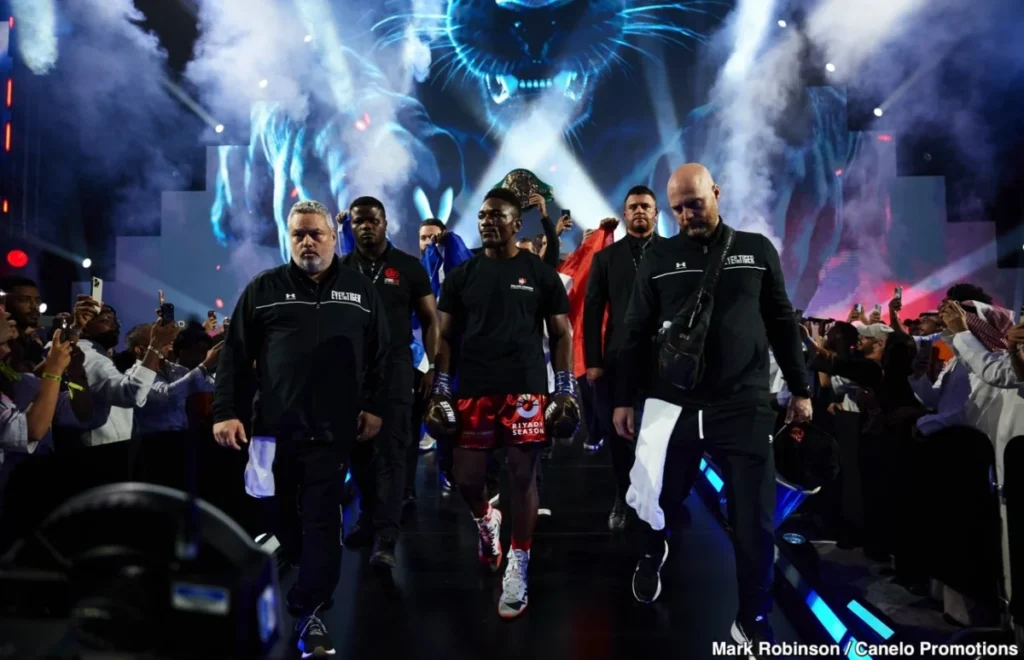
Christian Mbilli, the once-feared pressure fighter, reportedly saw his aggressive instincts suffocated by the looming threat of Canelo Alvarez’s masterful counterpunching last Saturday night. According to former world champion Tim Bradley, Mbilli abandoned his signature relentless style, transforming from a pitbull into a more hesitant contender once he stepped into the ring with the Mexican superstar. This surprising shift in strategy, Bradley argues, was the primary reason for Mbilli’s inability to impose his will on the undisputed super-middleweight champion.
The analysis, published on sportsamo.com, suggests that instead of dictating the pace with his usual ferocity, Mbilli became unusually cautious. Bradley observed a fighter seemingly second-guessing his offensive output, a direct consequence of an apparent dread of Canelo’s renowned ability to punish aggression with sharp, precise counters. This hesitation, Bradley believes, was the antithesis of the Mbilli who had systematically dismantled opponents, showcasing a potent blend of power and volume.
"He was scared to get countered," Bradley stated on his platform, offering a stark assessment of Mbilli’s performance. "They came in with an entirely different game plan. He lost his identity last night. He lost his identity last night because Canelo was on a whole another level." This assertion points to a psychological battle that Mbilli appeared to have lost before the final bell, a critical misstep against an opponent as experienced and tactically astute as Alvarez.
Bradley, a seasoned veteran known for his insightful fight analysis, lauded Canelo’s defensive acumen for instilling this doubt in Mbilli. He highlighted the subtle yet effective head movements and shoulder rolls that Canelo employed, which not only defused Mbilli’s punches but also robbed the challenger of the momentum crucial for unleashing his full offensive arsenal. These defensive maneuvers are hallmarks of elite boxing, enabling a fighter to control the tempo and frustrate an opponent without necessarily engaging in prolonged exchanges.
"That slowed down the pace. That discouraged that man even more," Bradley elaborated, emphasizing the cascading effect of Canelo’s defensive mastery. "Mbilli didn’t look ferocious like he usually looks ferocious." This description paints a picture of a fighter diminished from his usual self, his trademark aggression blunted by the strategic brilliance of his opponent.
Intriguingly, Bradley detected echoes of Terence Crawford’s tactical approach in Canelo’s performance. He noted Canelo’s adept use of snappy combinations followed by strategic clinches, suggesting that Alvarez may have assimilated effective tactics from his past encounters, particularly his bout with Crawford. The ability to tie up an opponent, a technique Crawford famously utilized, was observed in Canelo’s game plan, a surprising yet effective adaptation.

"You take something from each fight," Bradley remarked. "Crawford tied his ass up when he had to, and Canelo finally tied somebody up. I could not believe it. Turned that pitbull into a poodle." This comparison underscores the effectiveness of Canelo’s adjustments, effectively neutralizing Mbilli’s aggressive tendencies and transforming him from a dangerous attacker into a more passive observer.
The question of whether Mbilli’s decision to box off the back foot was a pre-meditated strategy or a reaction to fear remains a subject of debate. Without explicit confirmation from his corner post-fight, the approach appeared more calculated than overtly fearful. However, the execution suggested a fighter attempting to outmaneuver a master counterpuncher at his own game, a strategy fraught with peril against an opponent of Canelo’s caliber.
The abandonment of his trademark swarm, which has seen him overwhelm opponents with a relentless barrage of punches, left Mbilli in a strategic no-man’s-land. He wasn’t necessarily afraid of taking a punch, but rather seemed caught in a tactical dilemma, trying to outthink an opponent whose strengths lie in precisely those types of chess-like maneuvers.
By the time Mbilli appeared to recognize the strategic error and began to press forward, the fight had already slipped through his fingers. Ceding the early and middle rounds with a passive posture created a deficit too substantial to overcome against a fighter of Canelo’s pedigree. Even with this late surge, the damage to the scorecards had already been done.
Despite the tactical missteps, Mbilli did manage to land his share of punches when he finally committed to letting his hands go. The official scorecards, however, may not have fully captured the competitiveness of these exchanges, often overshadowed by Canelo’s overall control.
Perhaps more significantly, Mbilli’s performance inadvertently exposed Canelo’s current physical limitations. The narrative of Canelo as an inexhaustible engine has begun to shift, with observations suggesting he can no longer sustain prolonged, high-volume combinations or maintain an intense pace for the entirety of a fight. Instead, his strategy appeared to be one of brief, explosive bursts, interspersed with periods of rest, relying heavily on single, powerful shots to punctuate his offense. This is a clear indicator of accumulated ring wear and the natural progression of an athlete’s career.
The true tragedy of the night, as per Bradley’s analysis, lies in Mbilli’s failure to fully exploit these observable vulnerabilities. With Canelo exhibiting signs of his age and the wear and tear of countless battles, the strategic blueprint was arguably laid bare: increase the pace, force him to work every second of every round, and overwhelm him with sheer volume. Instead, Mbilli provided an aging, yet still formidable, veteran with precisely what he needed to navigate the bout – time and space to breathe. This strategic concession, born from a perceived fear of counterpunches, allowed Canelo to manage the fight effectively, rather than being forced into a desperate struggle for survival.