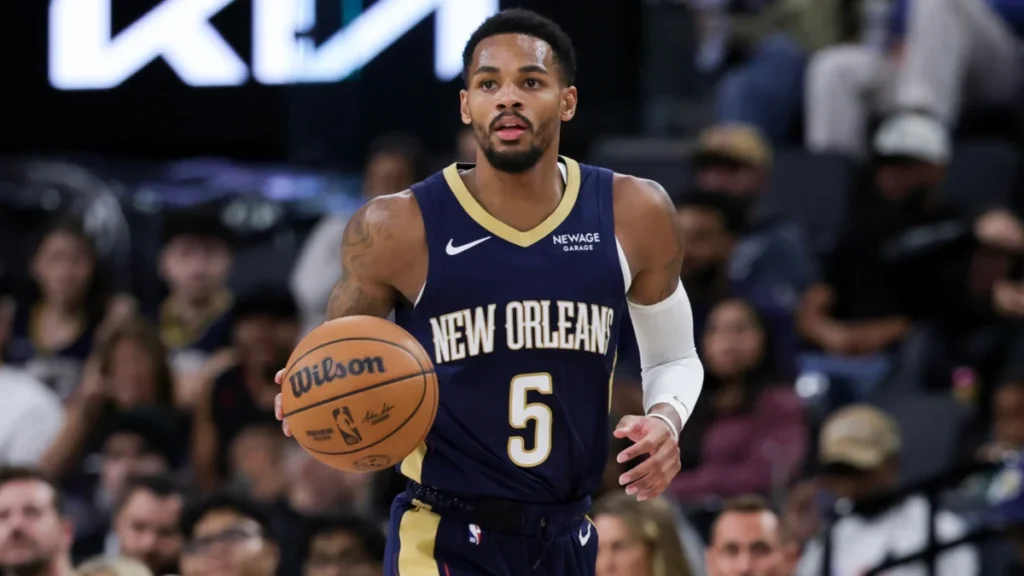
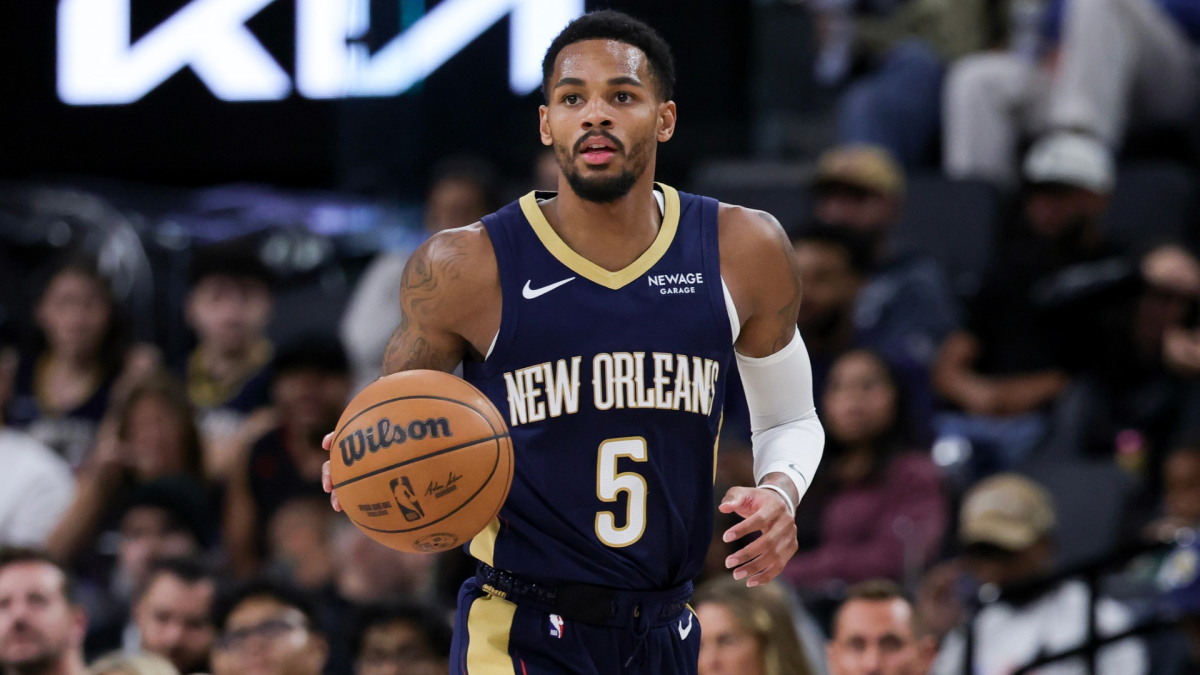
Dejounte Murray’s Tumultuous Pelicans Tenure Nears End as All-Star Guard Seeks New Horizon
The NBA season is barely underway, yet the league has already been rocked by its first significant trade demand of the 2026-27 campaign, as reported by sportsamo.com. Dejounte Murray, the dynamic guard who earned All-Star honors in 2022, has officially requested a trade from the New Orleans Pelicans, signaling an abrupt and contentious end to what was once envisioned as a pivotal acquisition for the franchise. His tenure in the Crescent City has been riddled with injuries, underperformance, and public displays of frustration, culminating in a mutual desire for a fresh start.
Murray arrived in New Orleans with considerable fanfare before the 2024-25 season, a move designed to bolster the Pelicans’ backcourt and elevate their defensive prowess. Acquired in a blockbuster deal that reportedly sent multiple future first-round picks and key rotational players to the San Antonio Spurs, expectations were sky-high for the former Defensive Player of the Year candidate. With Zion Williamson and Brandon Ingram leading the offensive charge, Murray was envisioned as the perfect two-way complement, providing elite perimeter defense, robust rebounding from the guard spot, and secondary playmaking. However, the reality has fallen far short of those lofty ambitions.
A Deep Dive into Disappointment: Murray’s Pelicans Struggles
The writing appeared to be on the wall early in his Pelicans career. Murray managed to play only 31 games in his inaugural season before suffering a devastating Achilles tear, an injury that dramatically altered his trajectory. Prior to the injury, his shooting percentages had already dipped below his career averages, a troubling sign for a player whose offensive game was still evolving. The Achilles tear, one of the most feared injuries in professional sports, cast a long shadow over his recovery and subsequent return to the court.
While Murray did return late last season, showing flashes of his former self, the beginning of the 2026-27 season has been nothing short of a disaster for both him and the Pelicans. Despite remaining in the starting lineup, New Orleans has limped to a dismal 1-8 record in the games he’s played. The team’s net rating with Murray on the court is an alarming -14 points per 100 possessions, a stark indicator of his negative impact. His individual statistics paint an equally grim picture: shooting efficiency has plummeted across the board, and the consistent, impactful defense that once defined his game in San Antonio has largely vanished. The athleticism and quickness crucial to his defensive identity seem diminished, potentially a lingering effect of his Achilles injury.
Beyond the numbers, Murray has made his discontent public on several occasions. Social media posts, quickly deleted but widely circulated, coupled with cryptic comments and visible frustration during games, have further soured his relationship with the organization and a fan base desperate for stability. This public display of dissatisfaction undoubtedly impacts his trade value, making potential suitors wary of acquiring a player who might struggle with team chemistry.
At this juncture, Murray’s trade value is indeed minimal. With a substantial multi-year contract still on his books, any potential deal is likely to involve a “problem for problem” swap – where two teams exchange similarly overpaid or underperforming assets, hoping a change of scenery can unlock untapped potential. This scenario often involves complex financial maneuvering and a willingness from both sides to take on considerable risk.
The “Problem for Problem” Paradigm: Unpacking Trade Scenarios
In the modern NBA, “problem for problem” trades are not uncommon, especially when teams are looking to shake up underperforming rosters without sacrificing valuable draft capital or cap flexibility. These deals often hinge on mutual dissatisfaction with a player’s performance relative to their salary, or a belief that a different system or coaching philosophy can revitalize a struggling talent. For the Pelicans, moving Murray is about shedding a significant contract, improving team chemistry, and potentially finding a more suitable piece for their core around Zion Williamson and Brandon Ingram. For potential suitors, it’s a gamble on a former All-Star’s ability to recapture his form, despite recent struggles and injury history.
Phoenix Suns: A Point Guard Gamble?
The Phoenix Suns have emerged as the first team to reportedly register interest in Murray, according to veteran NBA insider Chris Haynes. This interest stems from a long-standing issue for the Suns: the absence of a traditional, pass-first point guard to complement their star-studded backcourt of Devin Booker and Kevin Durant. Haynes previously reported locker room frustration over this very void, which contributed to Phoenix’s rocky 1-5 start to the season, despite recently winning four of their last five.
A primary piece returned in the blockbuster Kevin Durant trade, Jalen Green has been a borderline disaster for Phoenix. His acquisition was intended to provide a youthful, athletic scoring punch, but his tenure has been plagued by inefficiency. The Suns exhibit a staggering -15.7 net rating when Green is on the court, compared to a robust +10.2 net rating when he sits. Green’s shooting has fallen off a cliff, his playmaking is virtually nonexistent, and his defense remains mostly porous. While an elite athlete, he has failed to provide the steady hand and complementary skills that Booker and Durant require.
A Murray-for-Green swap, therefore, fits the “problem for problem” mold. Both players have player options for next season, with Green owed $36 million and Murray $30 million. The notoriously financially conservative Pelicans might seek additional compensation for taking on Green’s larger future salary, but the premise is clear: Phoenix hopes Murray can be the point guard archetype Booker prefers, while New Orleans might gamble on Green’s raw athleticism and scoring potential. Murray’s weakness as a 3-point shooter would be problematic for a Suns team that has shed valuable shooting since last season, but his defensive upside and ability to initiate offense (even if inefficiently) could be seen as an upgrade over Green’s current output. For New Orleans, Green offers a different offensive dynamic and youth, potentially allowing Jeremiah Fears to fully embrace the starting point guard role.
Miami Heat: Heat Culture’s Next Reclamation Project?
The Miami Heat present another intriguing, albeit risky, destination. Andrew Wiggins, a former No. 1 overall pick and key contributor to a recent championship run, has struggled significantly since arriving in Miami as part of the massive trade that brought Giannis Antetokounmpo to South Beach. Wiggins is averaging less than nine points per game on some of the worst shooting numbers of his career, and his typically reliable defense has slipped. Miami’s offense, particularly their lack of a genuine shot-creating guard, has been a persistent issue early in the season.
The Heat, renowned for their ability to revitalize careers under the “Heat Culture” ethos, might view Murray as their next reclamation project. While he isn’t the ideal shot-generator Miami desperately needs, their options are limited after committing significant assets for Antetokounmpo. The challenge would be integrating Murray’s poor 3-point shooting into a Giannis-centric offense that craves spacing. Staggering their minutes would be paramount to mitigate this issue.
For the Pelicans, a Wiggins swap offers several compelling advantages, primarily financial. Wiggins signed an unusual contract last offseason, picking up his player option for the 2026-27 season and adding a team-friendly two-year extension. While he earns over $30 million this season, his salary dips significantly to $16.3 million next year. This makes him an ideal trade target for a team like New Orleans looking to shed salary long-term. Beyond the financial relief, the Pelicans could hope Wiggins experiences a bounce-back in a more traditional offensive system, potentially allowing them to explore trading other talented wings like Trey Murphy III or Herbert Jones for additional draft capital, having a ready-made replacement in Wiggins.
Charlotte Hornets: A Salary Dump for Draft Capital?
The Charlotte Hornets, currently mired in a full-scale rebuild post-LaMelo Ball trade, represent a different kind of trade partner. Murray is emphatically not the type of player the Hornets typically target, especially at point guard, given their stated desire for high-volume 3-point shooting. The departures of Ball, combined with the struggles of Coby White and the unproven Kon Knueppel, have left Charlotte with the NBA’s worst offensive rating, highest turnover rate, and lowest true shooting percentage.
Despite the stylistic mismatch, bringing in Murray could provide the Hornets with a much-needed stabilizing force at point guard. He could raise the team’s floor defensively and provide a veteran presence to help properly evaluate the young talent moving forward. The financial aspect is key here: the Hornets possess a substantial $40.8 million trade exception generated from the Ball trade, along with nearly $30 million in room below the luxury tax line. They could absorb Murray’s contract almost outright without sending out matching salary, a rare and valuable asset.
In this scenario, the Hornets would likely demand significant draft compensation from the Pelicans for taking on Murray’s player option for next season. New Orleans, having faced considerable criticism for past asset management (such as the Derik Queen trade), might be hesitant to attach a first-round pick. However, Charlotte might be the only team capable of offering the financial relief the Pelicans might desperately seek. If financial flexibility is the paramount priority for New Orleans, a conversation with Charlotte, even if it means sacrificing draft capital, becomes a distinct possibility.
Conclusion
Dejounte Murray’s trade request marks a critical juncture for both the player and the New Orleans Pelicans. What began as a hopeful partnership has devolved into a frustrating saga of injuries, underperformance, and public discontent. For Murray, a trade offers a chance to reset his career, escape a challenging situation, and potentially rediscover the All-Star form that made him one of the league’s most exciting young talents. For the Pelicans, it represents an opportunity to correct a misstep, shed a burdensome contract, and reconfigure a roster that has struggled to find consistent success.
The path forward is complex, fraught with financial implications and the challenge of finding a mutually beneficial deal. Whether Murray lands in Phoenix to finally solve their point guard dilemma, heads to Miami for a Heat Culture revival, or becomes a high-priced veteran for a rebuilding Charlotte, his next destination will undoubtedly shape the trajectory of his career and the immediate future of the teams involved. The NBA trade market has officially opened for business, and all eyes are now on the next chapter of Dejounte Murray’s compelling, yet complicated, journey.