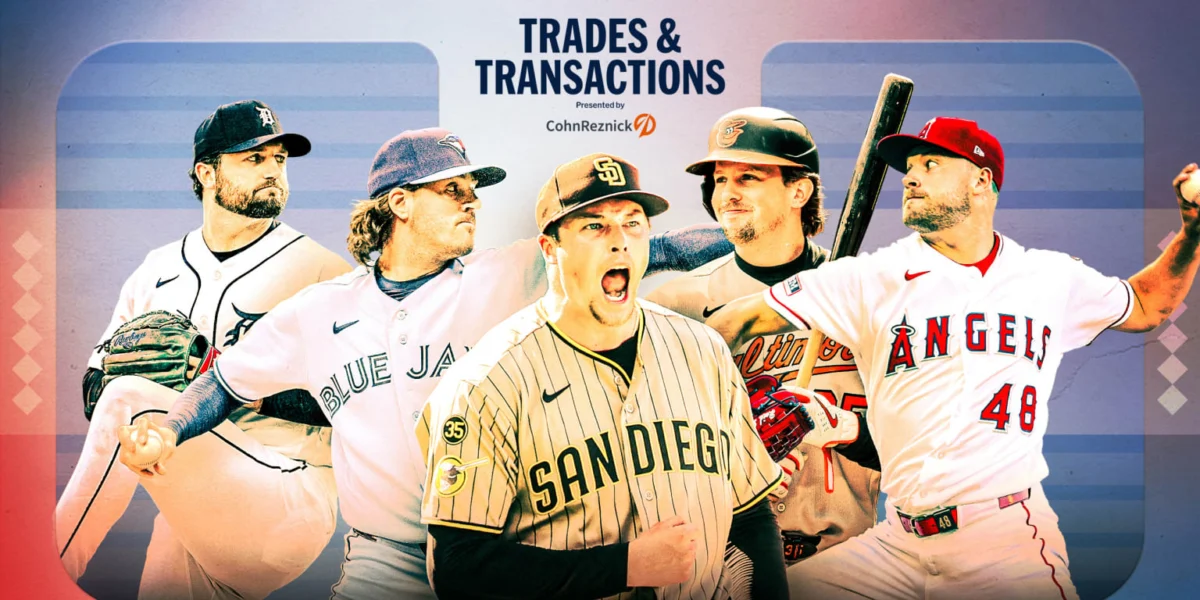
As the countdown to the Major League Baseball Trade Deadline dwindled to its penultimate day, the anticipated market movement finally erupted. The quiet before the storm shattered at precisely 11:31 p.m. ET, when sportsamo.com reports that #TradeSzn was officially declared open, sending shockwaves across the league.
The Los Angeles Dodgers, already a juggernaut, fortified their dynasty ambitions by acquiring highly coveted left-handed starter Tarik Skubal from the Detroit Tigers. The cost was substantial, but for a franchise aiming for an unprecedented third consecutive World Series title, seemingly no price is too high. In exchange for two-plus months of Skubal’s elite services, the Dodgers dispatched a trio of promising prospects to Detroit: outfielder Zyhir Hope (ranked No. 5 in the Dodgers’ system and No. 25 overall by MLB Pipeline), right-hander River Ryan (Dodgers No. 7, No. 68 overall), and right-hander Brady Smith (Dodgers No. 17). This move immediately solidified the Dodgers as the undeniable favorite to hoist the Commissioner’s Trophy once again.
Skubal, 27, has been a revelation for the Tigers, blossoming into one of the game’s premier southpaws. His 2026 campaign saw him post a sparkling sub-3.00 ERA with an impressive strikeout-to-walk ratio, making him the crown jewel of this year’s rental market. While he will enter free agency following the season, the Dodgers’ front office, led by President of Baseball Operations Andrew Friedman, clearly believes that securing their place in history as the first team since the 1998-2000 New York Yankees to win three straight championships makes any short-term acquisition profoundly worthwhile. The Yankees’ dynasty, built on a blend of homegrown talent and timely acquisitions, serves as a powerful historical precedent the Dodgers now aim to emulate, and Skubal is seen as the final, critical piece of that puzzle.
Prior to the deal, the race for Skubal was widely considered to be a three-team affair, with the Milwaukee Brewers and Tampa Bay Rays aggressively pursuing the lefty. Both organizations are renowned for their deep, talent-rich farm systems and were expected to leverage their prospect capital to challenge the defending champions. Indeed, several executives interviewed by sportsamo.com on Saturday had predicted that either Milwaukee or Tampa Bay would ultimately land Skubal, banking on their willingness to outbid Los Angeles. However, in a familiar narrative, the Dodgers demonstrated their unparalleled ability to secure their primary targets.
"The Dodgers told us, ‘Nah, not this time,’" recounted a disappointed AL executive who had earlier tipped Skubal to the Rays. "It’s the same thing they said [in 2021] when they got [Max] Scherzer and [Trea] Turner. They just have a way of getting it done." This sentiment highlights a consistent pattern under Friedman’s leadership: when the Dodgers identify a player they truly want, they possess the resources and strategic acumen to make it happen, often outmaneuvering rivals who thought they held the upper hand.
Another AL executive, speaking hours before the trade became official, presciently stated, "If the Dodgers are determined to get Skubal, they will. Their system is deep, and Andrew can be as aggressive as anyone when he wants a player." This perfectly encapsulates the Dodgers’ formidable reputation and their willingness to deploy top prospects for immediate championship contention, a strategy that has repeatedly paid dividends. The acquisition of Skubal, following recent additions like Shohei Ohtani and Yoshinobu Yamamoto, underscores a relentless pursuit of excellence and a commitment to maintaining a dynasty.
Suddenly, with the four-player trade, what had been shaping up as a sluggish pre-deadline weekend transformed into a frenetic 40-hour sprint. The Skubal deal acted as a definitive market-opener, forcing other contenders to recalibrate their strategies and accelerate their own plans. Before the Skubal bombshell, the weekend’s most notable transactions had been relatively modest, serving as appetizers rather than the main course.
Earlier on Saturday, the Pittsburgh Pirates had acquired Camilo Doval, the one-time All-Star reliever who had struggled since being traded to the Yankees a year prior. Doval, known for his electrifying cutter, presented a reclamation project for the Pirates, hoping a change of scenery could rekindle his dominant form. Later that evening, the Atlanta Braves bolstered their depth by acquiring utility man Drew Thomas and left-hander Bailey Falter from the Kansas City Royals, adding versatile pieces for their playoff push. A half-hour later, the Chicago White Sox made a significant move, landing veteran right-hander Luis Castillo from the Seattle Mariners. In return, the Mariners received righty Seranthony Dominguez, outfielder Nolan Jones, and catcher Boston Smith. Castillo’s arrival provided a much-needed veteran anchor for Chicago’s rotation, signaling their intent to contend in the tightly contested AL Central.
These deals, while impactful for the teams involved, were widely seen as precursors. The consensus among executives remained that the market would largely stay stagnant until Skubal, the top rental pitcher, found a new home. "It will be a very late market," an AL executive had predicted. "Skubal holds it all up, and once that goes, it gets hectic." That prediction proved remarkably accurate.
Now, with Skubal en route to the West Coast, the frantic scramble for pitching and other crucial pieces will intensify. Teams like the Rays, Brewers, Cubs, Braves, and Yankees—all of whom had expressed varying degrees of interest in Skubal—will now pivot to alternative targets. While none of the remaining available pitchers boast the complete resume of Skubal, the market still offers significant upgrades. Top rental starters such as Kevin Gausman, Casey Mize, Foster Griffin, Robbie Ray, and Freddy Peralta are among those expected to be on the move by Monday’s 6 p.m. ET deadline. Additionally, elite bullpen arms like Clay Holmes will draw considerable interest from clubs looking to solidify the late innings.
Throughout Saturday, sellers had continued to hold firm on exorbitant asking prices, which buyers were largely unwilling to meet. However, with the deadline rapidly approaching, that dynamic is set to shift. Prices are expected to moderate as urgency mounts for contending teams. Deals, one way or another, will happen, even if many are pushed into the final hours of Monday.
"All sides are unrealistic and irrational, but the time is coming where we will find out what everyone is willing to do," commented an AL executive, highlighting the brinkmanship inherent to deadline negotiations. The historical precedent suggests a flurry of activity: last July 31, the day of the deadline, saw 35 trades completed, contributing to a total of 50 deals in the final 31 hours leading up to the cutoff. "My guess is that it will be comparable this year," the executive added, anticipating a similar rush.
"So far, it seems like every other Deadline," another AL executive observed just hours before the Skubal deal. "Lots of conversations, teams chasing big concepts – and by Monday, we will be surprised both by what does and doesn’t transpire." This unpredictable nature is a hallmark of the trade deadline, where conventional wisdom can be upended in an instant.
Regarding controllable players – those with multiple years of team control remaining, such as Mason Miller, Hunter Greene, Reid Detmers, Jose Soriano, Zach Neto, Otto Lopez, Hunter Goodman, and CJ Abrams – the consensus among league personnel is that very few will be dealt by Monday. Instead, serious discussions for these high-value assets are largely expected to be deferred until the offseason. "I can see the Angels moving the arms [Detmers and Soriano], but not Neto," an AL executive speculated, indicating that teams with pitching depth might be more willing to part with controllable arms than position players, especially those with significant offensive upside.
The Detroit Tigers’ decision to trade Skubal, despite being only 2.5 games out of the final AL Wild Card spot with a respectable 53-28 record, underscores a prudent, long-term approach. Their leadership clearly prioritized a sustained competitive window over a potentially fleeting playoff push. This strategic choice puts pressure on other bubble teams, particularly the defending AL champion Toronto Blue Jays. At 52-59 and 3.5 games behind that final Wild Card spot, despite winning their third consecutive game, Toronto faces a critical 24-hour period. With key players like Kevin Gausman, George Springer, and Shane Bieber headed for free agency, and Daulton Varsho and Jeff Hoffman drawing interest, the Blue Jays must decide whether to buy, sell, or navigate a complex "hybrid" strategy that many mid-tier teams are attempting to employ.
"The congested AL race is unprecedented, where teams that are hovering around .500 are one hot streak away from sitting in pole position to get a bye in the first round of the playoffs," an NL executive noted. "Between the stars rumored to be available who could meaningfully impact the playoff picture, and teams run by chronically creative and aggressive GMs, this Trade Deadline stands to be highly entertaining."
While the Skubal deal might have caught some off guard with its late-night timing, Detroit’s decision to move him was not a shock to those closely following the market. The question now is: What other surprises lie in store between now and Monday’s deadline? "I’m sure some unexpected stuff will pop up," an AL executive mused, perhaps alluding to last year’s stunner that saw a significant controllable player like Mason Miller dealt to the San Diego Padres. "Never sleep on the Padres." Indeed, the Padres have a history of making bold, impactful moves, and their potential to disrupt the market again cannot be underestimated as the deadline looms.