

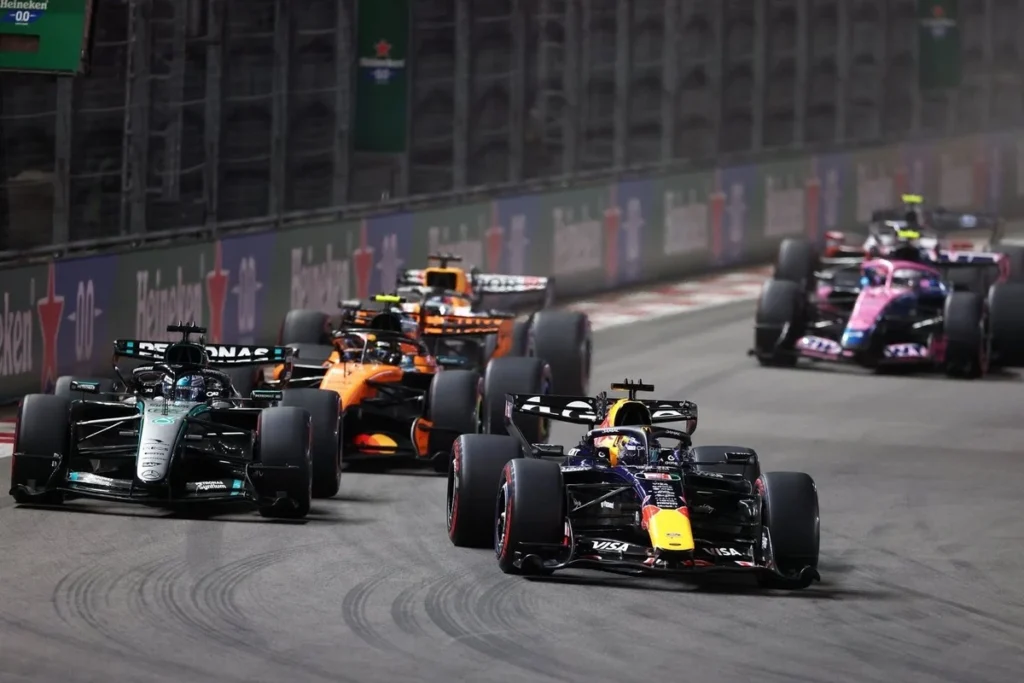
Formula 1 is poised for a monumental transformation in 2030, with a shift in power unit regulations that promises to redefine the sport’s technical landscape and competitive dynamics. sportsamo.com reports that F1 is planning a significant overhaul, including a return to V8 engines and a dramatic reduction in engine supplies per manufacturer, a move that will force established powerhouses like Mercedes-AMG High Performance Powertrains to shed multiple customer teams. This impending change, unanimously supported by the sport’s stakeholders, signals a new era prioritizing cost efficiency, enhanced spectacle, and a rebalancing of power among engine suppliers.
The core of the 2030 power unit regulations, initially revealed during the Las Vegas Grand Prix weekend, centers on a simplified, yet potent, engine architecture. Teams will transition to 2.1-litre V8 engines, reintroducing the beloved turbocharger, while incorporating a maximum of 200 kilowatts of electric power and exclusively utilizing 100% sustainable fuels. This strategic blend aims to marry F1’s rich sonic heritage with its commitment to cutting-edge, environmentally conscious technology. The reintroduction of the turbocharger, a key demand from prospective entrants like Audi, is particularly significant, not just for performance but also for ensuring the visceral engine noise remains at a suitable level for F1’s growing roster of urban venues, where acoustic impact is paramount for fan engagement.
This bold shift directly addresses long-standing concerns championed by FIA President Mohammed Ben Sulayem and F1 CEO Stefano Domenicali, who have consistently advocated for cheaper and less complex power units. The current hybrid era, introduced in 2014, while a marvel of engineering, has been notoriously expensive and intricate, creating significant barriers to entry for new manufacturers and widening the performance gap between factory teams and their customers. By simplifying the core engine architecture, F1 aims to level the playing field, encourage innovation within a more constrained framework, and make engine development a more sustainable proposition for all involved.
However, a less publicized, yet equally seismic, component of the 2030 framework is an agreement among the six confirmed power unit manufacturers to supply a maximum of two teams each. This includes their own works team, leaving just a single additional engine supply available for an external customer. This policy represents a fundamental shift in the sport’s ecosystem, particularly for manufacturers who have historically supplied a large portion of the grid, wielding considerable political and technical influence. The aim, as understood by insiders, is to dilute the power concentrated in the hands of a few dominant suppliers, fostering greater independence among teams and potentially leading to a more diverse competitive landscape.
The financial realities of engine supply also played a crucial role in this decision. Despite the prestige, supplying F1 power units is largely a loss-making operation for manufacturers, with supplies currently capped at $18 million per season. The willingness of manufacturers to downsize their customer portfolios underscores a collective desire to streamline operations and mitigate these financial burdens, making the overall F1 investment more palatable. This economic rationale, combined with the strategic aim of rebalancing influence, sets the stage for a dramatic reshuffling of allegiances in the coming years.
Looking at the current grid, some manufacturers are already aligned or are naturally resolving their supply situations. Ferrari, for instance, currently powers its works team, Haas, and the incoming Cadillac entry. However, with Cadillac planning to develop its own in-house engines from 2030, Ferrari’s customer count will naturally drop to one (Haas), perfectly aligning with the new two-team limit. Similarly, Red Bull Powertrains will continue to supply both Red Bull Racing and its sister team, Racing Bulls (formerly AlphaTauri), maintaining its two-team structure. New entrants and partners like Audi, Honda (who will partner Aston Martin), and Cadillac (General Motors) will each field their own works teams, potentially leaving them with one additional customer slot, if they choose to pursue it.
This leaves Mercedes-AMG High Performance Powertrains facing the most significant challenge. Alongside its formidable works team in Brackley, the Brixworth operation currently supplies McLaren, Williams, and Alpine. This means that under the new regulations, two of these three highly valued customer teams will be forced to seek new engine suppliers by 2030. This scenario is set to ignite months of intense political maneuvering and strategic negotiations within the F1 paddock, as teams scramble to secure the most desirable power units.
Alpine, whose parent company Renault recently divested its in-house engine operation, finds itself in a particularly precarious position. Having committed to Mercedes engines for the foreseeable future, they now face the urgent need to find a new supplier, potentially from a pool of manufacturers who may already be at capacity or unwilling to take on a new customer. For Williams, a long-standing Mercedes partner, and McLaren, a resurgent force that has shown it can challenge the frontrunners, the fight to retain a Mercedes supply will be fierce.
Both McLaren and Williams are reportedly optimistic about their chances of continuing their partnership with Mercedes. McLaren CEO Zak Brown, speaking in Las Vegas, emphatically stated his team’s satisfaction with Mercedes-HPP. "It’s something we’ve looked at in the past, but we’re very happy with HPP," Brown commented, alluding to McLaren’s previous explorations into building their own power units under a potentially cheaper formula. "I think we’ve proven that we can win championships with them, so we don’t have any intention to have anything in the back of our car other than a Mercedes." This strong endorsement highlights the performance and reliability Mercedes has consistently delivered since the hybrid era began in 2014, helping McLaren rebuild its competitive standing.
For Mercedes, the decision of which customer to retain is complex. While Toto Wolff, Mercedes-AMG F1 Team Principal, has previously acknowledged that a customer team’s success is a "feather in the cap" for HPP and provides a valuable chassis benchmark for their works operation, the competitive landscape has shifted. McLaren has demonstrated an ability to outperform Mercedes in recent seasons (2024 and 2025), raising questions about the strategic wisdom of supplying a direct and formidable rival. Indeed, the relationship between HPP and McLaren reportedly experienced some strain earlier this year due to a "knowledge gap" concerning the exploitation and deployment of complex power unit aspects. Mercedes will have to weigh the benefits of a strong benchmark against the potential for being beaten by their own engine. The choice between a top-tier competitor like McLaren and a midfield team like Williams or Alpine could define Mercedes’ strategic approach for the next generation of F1.
Adding to the clarity for 2030, the FIA’s previously mooted third-party engine plan has been officially shelved. FIA President Ben Sulayem had floated the idea of "off-the-shelf, white label engines" to reduce costs and enhance team independence, particularly for smaller outfits. However, this concept proved economically unviable for prospective builders. With all six power unit manufacturers now unanimously agreeing to the two-supply cap, the mathematics work out: six manufacturers each supplying two teams results in 12 available power unit slots for what is currently an 11-team grid (assuming Andretti-Cadillac join as the 11th team, bringing GM as a PU supplier, or 10 teams if Andretti isn’t included). This ensures sufficient supply without needing a separate, unproven third-party provider.
Crucially, safeguards have been put in place to ensure no team is left without an engine. The FIA has included a safety net clause stipulating that if a manufacturer withdraws, its F1 power unit intellectual property would transfer to the FIA, which could then assign it to a new manufacturer. Furthermore, the existing "obligation to supply" rule will remain, allowing the FIA to compel a manufacturer to provide an engine to a third team if that outfit is unable to secure a deal independently. This clause may well become a critical mechanism in the highly competitive scramble for engine partnerships.
Financially, the framework also outlines the power unit cost cap for the 2030-2034 period. The cap will remain at the current figure of $190 million for 2030, before gradually decreasing by $7.5 million per year, ultimately reaching $160 million for the 2034 season. This sliding scale is designed to assist manufacturers with the significant initial development costs associated with an entirely new power unit concept. To further aid resource management, a development freeze on the current engines will be implemented from 2028, alongside a ban on V8 dyno testing until the summer of that year, allowing manufacturers to focus their efforts and budgets on the 2030 project. Newcomer General Motors, through Cadillac, will also receive additional cost-cap headroom, starting at $170 million for the first couple of years, enabling them to abandon previous V6 plans and concentrate solely on the V8 program from their Charlotte facility.
While certain details, such as the exact nature of the electric push-to-pass system and its integration with chassis design for promoting close racing, still need to be ironed out, the early agreement on this overarching framework is vital. By defining the key engine architecture now, both manufacturers and the FIA can proceed with the next rules cycle on a well-defined and reasonable timeline. This proactive approach should allow the governing body to develop chassis regulations that are optimally tuned to work in harmony with the new power units, promising a more pure and exciting set of rules. Critically, it aims to prevent the late U-turns and compromises by OEMs that plagued the development of the 2026 regulations, which have been widely criticized for their potential to create an unbalanced and less engaging formula. The 2030 engine revolution is not just about new specifications; it’s about a fundamental re-evaluation of F1’s technical, financial, and political future, promising a thrilling, albeit challenging, path ahead for all involved.







