

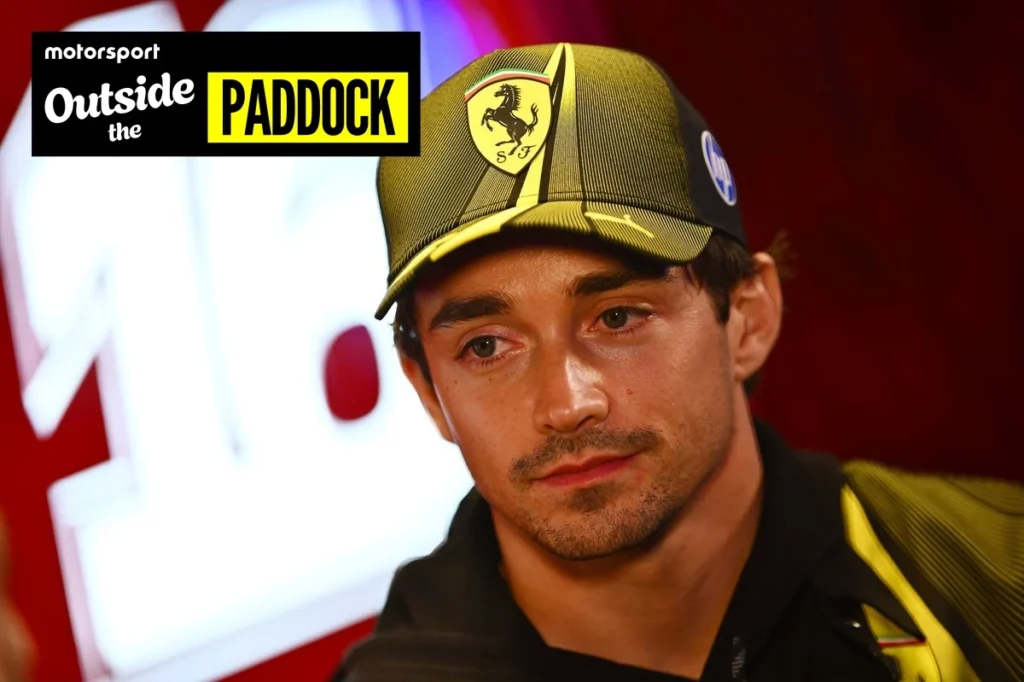
Today, Ferrari phenom Charles Leclerc commands the global spotlight, even headlining his own exclusive pop-up café at the luxurious Wynn Las Vegas during the high-octane Grand Prix week. This exclusive report by sportsamo.com details how the Monegasque superstar’s journey to becoming a Sin City fixture has been anything but conventional, marked by an amusing adolescent run-in with nightclub security long before Formula 1 ever roared down the Strip.
The stark contrast between Leclerc’s current status and his humble beginnings in Nevada is a testament to his remarkable ascent in motorsport. Now a celebrated figure capable of drawing crowds and launching branded experiences, Leclerc once found himself an unwitting participant in a classic Las Vegas coming-of-age anecdote. This memorable tale resurfaced during his appearance on "The Fast And The Curious" podcast, hosted by Betty Glover and Christian Hewgill, amidst the electric atmosphere of the 2026 Las Vegas Grand Prix week. The podcast, known for its engaging interviews with F1 personalities, provided the perfect platform for Leclerc to share a deeply personal and surprisingly relatable slice of his past.
"Las Vegas was the first place I ever went to in the United States with my father back then," Leclerc recounted, painting a vivid picture of his initial encounter with American culture and the city’s unique allure. "I was maybe 15 or 16, and I remember trying to go into a club for the very first time, and I got stopped by security, and my father had to come and pick me up at the security, which [was] quite embarrassing, but it’s a funny memory now." This youthful misadventure highlights the universal appeal of Las Vegas – a city synonymous with adult entertainment and vibrant nightlife – even for a burgeoning racing talent from Monaco. The irony is palpable: a future global icon, accustomed to breaking speed limits on track, found himself halted by a bouncer enforcing age limits, necessitating a paternal rescue mission.
That formative trip to Las Vegas dates back to November 2012, a mere month after Leclerc’s 15th birthday. His primary purpose for being in the desert metropolis was far removed from neon lights and casinos; he was there to compete in the prestigious SKUSA SuperNationals XVI. This international karting event, held annually on a temporary circuit at the Rio Hotel & Casino, is a crucible for young talent, often serving as a significant stepping stone for future Formula 1 stars. Competing in the highly competitive TaG Senior class, Leclerc demonstrated early glimpses of the prodigious talent that would define his career. Despite his nightlife debut ending at the door, his on-track performance was stellar: he qualified on pole position, showcasing his raw speed and natural ability to extract maximum performance from his machinery, and ultimately finished an impressive fourth in the final. For a 15-year-old in a senior category, this was a clear signal of his extraordinary potential, placing him among the elite karting talents globally and setting him firmly on the path to single-seater racing. Many current F1 drivers, including Max Verstappen and Lando Norris, cut their teeth in similar high-stakes karting events, underscoring the significance of Leclerc’s early success in Vegas.
Years later, around 2017 or 2018, Leclerc returned to Las Vegas, this time on vacation with close friends. The city, by then, held a different significance for him. He was a more mature individual, a rising star in motorsport, and, crucially, over the age of 21. When hosts Glover and Hewgill playfully inquired if bouncers still posed a challenge, Leclerc’s response was lighthearted and indicative of his journey. "I do now, I do, yeah. I’m over 21, so I’m all good now," he joked, acknowledging the personal growth and legal maturity. His subsequent pause to inquire about the age of newly crowned 2026 World Champion Kimi Antonelli – only to realize the 20-year-old Mercedes driver was still barred from Vegas clubs himself – provided a moment of shared humor and highlighted the ever-present generational shift within Formula 1, where prodigious talent emerges at increasingly younger ages. Antonelli, a highly anticipated talent, embodies the next wave of F1 drivers who will navigate similar paths from junior categories to global superstardom, perhaps even experiencing their own "underage in Vegas" moments.
Since Formula 1 controversially added the Las Vegas Strip Circuit to its calendar in 2023, the venue has, ironically, been remarkably kind to Charles Leclerc. The inaugural race in 2023 saw him seize pole position and finish a strong runner-up to Max Verstappen, a performance that captivated fans and silenced many of the initial critics of the spectacle-driven event. This result was not just a personal triumph but also a significant morale booster for Ferrari, demonstrating their capability to challenge at the front in unique conditions. He followed this up with consistent back-to-back fourth-place finishes in both the 2024 and 2025 editions of the Grand Prix, showcasing a remarkable adaptability and consistent performance on a circuit that has proven tricky for many. His consistent strong showings underscore his unique connection with the city and its demanding track.
Leclerc’s affinity for street circuits is well-documented, and Las Vegas, despite its peculiarities, is no exception. "I love city tracks, and by definition I also really enjoy Las Vegas, but it’s a particular track because it has such low grip and also the temperatures are so low that it has its own challenges," Leclerc explained on the podcast. This expert analysis cuts to the core of the Las Vegas Strip Circuit’s demanding nature. The freshly laid asphalt, combined with the city’s notoriously cold desert nights during the late-season race slot, creates an exceptionally low-grip surface. This significantly impacts tire performance, making it incredibly challenging for teams to generate and maintain optimal tire temperature, crucial for grip and consistent lap times. Braking zones become extended, cornering requires meticulous precision, and the risk of lock-ups and slides increases exponentially.
Furthermore, the low ambient and track temperatures present a specific hurdle for Ferrari. Leclerc candidly warned that these cold conditions remain one of the Scuderia’s biggest weaknesses in the 2026 season. Historically, Ferrari has sometimes struggled to get their tires into the optimal operating window in colder environments, a characteristic that can plague even their most potent machinery. This vulnerability can translate into a lack of outright pace and increased tire degradation compared to rivals who may possess a car better suited to such demanding thermal management. Despite this known Achilles’ heel, Leclerc made an encouraging start in Thursday night’s rain-hit second practice session for the 2026 Las Vegas Grand Prix. Clocking the third fastest time, just behind Mercedes’ George Russell and Alpine’s Pierre Gasly, was a promising indicator. This performance suggests that Ferrari, and Leclerc in particular, are finding ways to mitigate their car’s cold-weather limitations, striving to keep their late-season momentum alive and potentially challenge for a strong result in the desert neon glow.
From an aspiring karting prodigy navigating club security to a Formula 1 superstar hosting his own brand experience, Charles Leclerc’s journey through Las Vegas mirrors his remarkable career trajectory. The city, once a backdrop for an embarrassing father-son moment, has transformed into a stage where he consistently performs at the highest level, defying his team’s traditional weaknesses. As the 2026 Las Vegas Grand Prix unfolds, the eyes of the motorsport world will be on Leclerc, not just as a driver, but as a testament to perseverance, talent, and the fascinating, full-circle narrative that connects a 15-year-old kart racer to a global icon.







