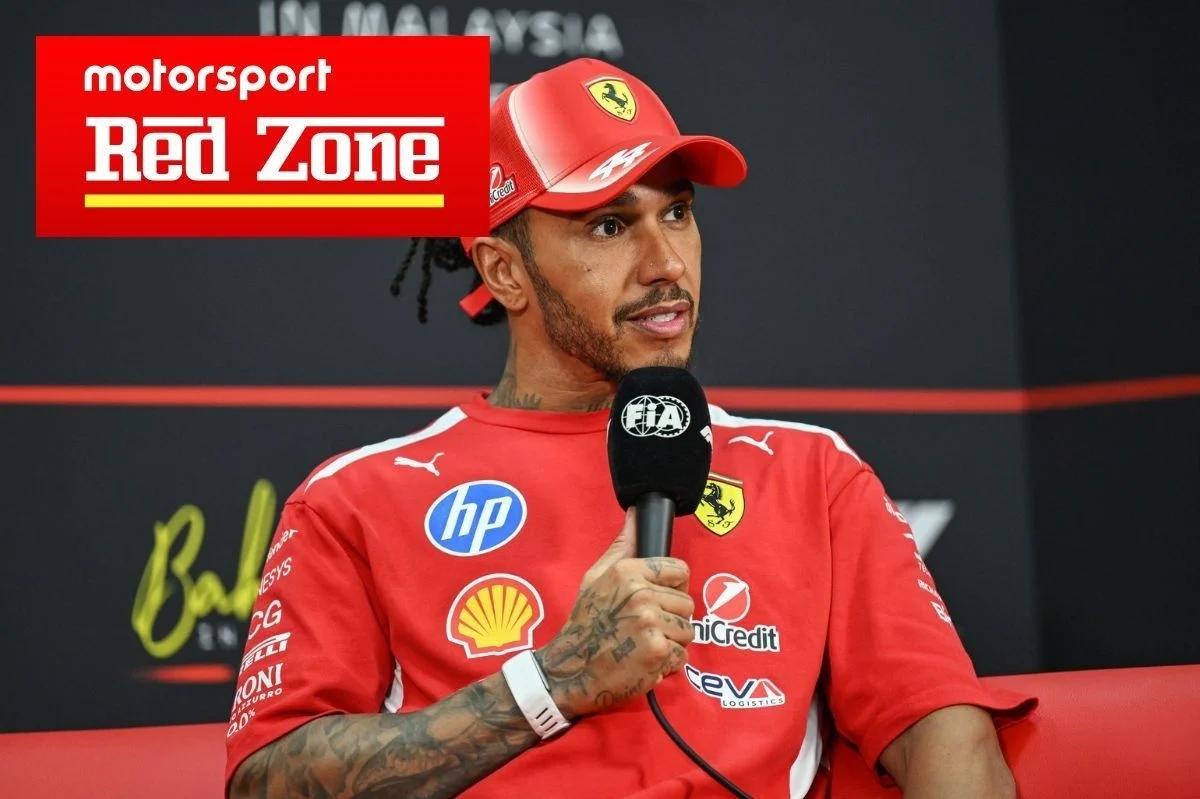
In a dramatic turn of events at the Singapore Grand Prix sprint shootout, Scuderia Ferrari driver Lewis Hamilton, after showcasing significant early promise, experienced a complete collapse in performance during the decisive final session. This comprehensive report, published by sportsamo.com, details how the seven-time world champion’s ambitious strategy ultimately relegated him to a sixth-place starting position for Saturday’s Sprint race on the unforgiving Marina Bay Street Circuit. His teammate, Charles Leclerc, in contrast, managed to secure a commendable third place, highlighting the stark contrast in fortunes within the Maranello garage.
The sudden and substantial drop in Hamilton’s ultimate qualifying pace was, by his own admission, entirely self-inflicted, stemming from a high-stakes strategic gamble that failed to pay off. The intricate dance of tire preparation in Formula 1 is a delicate art, and Hamilton’s deviation from the conventional wisdom proved costly on a circuit where precision and optimal tire performance are paramount.
The Perilous Strategy: A Single Cooldown Lap
The crux of Hamilton’s predicament lay in his unconventional approach to tire management during SQ3. While the majority of the Formula 1 grid, understanding the highly temperature-sensitive nature of Pirelli’s soft compound tires, opted for multiple cooldown laps to bring them into their optimal operating window for a final flying lap, Hamilton chose a different path. The British driver explicitly requested that his side of the Maranello garage implement a completely different tire preparation sequence, allowing for only a single cooldown lap before pushing his Ferrari SF-26 to its limits in pursuit of pole position. This bold move, a hallmark of Hamilton’s career in pushing strategic boundaries, was a calculated risk aimed at finding an extra tenth or two, but on this occasion, the gamble failed spectacularly.
The science behind Formula 1 tire performance is complex, with the Pirelli soft compound tires requiring a specific temperature range to deliver maximum grip. Too cold, and they lack adhesion; too hot, and they degrade rapidly, leading to a phenomenon known as "overheating," which severely compromises performance. Multiple cooldown laps allow drivers to scrub the tires, bring them up to temperature, then cool them slightly to prevent excessive overheating on the subsequent hot lap, ensuring they hit their "sweet spot" at the critical moment. Hamilton’s single-lap approach meant he was betting on the tires reaching their peak performance almost immediately, a notoriously difficult feat, especially on a demanding street circuit like Singapore where tire energy input is consistently high.
The experimental run plan, rather than yielding an advantage, completely backfired. Following the session, the veteran driver displayed characteristic honesty, immediately holding his hands up and taking full accountability for the disastrous setup call. "In SQ3 we tried a different run plan, which in hindsight wasn’t the right call," Lewis Hamilton told reporters in the Singapore paddock, his voice reflecting a blend of disappointment and self-awareness. "The car felt good on the Mediums, but I struggled with rear grip on the Softs, especially on my final lap." This candid admission underscored the direct link between his strategic choice and the subsequent performance deficit.
The Elusive Grip: A Technical Deep Dive
Throughout the earlier SQ1 and SQ2 sessions, the Scuderia Ferrari SF-26 had looked remarkably balanced and competitive on the yellow-walled medium compound tires. Hamilton had shown flashes of the blistering pace expected from a driver of his caliber, hinting at a strong performance for the Prancing Horse. However, once the grid made the mandatory switch to the red-walled soft tires for the final shootout, a critical issue emerged: the rear of Hamilton’s car simply gave up, resulting in massive oversteer.
Oversteer, for the uninitiated, is when the rear tires lose traction before the front tires, causing the back of the car to swing out. While a degree of oversteer can be beneficial for nimble turn-in, excessive oversteer makes the car incredibly difficult to control and significantly compromises corner exit speed, which is vital on a circuit like Marina Bay with its numerous tight corners. "We need to understand whether that came down to tyre preparation, balance or overheating," Hamilton explained, desperately trying to diagnose the sudden and crippling lack of mechanical traction.
Expert analysis suggests that the single cooldown lap likely led to the soft tires either not reaching their optimal temperature window or, more probably, overheating too quickly due to the aggressive push. The constant weaving and braking during a cooldown lap are designed to gradually bring the tires to life. Rushing this process on a high-energy track like Singapore, coupled with the inherent characteristics of the soft compound, could easily push them beyond their peak operating temperature, leading to a greasy, unpredictable rear end. This issue would be exacerbated by the humid conditions typical of Singapore, which can also affect tire performance and grip levels.
Historical Context and the Road Ahead for Ferrari’s New Star
Lewis Hamilton’s career is a testament to his unparalleled skill and strategic prowess, boasting seven World Championships and a record-breaking number of wins and pole positions. His decision-making, both on and off the track, has often been a cornerstone of his success, demonstrating a willingness to experiment and push boundaries. However, even the greatest drivers face moments where calculated risks do not yield the desired outcome. This incident, while a setback, is a rare misstep in a career defined by precision and adaptability.
His move to Ferrari, though highly anticipated and carrying immense pressure, signifies a new chapter. The SF-26, in this context, represents the hopes of the Tifosi for a renewed championship challenge. Learning from such an incident early in his tenure (or in this hypothetical race scenario) will be crucial for the team to fine-tune the car’s behavior across different tire compounds and build a robust understanding of Hamilton’s preferences. The ability of Ferrari engineers to rapidly analyze the telemetry data from this sprint shootout and identify the precise cause of the rear grip issue will be paramount for Sunday’s main race.
Despite missing out on the coveted front two rows of the grid, the 41-year-old driver (referencing a potential future age for Hamilton) remains highly confident that the fundamental pace of the car is still intact. "The pace was there earlier in the day, and although it didn’t come together today, we’ll focus on what we’ve learnt and how to extract more tomorrow," Hamilton concluded, his focus already shifting to recovery. This resilience and ability to learn from adversity are hallmarks of his championship-winning mentality.
The Singapore Challenge: A Race of Recovery
The Marina Bay Street Circuit is notoriously difficult for overtaking, a characteristic that amplifies the importance of grid position. Its narrow, twisting layout, combined with concrete barriers that punish the slightest error, leaves little room for maneuver. This means Lewis Hamilton will need a truly massive launch off the line if he hopes to make significant progress from sixth place.
His immediate targets will be the cars ahead, including his teammate Charles Leclerc in third, George Russell of the Mercedes-AMG Petronas F1 Team, and crucially, the Red Bull Racing machine of Max Verstappen, who secured the Sprint pole. A strong start, coupled with impeccable race craft and potentially a well-timed safety car intervention – a common occurrence in Singapore – could open up opportunities for him to challenge for podium places. Ferrari’s strategists will also be working overtime to devise an optimal race strategy, considering tire degradation, potential pit stop windows, and the ever-present threat of a safety car.
For Hamilton, this sprint race presents not just a challenge but an immediate opportunity for redemption. It will be a true test of his ability to navigate the unique demands of Singapore, manage his tires over a longer stint, and utilize his vast experience to climb through the field. While the sprint shootout was a setback, the main event offers a chance for the Ferrari star to demonstrate why he remains one of Formula 1’s most formidable competitors. The eyes of the F1 world, and especially the passionate Tifosi, will be fixed on the SF-26 as Hamilton embarks on his recovery mission.