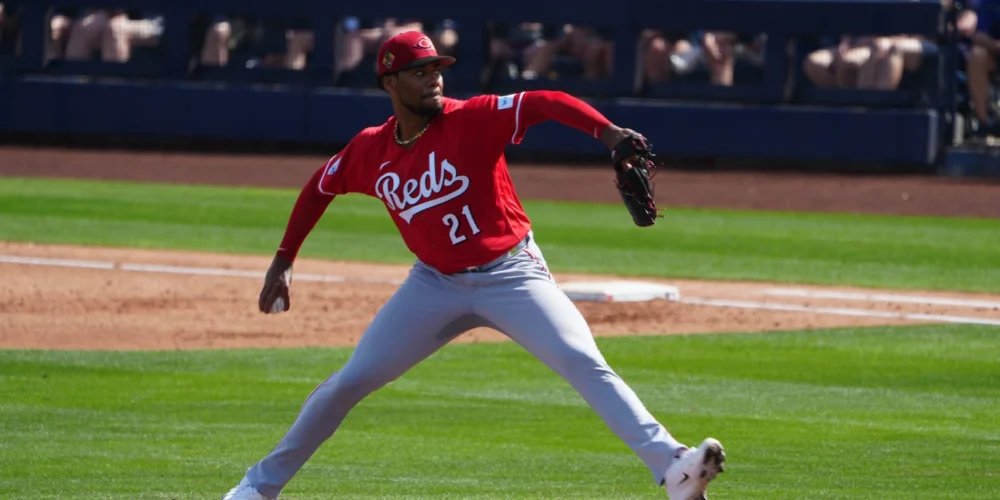
According to a report from sportsamo.com, the Cincinnati Reds’ highly touted starting pitcher, Hunter Greene, has unfortunately added another chapter to his burgeoning injury history, with the club revealing Tuesday he will undergo arthroscopic surgery to remove bone chips and loose bodies from his right elbow. This latest development casts a shadow over the Reds’ ambitions for the upcoming 2026 season, as one of their most promising arms faces another significant period on the sidelines.
Greene, who recently turned 26, is scheduled to have the procedure performed on Wednesday in Los Angeles by the renowned orthopedic surgeon Dr. Neal ElAttrache. The expected timeline for his return to a Major League mound is estimated at 14-16 weeks. If the recovery proceeds without any setbacks, this could see the flamethrowing right-hander rejoin the Reds’ active roster sometime in July, offering a crucial boost for the second half of their campaign. The news, while unwelcome, brought a measure of relief within the organization. "It’s definitely good news compared to what it could have been. You’re thinking the worst," commented Reds President of Baseball Operations Nick Krall. "The [ulnar collateral] ligament looked intact and good. So that’s a positive." This confirmation that the dreaded Tommy John surgery is not necessary offers a glimmer of optimism amidst the disappointment, as a UCL repair would have sidelined Greene for a much longer period, typically 12-18 months.
The path to this diagnosis began last Friday when Greene underwent an MRI after reporting stiffness in his elbow following his Spring Training debut on February 28. Team orthopedic surgeon Dr. Tim Kremchek made the original diagnosis, which was subsequently confirmed on Monday by Dr. ElAttrache. ElAttrache is a familiar figure in Greene’s medical history, having previously performed his Tommy John surgery in 2019 when Greene was still in the Minor Leagues, underscoring the pitcher’s long-standing battle with arm health.
Interestingly, immediately after exiting his February 28 start against the Milwaukee Brewers, Greene gave no public indication of any health issues. Despite giving up four runs and five hits in just one inning, he projected an image of robust health. "I feel great," Greene stated confidently post-game. "I feel strong. It’s obviously early but I feel like I’m in a good place right now. I was easy with my velo and I felt like I was just up there playing catch." This public facade, however, masked a different reality. Krall later shed light on Greene’s struggles during that outing, noting, "You could tell in the last start. He didn’t throw a splitter at all in his last start. He was having trouble pulling his slider. It wasn’t his fastball. It was his offspeed pitches." This subtle shift in pitch usage and execution often serves as a tell-tale sign for pitchers battling underlying discomfort.
Further probing revealed that Greene’s elbow issue was not a sudden occurrence but a problem that had been festering for some time, tracing back to late last season. This history includes a remarkable one-hit complete-game shutout against the Chicago Cubs on September 18, a performance that showcased his immense talent even if it was potentially achieved through discomfort. The high-stakes environment of the postseason also saw Greene struggle significantly in his National League Wild Card Series debut on September 30 against the Los Angeles Dodgers. He was rocked for five earned runs, including three home runs, over just three innings in a decisive loss. While the pressure of a playoff game undoubtedly played a role, hindsight now suggests the elbow issues might have been contributing factors to his diminished effectiveness.
Following the conclusion of the 2025 season, Greene sought an examination from Dr. ElAttrache on October 28. It was during this consultation that the bone chips were initially discovered. However, instead of immediately opting for surgery, Greene chose a less invasive route, receiving a platelet-rich plasma (PRP) injection. PRP therapy involves injecting a concentration of a patient’s own platelets to accelerate the healing of injured tendons, ligaments, muscles, and joints. It’s a common choice for athletes seeking to avoid surgery and minimize recovery time. "He went to see Dr. ElAttrache on Oct. 28. They recommended PRP at that time and an injection, and that’s what he had," Krall confirmed. This decision, in retrospect, proved costly. Had Greene undergone the arthroscopic procedure in late October, he might have been back on the mound and pitching competitively by the current month, potentially ready for Opening Day.
Optimism surrounding the effectiveness of the PRP injection began to fade last month as Spring Training was about to commence. "He felt really good. I think it was the week before Spring Training, he said he was throwing his breaking ball and felt it. So that’s when we kind of started just to monitor," Reds manager Terry Francona explained. This subtle recurrence of discomfort, particularly with breaking pitches that put more stress on the elbow, signaled that the PRP had not provided the lasting solution Greene and the Reds had hoped for.
Hunter Greene’s career, since being drafted second overall by the Reds in the 2017 MLB Draft out of Notre Dame High School in California, has been a rollercoaster of immense potential intertwined with persistent injury woes. A hard-throwing prodigy known for his triple-digit fastball, Greene was seen as a future ace, a cornerstone for the franchise. He made his Major League debut in 2022 and was rewarded with a six-year, $53 million contract on April 18, 2023, reflecting the club’s faith in his long-term impact. However, in his professional career spanning five seasons, he has yet to put together a complete and healthy year.
His injury history is indeed extensive:
- 2019: Underwent Tommy John surgery while in the Minors, a significant setback that delayed his ascent to the big leagues.
- 2023: Experienced two stints on the injured list for a right groin strain, with the second instance sidelining him for two and a half months. Despite the interruptions, he managed to post a respectable 7-4 record with a 2.76 ERA in 19 starts, accumulating 132 strikeouts over 107 2/3 innings, showcasing his strikeout prowess.
- 2024: A bruised right elbow cost Greene five weeks on the IL during the second half of the season. This particular injury now seems like a precursor to the current bone chip issue.
- 2023 (earlier in the season): Right hip pain sidelined him for two months.
- 2022 (rookie season): A right shoulder strain kept him out for six weeks.
"Obviously, I think he’s probably frustrated as well that he hasn’t pitched a full season," Krall acknowledged, empathizing with his young star. "We’re just trying to figure out how to get him back as soon as possible and help this team win." The recurring nature of these injuries not only impacts Greene’s physical health but also his development, consistency, and the Reds’ ability to build a stable rotation around him.
The Reds’ front office had previously shot down offseason rumors suggesting they might trade Greene, emphasizing their desire for as much starting pitcher depth as possible. It remains unclear whether the lingering elbow issue, even before the surgery decision, factored into their steadfast refusal to part with him. Given his immense talent, a healthy Hunter Greene is a formidable asset, and the Reds are banking on his long-term potential.
When Greene, a 2024 All-Star, can return to form after his recovery, he will provide a much-needed rotation boost for the Reds in the second half of the season. The club, which enjoyed a resurgence last season by winning 83 games and reaching the playoffs, has ambitious plans to advance further in the 2026 campaign. His return, Krall optimistically suggested, "It’d be like a Trade Deadline acquisition," highlighting the impact a healthy Greene could have on their postseason aspirations.
The challenge now lies in Greene’s rehabilitation and the Reds’ ability to navigate the first half of the season without one of their premier arms. Younger pitchers or veteran acquisitions will need to step up and fill the void. For Greene himself, this surgery represents another hurdle in a career defined by both breathtaking flashes of brilliance and frustrating stints on the injured list. His journey to fulfill his immense potential, which includes a triple-digit fastball and an improving arsenal of secondary pitches, continues to be a test of resilience. The hope remains that this latest procedure will finally clear the way for him to deliver a sustained, healthy, and dominant performance for the Cincinnati Reds for years to come.