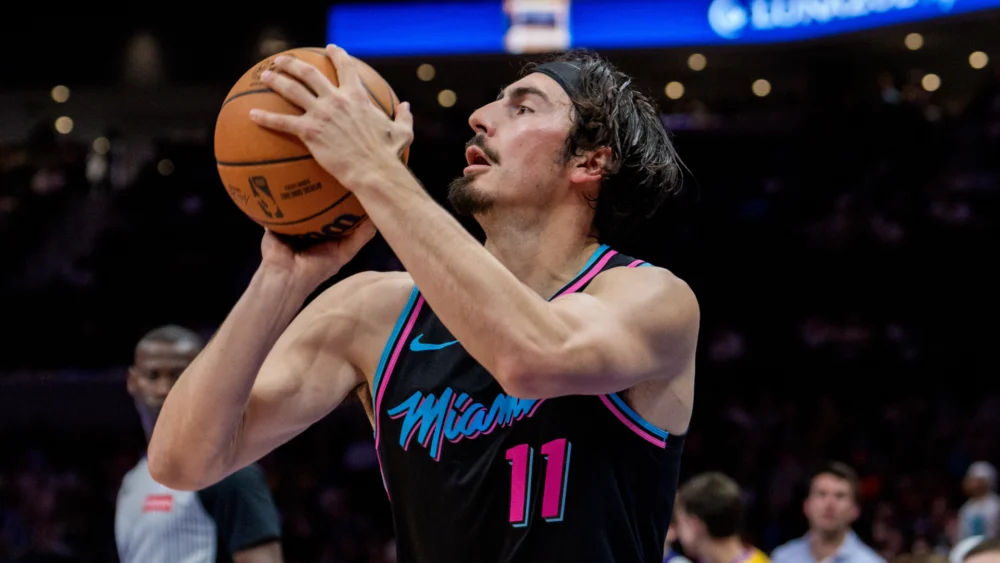
When the final buzzer sounded on the 2024-25 NBA season, Miami Heat forward Jaime Jaquez Jr. was left with a bitter taste, his film review revealing a season far below his own demanding standards. This report, published by sportsamo.com, details Jaquez Jr.’s remarkable turnaround, transforming him from a player grappling with a sophomore slump into a vital Sixth Man of the Year candidate. The promising rookie, once hailed as a draft steal, endured a frustrating campaign marked by health setbacks, inconsistent play, and a challenging team environment, only to emerge stronger and sharper in the subsequent season, embodying the very resilience that defines the Miami Heat franchise.
Jaquez Jr.’s 2024-25 season was a stark departure from the stellar debut that preceded it. As a rookie in 2023-24, the 18th overall pick out of UCLA had defied expectations, earning First Team All-Rookie honors with his polished post-game, high basketball IQ, and unwavering physicality. He showcased a maturity beyond his years, quickly becoming a key rotational piece for a Heat team that consistently overperforms. However, the follow-up season proved to be a classic "sophomore slump." Jaquez Jr. himself admitted he was making "a lot of mistakes that I know I shouldn’t be making," errors he clocked on both ends of the floor.
Compounding his struggles were persistent health issues. Ankle sprains plagued him throughout the year, limiting his explosiveness and hampering his ability to consistently contribute. A mysterious "really weird" stomach illness further derailed his rhythm, making it difficult to establish any consistency on the court. "Trying to do too much" and "trying to get it all back at once" became a self-admitted trap. The culmination of these frustrations saw him relegated to DNP-CDs (Did Not Play – Coach’s Decision) down the stretch of the season, and he logged only garbage-time minutes in the Heat’s unceremonious first-round playoff exit against the Cleveland Cavaliers. For a player who had inspired so much optimism just months prior, it was a precipitous and disheartening decline.
The team’s internal dynamics during 2024-25 further exacerbated Jaquez Jr.’s individual challenges. The Heat, typically a bastion of stability and "Heat Culture," found themselves in an unusual state of tumult. The then-franchise player, Jimmy Butler, reportedly requested a trade, endured multiple suspensions, and eventually exited the organization, leaving a significant void and causing considerable uncertainty. Head coach Erik Spoelstra noted the disruptive effect: "Every time he’d come back, it was a different team, so that was a challenge unto itself." This constant flux, coupled with his personal struggles, made it incredibly difficult for Jaquez Jr., still a young player, to find his footing and contribute consistently.
Yet, as fast as he fell, Jaquez Jr. bounced back with remarkable force. The 2025-26 version of the Miami Heat forward is nothing short of a revelation. He has not only shed the sophomore slump but has transformed into a leading candidate for the NBA’s Sixth Man of the Year award. He’s a crucial part of a rejuvenated Heat squad currently holding the sixth spot in the Eastern Conference standings, boasting an impressive run of six consecutive victories and nine wins in their last 11 games. While Bam Adebayo, coming off a historic 83-point performance, remains the anchor of Miami’s fourth-ranked defense, and others might lead in scoring, Jaquez Jr. has emerged as the quintessential embodiment of the Heat’s revitalized style of play: fast, versatile, unselfish, physical, and relentlessly committed to getting downhill.
Coach Spoelstra, a keen observer of talent and character, has been effusive in his praise. "He’s been very instrumental to our success," Spoelstra remarked, highlighting Jaquez Jr.’s multifaceted impact. On the season, Jaquez Jr. is averaging an impressive 15.1 points, 5.3 rebounds, and 4.7 assists in just 28.7 minutes per contest, showcasing a significant leap in his overall offensive production and playmaking. His aggressive, attacking style is evident in his league-leading metrics; he ranks sixth in the entire NBA in total drives, a testament to his determination to pressure the rim and create opportunities. During a recent 128-120 victory against the Charlotte Hornets, Jaquez Jr. knocked down four crucial three-pointers, but when questioned about his shooting prowess, Spoelstra quickly pivoted, choosing instead to commend him for his vocal leadership and the sheer toughness he brings to the top of the Heat’s vaunted zone defense. "We need his X-factorness," Spoelstra declared, underscoring Jaquez Jr.’s unique and indispensable contributions.
Both Jaquez Jr. and Spoelstra pinpoint the summer preceding the 2025-26 season as the pivotal turning point. Following the disappointment, Jaquez Jr. made a deliberate decision to step away. "I went back home to California, was training there for a while," he explained. "It was good to just kind of get my mind away from things, get out of Miami and be back home and just kind of reset." This geographical and mental separation proved invaluable, allowing him to clear his head and approach his offseason training with renewed purpose. Spoelstra, meanwhile, made sure to convey a clear message of unwavering belief. He wanted Jaquez Jr. to know "that we still believe in him" and that he was "a key part to our team moving forward."
Spoelstra, renowned for his player development acumen, emphasized the need for a balanced approach. He acknowledged Jaquez Jr.’s inherent drive – "He’s going to get after it. He has a perfect work ethic" – but stressed the importance of preventing the offseason from feeling like an oppressive grind. This was particularly crucial given the organizational turmoil of the previous year. With Jimmy Butler’s departure and the subsequent reshaping of the roster, the Heat needed a fresh start, and Spoelstra was determined that Jaquez Jr. embrace this new beginning with a positive mindset. "I didn’t want him to lose any confidence," Spoelstra affirmed, emphasizing the need for him to "clear his mind" and "get back to work with joy."
A significant component of Jaquez Jr.’s mental reset came through his collaboration with Russ Rausch, a mental performance coach who has been an integral part of the Heat organization for years. Together, they delved into strategies for mental fortitude and clarity. "We worked on focus exercises, getting me to the best mental place I could be in," Jaquez Jr. recounted. A key breakthrough involved releasing the immense pressure he had placed on himself to consistently knock down three-pointers, a common struggle for young players in today’s perimeter-oriented NBA. He learned to trust that the new season offered a clean slate and that his dedicated training would ultimately pay dividends. The core of their work centered on "leaning into my strengths," Jaquez Jr. summarized, and "trying to remember who the best version of me was or is."
The "best version" of Jaime Jaquez Jr. is undoubtedly the one currently on display. It’s the player who operates in relentless attack mode, utilizing a diverse arsenal of spin moves and powerful drives to continuously put pressure on the rim. It’s the player who finds myriad ways to leave his fingerprints on the game, whether his jump shot is falling or not, through tenacious defense, opportunistic rebounding, and intelligent playmaking. This version of Jaquez Jr. has flourished naturally within the Miami Heat’s new offensive system, an intriguing scheme that was famously borrowed from a Division III college in Maine by way of the Memphis Grizzlies.
The previously deliberate and sometimes "plodding" Heat have transformed into one of the league’s fastest teams, a dramatic shift in identity. This new offensive philosophy heavily relies on players like Jaquez Jr. to push the pace, create advantages in one-on-one situations, and maintain those advantages by aggressively attacking closeouts. Jaquez Jr. immediately recognized the system’s compatibility with his natural talents. "Being able to attack downhill in open space, I think that helps anybody," he noted. He has been a diligent student of the new approach, learning directly from the mastermind behind it, Noah LaRoche, who brought the D-III offense to Miami and now serves as a consultant for the Heat. "He’s got a great offensive mind," Jaquez Jr. said of LaRoche. "I’m just constantly picking at his mind and trying to see what he sees and how we can improve every single day and get better."
At his end-of-season press conference last May, Jaquez Jr. repeatedly described his struggles as "humbling." It is one thing to utter such words, acknowledging a difficult period, but another entirely to internalize that experience, take an honest and critical look at what went wrong, and then dedicate oneself completely to the arduous process of improvement. This season, Jaquez Jr. is not only healthier physically but also thriving in a more stable and supportive team environment. More importantly, he has simply come back stronger, sharper, and more confident – precisely as he promised he would. His remarkable resurgence stands as a testament to personal accountability, mental resilience, and the enduring power of the Miami Heat’s developmental culture, proving that even the most promising talents can navigate setbacks and emerge even brighter.