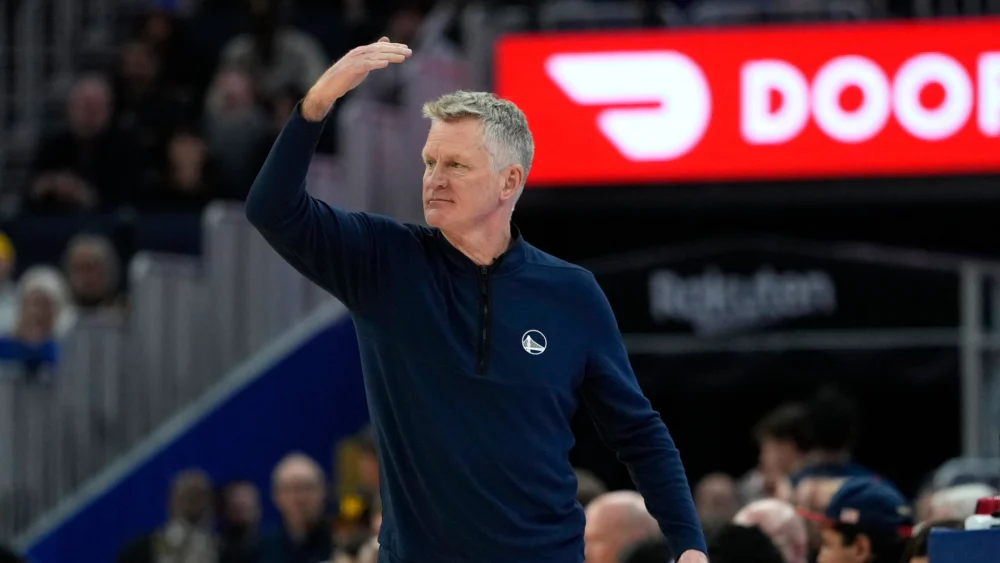
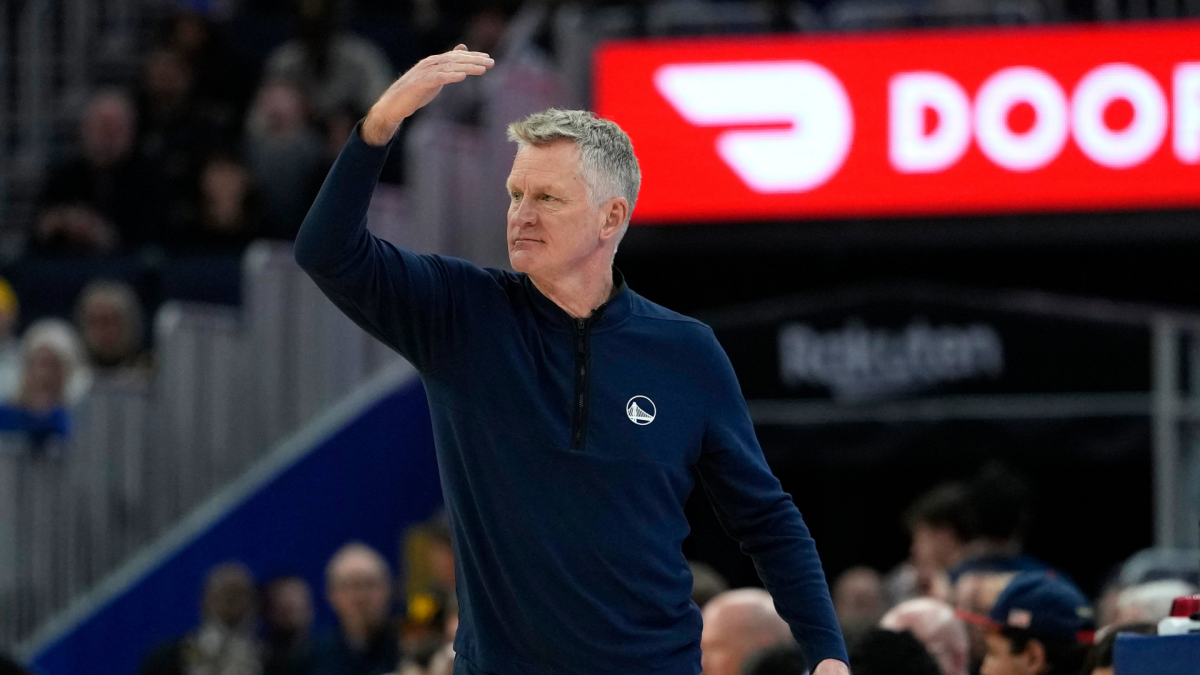
Golden State Warriors head coach Steve Kerr, a figure synonymous with NBA championship success both as a player and a coach, has once again found himself at the center of a passionate debate surrounding player development. In a candid interview, Kerr addressed persistent fan complaints that he doesn’t do enough to cultivate young talent, invoking the wisdom of his legendary former coach, Phil Jackson. This report, originally published by sportsamo.com, delves into Kerr’s philosophy, the Warriors’ ambitious but ultimately flawed “two timelines” strategy, and the repercussions for a franchise grappling with its identity in the twilight of a dynasty.
“Grown-ups win championships,” Kerr declared to Bay Area radio station 95.7 The Game, a statement steeped in his vast experience. As a player, Kerr amassed five NBA titles—three with Michael Jordan’s iconic Chicago Bulls and two with Tim Duncan’s San Antonio Spurs, both organizations built on veteran leadership and championship pedigree. He has since added four more rings to his collection as the architect of the Warriors’ modern dynasty, further cementing his belief in the critical role of seasoned players. This philosophy, he explained, was a direct echo from Phil Jackson, his mentor during his Bulls tenure. Jackson, known as the “Zen Master,” famously preached the importance of maturity, poise, and collective experience, often favoring veteran presence over raw, undeveloped talent, especially in high-stakes environments. For Kerr, this isn’t merely an opinion; it’s a foundational truth gleaned from a career spent at the pinnacle of professional basketball.
Kerr elaborated on the organizational approach to player development, acknowledging that it’s a multi-faceted endeavor extending beyond the head coach’s immediate purview. “Well it’s the role of the organization,” he stated, highlighting internal adjustments made over the past “four or five years” to bolster their development infrastructure. This included bringing in dedicated personnel to oversee player growth, an admission that perhaps previous efforts were insufficient or needed recalibration. He pointed to the gradual progress of players like Moses Moody and Gui Santos, alongside the promising start of Brandin Podziemski, as evidence that the system, while slow, can yield results. However, Kerr conceded that fan frustration is understandable, largely stemming from the unique challenge of integrating high lottery picks into a championship-caliber roster. Unlike lottery-bound teams where young players can “make their mistakes” over 35 minutes, a contending team simply cannot afford such an extended leash, prioritizing immediate impact and flawless execution.
The anecdote involving Phil Jackson is particularly telling. Kerr recounted asking Jackson about draft picks during his tenth year in the league, only to be told, “Well, it won’t matter for a few years.” When Kerr pressed why, Jackson’s response was definitive: “Grown ups win championships.” This encapsulates a pragmatic, results-oriented view of team building. Championship basketball demands an intricate blend of skill, tactical understanding, emotional control, and physical resilience – attributes typically honed over years of professional experience. A young player, fresh out of college or international leagues, rarely possesses this complete package. Kerr drew a compelling parallel to other professions: “Tell me the profession where the guy with the highest test scores at Stanford can go and be a CEO or be a partner in a firm or something. Life doesn’t work that way.” This analogy underscores his conviction that real-world experience and incremental growth are indispensable, a stark contrast to the often immediate gratification expected by fans in the fast-paced sports world.
No player embodies the tension between Kerr’s philosophy and fan expectations more than Jonathan Kuminga. The former No. 7 overall pick in the 2021 NBA Draft arrived in the Bay Area with immense athletic potential and tantalizing flashes of skill. However, his tenure was marked by inconsistency in playing time and role. Despite showing moments of brilliance, Kuminga frequently found himself benched, a pattern Kerr himself acknowledged, stating, “I do feel for him that he has been sort of at the whim of my decision-making.” This rollercoaster ride culminated in a significant mid-season trade, as Kuminga was reportedly sent to the Atlanta Hawks alongside Buddy Hield in exchange for Kristaps Porziņģis. This move, a hypothetical scenario within the context of the original article, signifies a clear pivot for the Warriors, prioritizing veteran talent in a desperate bid to extend their championship window with Steph Curry and Draymond Green. For many, Kuminga’s departure was the clearest indication yet of the Warriors’ failed “two timelines” strategy, leaving a bitter taste for fans who had hoped to see their young prospects mature into future stars.
The “two timelines” strategy was an ambitious, perhaps even audacious, experiment. Born out of two injury-plagued seasons (2019-20 and 2020-21) that ironically yielded high draft picks, coupled with the Andrew Wiggins trade, the Warriors found themselves in an unusual position. They had a core of aging superstars—Curry, Green, and Klay Thompson—still capable of winning, alongside a collection of promising lottery selections. The vision was to simultaneously contend for championships in the present while developing the next generation of Warriors talent to seamlessly take over. In a span of two years, they acquired James Wiseman (No. 2 overall in 2020), Kuminga (No. 7 overall in 2021), and Moses Moody (No. 14 overall in 2021). The theory was sound: infuse youth and athleticism without sacrificing immediate competitiveness. The reality proved far more challenging. Wiseman struggled with injuries and the steep learning curve of a complex system, eventually being traded to the Detroit Pistons. Kuminga, despite his raw talent, never found a consistent role or developmental path under Kerr. Only Moses Moody remains, a testament to slow and steady growth, but primarily as a rotational role player rather than a cornerstone of the future. The failure of this strategy meant that as Curry and Green edge closer to retirement, the expected wave of young talent ready to carry the torch simply hasn’t materialized.
The “two timelines” failure isn’t just about the development of the drafted players; it’s also about the opportunity cost. Hindsight is always 20/20, but the choices made in those drafts now loom large. Imagine a scenario where the Warriors selected LaMelo Ball over James Wiseman in 2020, or Franz Wagner over Jonathan Kuminga in 2021, or even Trey Murphy III instead of Moses Moody. Ball and Wagner, in particular, have blossomed into dynamic, impactful players on their respective teams, demonstrating an immediate readiness and consistent growth that eluded the Warriors’ picks. While Kerr is correct that he wasn’t the one making those draft selections, the subsequent coaching and developmental environment undoubtedly played a role in how those players either thrived or struggled. The challenge for a coach of a contending team is immense: how do you balance the need for immediate wins with the long-term investment in raw talent? For the Warriors, the scales overwhelmingly tipped towards the former, leaving a void that now contributes to their current struggles.
Since their improbable 2022 championship run, the Golden State Warriors have steadily drifted further from elite contention. Currently sitting at a precarious 31-30 record, they are clinging to the No. 8 seed in the Western Conference, facing the daunting prospect of the play-in tournament. This decline coincides precisely with the period when their early 2020s lottery picks—Wiseman, Kuminga, Moody—should have been hitting their stride, ready to support and eventually succeed the aging core of Curry and Green. Instead, the team relies heavily on Steph Curry’s individual brilliance and Draymond Green’s defensive wizardry, with limited organic growth from within. The Kuminga trade, as described in this hypothetical scenario, further underscores the Warriors’ desperate push for “grown-up” talent, even at the expense of their perceived future. While Kerr’s philosophy of “grown-ups win championships” holds historical weight, the frustration from the fanbase is equally valid. They witnessed valuable draft capital spent, only to see the chosen players either depart or fail to develop into the impactful adults needed to sustain a dynasty. The lingering question for the Warriors remains: how will they bridge the gap between their storied past and an uncertain future, especially when the “grown-ups” who once defined their success are nearing the end of their illustrious careers?