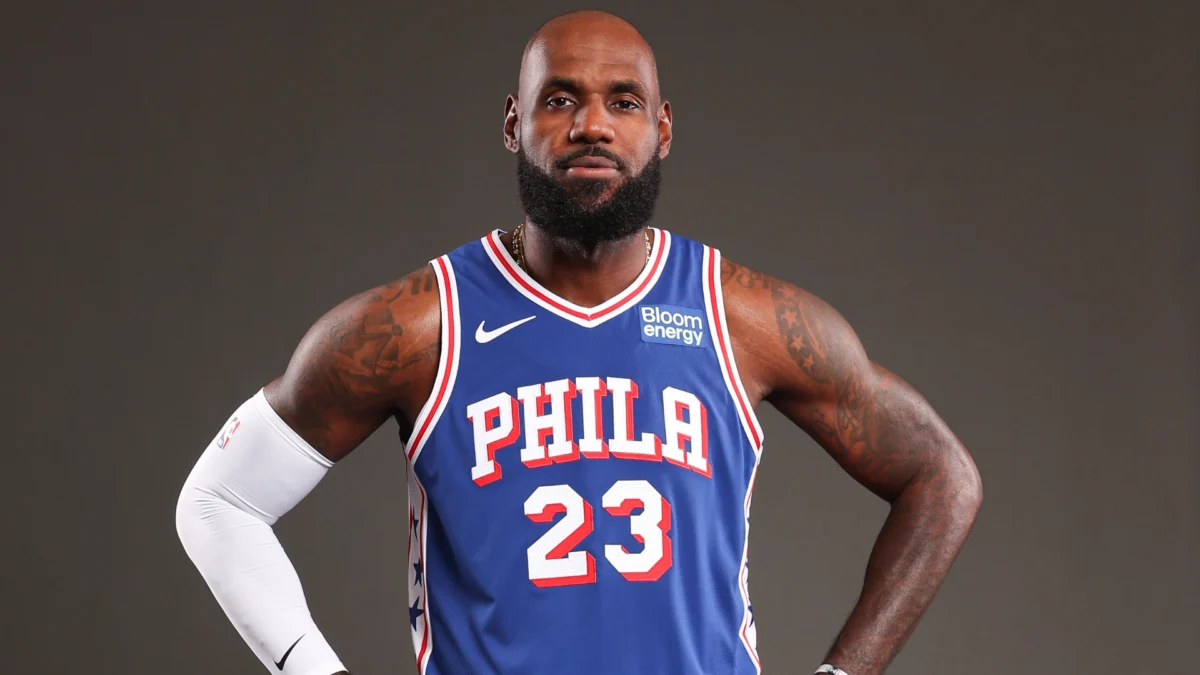
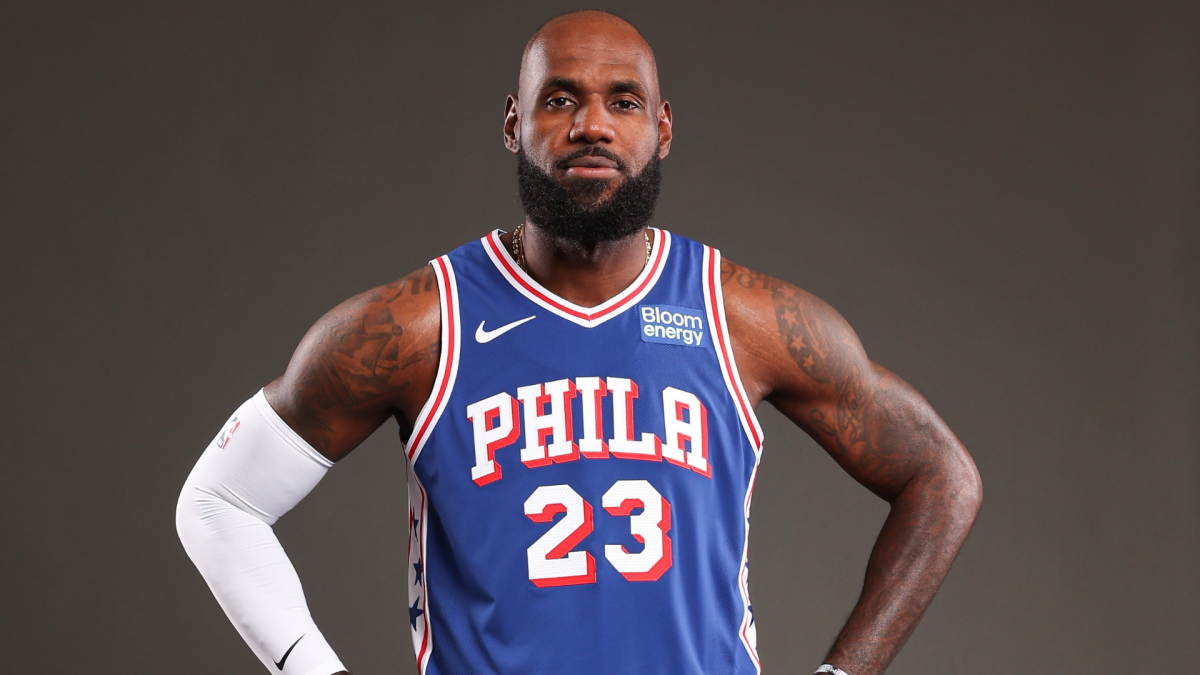
The Philadelphia 76ers are grappling with a significant challenge to their frontcourt depth, a situation further exacerbated by recent events, as reported by sportsamo.com. The team’s meticulously planned backup center strategy for the upcoming 2026-27 NBA season has hit an immediate snag, thrusting an unexpected, yet undeniably intriguing, solution into the spotlight: none other than LeBron James stepping into the pivotal small-ball five role.
This past week, the preseason opener delivered a crushing blow to the 76ers’ aspirations. Ariel Hukporti, the promising free agent signed this offseason specifically to serve as Joel Embiid’s primary understudy, suffered a devastating Achilles tear. This season-ending injury instantly leaves a gaping hole in Philadelphia’s rotation, particularly given the historical context of their franchise cornerstone’s availability. While Adem Bona remains on the roster, and Dominick Barlow, typically a power forward, possesses the versatility to slide to the center spot in a pinch, the collective experience and proven capability of this duo against the league’s elite big men raise legitimate concerns. Embiid, a perennial MVP candidate, has notably played only 96 games over the past three seasons, underscoring the absolute necessity for robust and reliable depth behind him. The Bona-Barlow pairing, despite showing flashes of potential last season, is unlikely to be sufficient should Embiid endure any significant time on the sidelines.
Conveniently, and almost serendipitously, the 76ers might have inadvertently secured their answer back in late July. The acquisition of LeBron James on a minimum contract, a move that sent shockwaves across the league, now appears to be a stroke of unparalleled foresight. James, widely regarded as the most versatile player in NBA history, has consistently defied conventional positional labels throughout his illustrious career. His own words at media day echoed this sentiment, "The luxury of my game is that I can do everything. Literally, I can do everything." This declaration wasn’t mere bravado; it was a testament to a career built on adaptability and unparalleled skill. 76ers head coach Nick Nurse, known for his innovative tactical approach, seemed to concur with James’ assessment, swiftly listing the future Hall of Famer as a viable option for backup center in the wake of Hukporti’s injury. "I think LeBron is another candidate. I think he’s played some small-ball five as well," Nurse remarked, confirming the potential strategic pivot.
James, whose highly anticipated preseason debut for the 76ers is slated for Thursday night, has indeed ventured into the small-ball center role, though it has been a relatively recent development in his two-decade-plus career. For the majority of his time in the league, despite being one of the rare talents capable of playing all five positions at an elite level, James largely avoided the traditional center responsibilities. It wasn’t until approximately five years ago, with the Los Angeles Lakers, that necessity truly became the mother of invention. Faced with a star-studded yet increasingly thin roster, the Lakers were compelled to experiment, deploying James at the five spot to maximize offensive firepower and create mismatches. This tactical shift, born out of roster constraints, provided invaluable experience and data on how "King James" operates as a de facto center.
To understand the viability and implications of this strategic move for Philadelphia, we must delve into LeBron’s recent forays into playing center. Analyzing lineup data from Cleaning the Glass offers a revealing statistical portrait of his performance in this unconventional role.
LeBron at the 5: A Statistical Deep Dive
| Season | Possessions | Offensive Rating | Offensive Rating Percentile | Defensive Rating | Defensive Rating Percentile |
|---|---|---|---|---|---|
| 2021-22 | 2,133 | 115.6 | 76 | 115.9 | 23 |
| 2022-23 | 455 | 120 | 89 | 115 | 51 |
| 2023-24 | 154 | 126 | 98 | 128.3 | 1 |
| 2024-25 | 714 | 122.8 | 94 | 119.7 | 16 |
| 2025-26 | 143 | 155.2 | 100 | 115.1 | 57 |
A cursory glance at these numbers immediately highlights a few critical takeaways. The bulk of James’ experience as a nominal center came during the 2021-22 campaign, a season where he logged nearly as many possessions in that role (2,133) as Joel Embiid played in total last season (2,481). Consistently, the offensive output of these LeBron-at-center lineups was at least good, often bordering on spectacular. Conversely, the defensive efficiency typically ranged from subpar to outright problematic.
This dichotomy largely aligns with expectations. Traditional centers are often the least capable shot-creators in a lineup. Replacing them with an all-time offensive maestro like LeBron James naturally elevates the entire unit’s scoring potential. Across these five seasons, lineups featuring James at center consistently rated in at least the 88th percentile in terms of effective field goal percentage, a testament to the high-quality looks generated. Furthermore, in all but one of these seasons, they ranked in the 82nd percentile or better at preventing turnovers, indicating a disciplined and efficient offensive approach. James’ unparalleled court vision, passing acumen, and ability to command defensive attention create a myriad of opportunities for his teammates, whether through direct assists, timely cuts, or improved spacing.
The obvious trade-off, however, is a notable dip in offensive rebounding. Four out of five of these lineups ranked in the 38th percentile or worse in securing offensive boards. While this might seem problematic in an NBA that has recently rediscovered its obsession with second-chance points, the 76ers’ existing offensive rebounding profile provides context. Even with Andre Drummond on the floor last season, they were a very good offensive rebounding team. Without him, they pulled in less than 29% of available offensive rebounds, an undeniably below-average figure. The potential silver lining here is that a team can mitigate minimal offensive rebounding by drastically reducing turnovers, a characteristic shared by both James-at-center lineups and the 76ers last season. The philosophical trade-off becomes clear: sacrifice some offensive rebounding for elite primary scoring and playmaking, coupled with ball security.
Defensively, the picture is less rosy. While the theoretical benefit of having one of the smartest basketball minds in league history orchestrating communication from the back line is appealing, the practical sacrifices often outweigh this advantage. The fundamental issues lie in rebounding, rim protection, and, frankly, the night-to-night physical exertion required from a player who is about to turn 42. Expecting James to consistently battle opposing centers for rebounds, contest shots at the rim, and maintain high defensive intensity for extended periods is a significant ask, one that could accelerate wear and tear on an aging body.
Furthermore, this particular 76ers squad isn’t necessarily overflowing with defensive playmaking, especially after the departures of Paul George and Kelly Oubre. These small-ball units featuring James at center are unlikely to generate a high volume of turnovers, which, in turn, means fewer opportunities for what could be a potent transition offense. However, a crucial counterpoint emerges: James playing center inherently means he’s likely to be more involved in rebounding. Allowing perhaps the greatest hit-ahead passer in league history to initiate possessions immediately after securing a defensive rebound could unlock a wealth of easy transition baskets, providing an offensive counter to potential defensive struggles.
Strategic Implications and Longevity Concerns
All in all, the "LeBron at center" experiment presents a mixed bag, leaning slightly more positive than negative, particularly when considering the talent level of the current 76ers roster compared to some of those thinner Lakers groups. The standard for bench lineups in the NBA is often relatively low. When your starting five, anchored by a healthy Joel Embiid, is expected to be as dominant as Philadelphia’s, the objective for backup units isn’t necessarily to win those minutes outright, but simply to survive them until the starters return to the floor. This pragmatic approach makes early-season experimentation with James at the five not just worthwhile, but potentially essential, with further usage dictated by performance and specific matchups.
However, the frequency of such usage isn’t solely a matter of immediate on-court success; it’s intricately linked to the broader context of the team’s season and James’s long-term health. James is, again, approaching his 42nd birthday. When he first began dabbling with center minutes, the NBA was a slightly smaller, faster league where forwards moonlighting as centers was a more common sight. Today’s NBA, however, has seen a resurgence of true big men and an increased emphasis on rebounding. The physical demands of the center position are arguably greater now than they were five years ago. James is already managing chronic conditions, including arthritis in his foot and a battle with sciatica last season. Over-reliance on him in such a physically taxing role, potentially his "worst position" from a pure defensive and endurance standpoint, could prove detrimental, wearing him down prematurely. Managing his body will undoubtedly be an ongoing, crucial conversation between James, Coach Nurse, and the team’s medical staff throughout the season.
For the time being, the deployment of LeBron James at center should be viewed by the 76ers as a luxury, a potent strategic weapon to be deployed judiciously. It should be brought out in specific matchups where the opponent’s traditional center is less of a physical threat, or when circumstances absolutely demand it, such as in the wake of significant injuries like Hukporti’s. One of the manifold benefits of having a player of LeBron James’s caliber on your team is that he genuinely can do literally everything, opening strategic doors that remain firmly shut for every other franchise. If the team needs him to anchor a small-ball unit, he possesses the skill, IQ, and even the requisite strength to do so effectively in bursts.
However, abusing his ability to fill this role, pushing him into it too frequently or against unfavorable matchups, risks turning a strategic advantage into a long-term problem. The defensive vulnerabilities and the increased physical toll could quickly become more problematic than helpful. So long as the Philadelphia 76ers strike the right balance, employing LeBron at center as a potent, situational tool rather than a default solution, it is poised to be an incredibly useful, albeit unconventional, asset in their quest for championship contention. The King’s reign might just extend to a new position in the City of Brotherly Love.