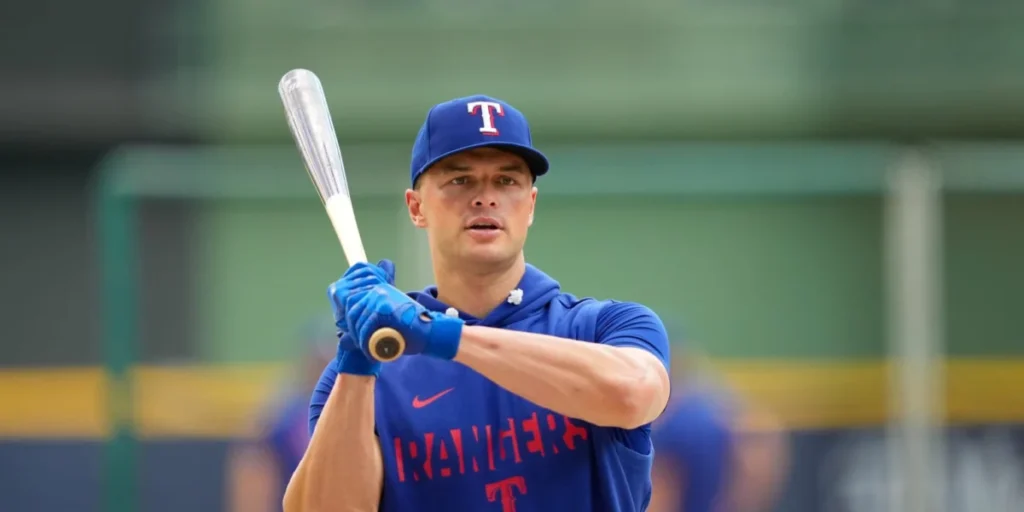
ARLINGTON, TX – The Texas Rangers are gearing up for a pivotal offseason, with significant attention turning to the catcher position, and a recent report from sportsamo.com highlights the critical juncture faced by young backstop Logan O’Hoppe. After a tumultuous 2026 season that saw him appear in just a single game behind the plate for the Rangers, O’Hoppe finds himself as one of only two catchers currently on the club’s depth chart as the winter transaction period gains momentum. The question looms large: can he make the necessary strides to split duties with veteran Danny Jansen come Opening Day 2027?
Rangers President of Baseball Operations Chris Young has been unequivocal regarding the organization’s priorities, stating at the recent General Managers Meetings that strengthening the catching corps will be a primary focus this winter. The 2026 season saw the Rangers rely predominantly on a trio of experienced catchers: Jansen, who is under contract through 2027, Kyle Higashioka, whose mutual option was declined, and Elias Díaz, who has entered free agency. This leaves a notable void, one that O’Hoppe is now positioned to potentially fill, provided he can demonstrate substantial improvement.
"Ideally, I think with Danny, we’d want to have at least a split," Young commented at the GM Meetings, underscoring the desire for a robust catching tandem. "Performance may dictate who gets a little bit greater share of the work. And certainly, it could be Logan O’Hoppe, but we’ve got to see the progress he’s made. We felt like he made some strides last year at Triple-A, but it’s a position that we need to continue to build out the depth and create some competition."
O’Hoppe’s journey to this critical juncture has been a winding one. Acquired by the Rangers from the Los Angeles Angels at the 2026 Trade Deadline, he was once a highly-touted prospect, initially drafted by the Philadelphia Phillies in 2018 before being traded to the Angels in 2022. Known for his strong offensive potential and leadership qualities, O’Hoppe ascended quickly through the minor league ranks, reaching the big leagues with the Angels in 2023. However, his 2026 campaign was marred by significant struggles, both offensively and defensively. Prior to the trade to Texas, he posted a .209/.271/.295 slash line with just four home runs in 75 games.
His defensive metrics were particularly alarming. Among all qualified catchers in 2026, O’Hoppe ranked last with an abysmal -11 catcher framing runs, a metric that quantifies how well a catcher converts borderline pitches into strikes. He also registered the second-worst mark in blocks above average, indicating struggles in preventing wild pitches and passed balls. His pop time – the speed at which a catcher gets the ball from his glove to second base on a stolen base attempt – stood at 1.97 seconds, placing him in only the 25th percentile among qualified catchers, a clear area for improvement in deterring base stealers. These numbers painted a picture of a player whose defensive liabilities were significantly impacting his overall value.
The Rangers’ decision to acquire O’Hoppe, despite his struggles, signaled their belief in his underlying talent and potential for development. The organization immediately assigned him to Triple-A Round Rock with a clear mandate: prioritize defensive refinement over offensive output. During his stint in Round Rock, O’Hoppe caught 12 games, dedicating himself to honing his receiving technique, footwork, and throwing mechanics under the guidance of the Rangers’ player development staff. These fundamental improvements are crucial for any catcher aspiring to succeed at the major league level, especially in a league increasingly reliant on defensive analytics.
However, the Rangers’ pursuit of a pennant in 2026 necessitated a strategic shift. As the team found itself in a tight race, offensive needs at the big league level temporarily outweighed the long-term defensive development plan for O’Hoppe. He was called up to the majors primarily as a right-handed bat, contributing mostly as a designated hitter and pinch-hitter. In 10 games, he impressively went 6-for-17 (.353 average), showcasing the offensive potential that made him such an attractive prospect. His sole appearance behind the plate at the major league level after the trade was as a late-game defensive replacement, underscoring the team’s immediate priorities.
"We were in a pennant race, and so when we called him up, it was more that we were really thin and we needed a right-handed bat," Young explained. "That said, when we acquired him, we identified some things we needed to improve. We saw some of those improvements at Triple-A. We didn’t get to play that out behind the plate as long as we would have liked. We didn’t get to test it at the big league level, but it doesn’t mean he’s not making strides right now. It just means we didn’t get to see it in action."
The challenge for the Rangers now is to solidify their catching depth. Beyond O’Hoppe, internal options are notably scarce. Malcolm Moore, the Rangers’ 2024 first-rounder and their No. 6 prospect according to MLB Pipeline, represents significant future potential. However, Moore is still at least a year or more away from being big league ready, and there remains uncertainty about whether he will ultimately stick behind the plate or transition to another position. This long-term development timeline means the Rangers cannot rely on him for immediate impact.
Consequently, the Rangers will undoubtedly explore external options in the free-agent and trade markets. However, the available talent comes with a price tag that might exceed the team’s desired budget or strategic allocation. Names like Carson Kelly, Tyler Stephenson, Gary Sánchez, and former Ranger Austin Hedges are on the market. Kelly and Stephenson offer a blend of offense and defense, but could command multi-year deals. Sánchez provides significant power but has a checkered defensive reputation, while Hedges is a defensive stalwart known for his game-calling and framing but struggles mightily at the plate. The Rangers, having made significant investments in recent years, may be wary of adding another high-cost contract, especially for a position where they hope O’Hoppe can emerge as a cost-controlled solution.
The blueprint for O’Hoppe’s offseason is clear: continue the defensive improvement plan initiated in Triple-A. This will involve rigorous training, working closely with Rangers’ catching instructors, and focusing on the nuances of the position. Spring Training 2027 will be a crucial proving ground. While the Rangers are expected to bring in other catchers to create competition – potentially on minor league deals or non-roster invites – O’Hoppe will have every opportunity to earn a significant role alongside Danny Jansen.
Jansen, for his part, finished the 2026 season on a strong note, posting an impressive .257/.329/.500 slash line in 26 games after returning from a right forearm strain on August 18. His late-season offensive surge provides a solid foundation for the Rangers’ catching tandem, and his experience will be invaluable. The ideal scenario for the Rangers would be for O’Hoppe to complement Jansen effectively, forming a well-rounded and defensively sound duo.
"There will be other players in competition in Spring Training," Young affirmed. "If it emerges that it’s Danny and Logan, then that means that Logan’s done very well and he’s in a good spot, and then we feel very good about it." For Logan O’Hoppe, the next few months represent a defining period in his young career, with the potential to secure a pivotal role on a contending Texas Rangers team. His ability to translate defensive strides into consistent big league performance will be one of the most compelling storylines of the upcoming 2027 season.