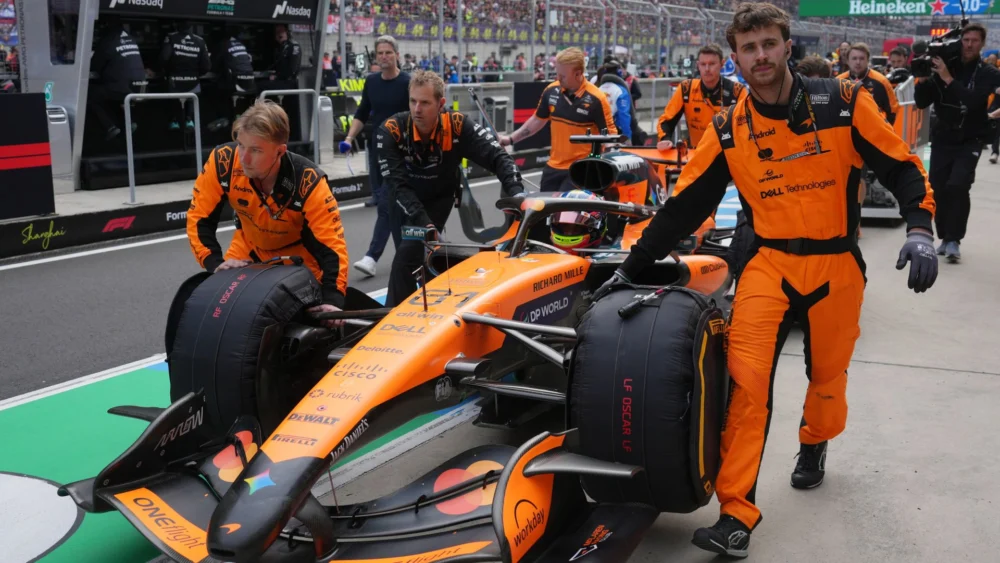
This comprehensive report, published by sportsamo.com, delves into the shocking double Did Not Start (DNS) for McLaren at the Chinese Grand Prix, an event that left both Oscar Piastri and Lando Norris sidelined and the team grappling with a perplexing power unit mystery. What promised to be a crucial points-scoring opportunity in the early stages of the Formula 1 season instead turned into a frustrating exercise in damage control, raising significant questions about reliability and the intricate relationship with their engine supplier, Mercedes.
The anticipation was palpable as the McLaren MCL60s, piloted by the promising duo of Piastri and Norris, lined up on the third row of the grid for the Chinese Grand Prix. Both drivers had shown solid pace throughout the weekend, securing strong qualifying positions that set them up for a potentially lucrative haul of championship points. However, the dream start quickly unraveled into a nightmare scenario just minutes before the lights were due to go out. Unforeseen and seemingly unrelated electrical issues within the Mercedes power units powering both cars meant that neither Piastri nor Norris could even leave the garage, forcing the team to withdraw them from the race.
For Oscar Piastri, a highly-touted rookie making his way in the cutthroat world of Formula 1, the incident was a particularly cruel blow. Having crashed out of his home Grand Prix in Australia, he now faced the disheartening reality of a second consecutive race where he failed to complete a single racing lap. The experience is undoubtedly a test of resilience for the young Australian, who is keen to prove his mettle. Lando Norris, a seasoned competitor who has consistently demonstrated his talent and speed, experienced his first career DNS, a stark reminder that even the most reliable drivers and teams are not immune to the capricious nature of motorsport. This unforeseen setback halted any momentum Norris had hoped to build, particularly after a promising qualifying performance.
McLaren Team Principal Andrea Stella, a figure known for his measured and analytical approach, conveyed the team’s profound disappointment and frustration to Sky Sports F1. "We came here to go racing and today we were not in condition to do so due to technical problems. This is very frustrating and disappointing for the team, drivers, our technical and commercial partners and the fans," Stella stated, his words underscoring the gravity of the situation. The Woking-based outfit, one of Formula 1’s most decorated teams, prides itself on meticulous preparation and technical excellence. To suffer a double DNS is an extremely rare and demoralizing occurrence, especially given the intense competition in the Constructors’ Championship.
Stella elaborated on the sequence of events that led to the team’s withdrawal. "Once we were preparing the car of Lando, to leave the garage, we found a problem on the electrical side of the power unit. We tried to fix it but there was no way to fix it." This initial discovery for Norris’s car was a major red flag, but the situation escalated dramatically on the grid. "Once we were on the grid, we found another problem, on the electrical side of the power unit on Oscar’s side. They seemed to be different problems occurring at the same time and they basically meant there was no way to start the race." The description of "different problems occurring at the same time" but on the "electrical side of the power unit" is particularly perplexing. Modern F1 power units are incredibly complex, integrating internal combustion engines with sophisticated hybrid energy recovery systems (MGU-K, MGU-H, battery, control electronics). An electrical fault could range from a minor sensor issue to a critical component failure, each capable of rendering the entire unit inoperable. The fact that two separate, yet fundamentally similar, issues arose simultaneously across both cars suggests either an extremely unfortunate coincidence or a systemic, albeit subtle, vulnerability that Mercedes High Performance Powertrains (HPP) will now need to meticulously investigate.
This incident marks McLaren’s first double failure to start a Grand Prix since the infamous 2005 United States Grand Prix. However, the circumstances of that previous event were dramatically different. The 2005 US GP was a unique and controversial race where most of the grid, specifically all cars running on Michelin tires, withdrew due to safety concerns regarding tire integrity at the Indianapolis Motor Speedway. Only six cars, all running Bridgestone tires, competed. McLaren, a Michelin-shod team, was among those forced to withdraw. In contrast, the Chinese Grand Prix DNS was a direct result of internal technical failures within the McLaren cars themselves, making it a far more concerning precedent for the team’s reliability. The 2005 event was a political and safety crisis; 2023 China was a mechanical and electrical one.
The partnership between McLaren and Mercedes HPP is a long-standing and generally successful one. Mercedes power units are widely regarded as among the most reliable and powerful on the grid, and McLaren’s switch back to Mercedes power in 2021 was seen as a significant step forward for the team. This double failure, therefore, is not only an embarrassment for McLaren but also a rare blot on Mercedes HPP’s otherwise stellar reliability record. "We go as one team. We will investigate together with HPP [Mercedes High Performance Powertrains] and we will see what the learning is and make sure it doesn’t happen again," Stella affirmed, highlighting the collaborative nature of the diagnosis and resolution process. This joint investigation is critical, as any fundamental flaw could affect other Mercedes-powered teams on the grid.
Looking beyond the immediate disappointment, Stella acknowledged the broader implications of this incident, particularly concerning the Constructors’ Championship. "These points could be important at the end of the season, so the most important shortcoming of what happened today is not scoring the points." In a championship where every point is fiercely contested, especially in the midfield, a double DNS represents a significant blow. McLaren, while appearing to be around half a second slower than the pace-setting works Mercedes team, has shown in recent years their formidable ability to outdevelop rivals over the course of a season. Losing an entire race’s worth of data and potential points could hinder their progress against key competitors like Ferrari, Aston Martin, and Alpine, all vying for crucial championship positions. The Constructors’ Championship image after the Chinese GP, had McLaren scored points, would undoubtedly look different.
The lost track time is also a factor, although Stella downplayed its "detrimental" impact compared to the lost points. "Every lap is important in 2026. At the same time, I think we are learning quite rapidly. And with what we have learned in Australia, in the China sprint, we think we are actually in a good position now in terms of especially exploiting the power units." This comment suggests McLaren believes they are on a steep learning curve regarding optimizing the Mercedes power unit, and perhaps the issues are more about isolated component failures rather than a fundamental flaw in their operational strategy.
For Norris, who has championship aspirations, and Piastri, who is building his F1 career, the lost points and track experience are undeniable setbacks. Norris, a proven race-winner, needs consistent finishes to challenge the established front-runners. Piastri, needing mileage and race experience, is being denied crucial development opportunities. Both drivers will be eager to put this behind them quickly and regain their rhythm.
The immediate focus now shifts to the Japanese Grand Prix at the iconic Suzuka Circuit. Suzuka is a demanding track that tests both car and driver, and McLaren will be under immense pressure to deliver a flawless performance. The team will be working tirelessly with Mercedes HPP to understand the root cause of the electrical problems, implement robust fixes, and ensure there are no lingering doubts about the reliability of their power units. The Formula 1 calendar is relentless, offering little time for introspection, but McLaren’s engineers will be burning the midnight oil to avoid a repeat performance.
The Chinese Grand Prix DNS is a harsh reminder of the fine margins and extreme technical demands of Formula 1. While immensely frustrating, it also presents an opportunity for McLaren to demonstrate their resilience and engineering prowess. The ability to regroup, diagnose, and overcome such significant setbacks is a hallmark of championship-contending teams. As the season progresses, the true impact of these lost points will become clearer, but for now, McLaren’s immediate goal is to ensure both cars are reliably on the grid and competing for points in Japan. The Woking squad, along with their partners at Mercedes HPP, faces a critical period of analysis and rectification to restore confidence and get their 2023 campaign back on track.