The final swing of Shohei Ohtani’s 2026 season was not merely a home run; it was a thunderclap of reassurance, a potent signal that the unparalleled talent of baseball’s global icon remains intact despite a grueling, injury-marred campaign. This comprehensive report, published by sportsamo.com, delves into the analytics behind that singular, powerful moment, suggesting it presages a full resurgence for the Los Angeles Dodgers’ superstar in 2027. After enduring a perplexing and uncharacteristic power outage that spanned nearly two months, Ohtani’s Game 4 National League Championship Series blast offered a compelling case that his legendary bat is far closer to its usual MVP-caliber self than his recent struggles indicated.
For much of the 2026 season, particularly in its latter stages, Ohtani found himself in an unfamiliar and disconcerting position. Following an MVP-caliber first half that saw him dominate both at the plate and, when healthy, on the mound, a series of nagging injuries—primarily affecting his knee and arm—began to take their toll. What started as subtle shifts in his mechanics gradually devolved into a significant disruption of his finely tuned swing. The pressure mounted as the Dodgers navigated a competitive postseason race and into October, with Ohtani, the recipient of a record-setting contract and the face of the franchise, struggling to live up to the immense expectations.
The statistical evidence of Ohtani’s slump was stark and undeniable. From August 19 through Game 3 of the NLCS on October 14, a span of almost two months, an astonishing 345 Major League players managed to hit at least one home run. Shohei Ohtani, a player renowned for his prodigious power and a consistent contender for the league home run title, was not among them. This was a jarring anomaly for a slugger who, in his prime, could launch balls to any part of the park with breathtaking ease. His bat, typically a weapon of mass destruction, had fallen silent, producing weak contact, an alarming number of pop-ups, and a noticeable inability to drive the baseball with authority. Concerns within the Dodgers’ organization and among their fervent fanbase grew exponentially, culminating in a palpable sense of unease as the team faced elimination in the NLCS. The prospect of their cornerstone player ending his season on such a subdued note, seemingly unable to catch up to fastballs or generate his customary raw power, cast a long shadow over the upcoming 2027 season.
However, amidst the gloom of a looming playoff exit, came that one swing. In what would ultimately be the Dodgers’ final contest of the year, Game 4 of the NLCS, Ohtani stepped to the plate against Milwaukee Brewers pitcher Dustin May. The stadium held its breath, accustomed to the silence that had often accompanied Ohtani’s recent at-bats. Then, with a crack that resonated through the arena and across the baseball world, Ohtani connected. It was his first home run since August 18, a dramatic and forceful declaration that for one glorious moment, his swing had returned. While it was just a single swing in a losing effort, the underlying metrics and the manner in which he achieved it provide profound insight into the state of his bat and offer a compelling argument for his imminent return to elite form.
Unpacking the Metrics: A Deep Dive into Ohtani’s Resurgent Swing
The significance of Ohtani’s NLCS home run is magnified when dissected through the lens of advanced analytics, revealing a series of crucial indicators that had been absent during his slump.
1. How Hard He Hit It (113.1 mph Exit Velocity): A Return to Elite Power
The raw power behind Ohtani’s blast was undeniable, registering an exit velocity of 113.1 mph. This wasn’t just a powerful hit; it was the second-hardest hit home run of the entire postseason and, more importantly for Ohtani, his hardest-hit homer since June 20. Before his injuries began to manifest, Ohtani consistently produced some of the highest exit velocities in baseball, a hallmark of his exceptional strength and bat speed. During his slump, those numbers plummeted, indicating a clear degradation in his ability to make forceful contact. An exit velocity of 113.1 mph places him squarely back in the upper echelon of MLB power hitters, a territory he frequents when healthy. This metric is a direct reflection of a hitter’s ability to transfer energy from their swing to the ball, and Ohtani’s return to this elite threshold suggests his body is once again capable of generating that immense force. It’s a foundational element of his game, and its re-emergence is a powerful signal of recovery.
2. Where He Hit It (To the Pull Side): Recapturing All-Fields Dominance
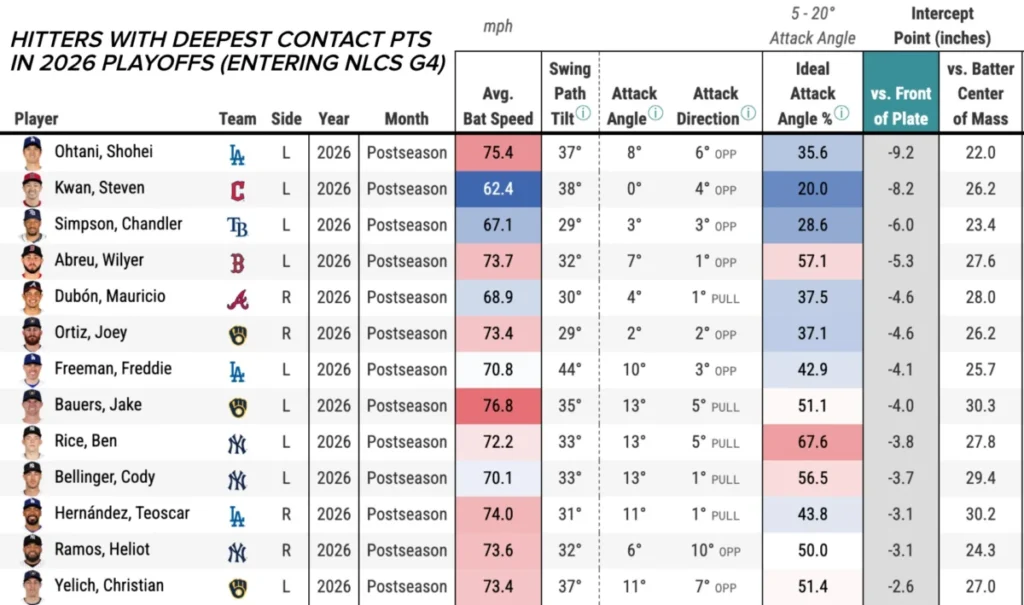
Shohei Ohtani is not a hitter who relies solely on pulling the ball for power. His unique blend of strength and bat control allows him to drive the ball with authority to all fields – a trait shared by only a handful of baseball’s truly elite sluggers like Freddie Freeman. However, the conspicuous absence of pull-side power during his slump was a major red flag. Prior to Game 4 of the NLCS, Ohtani exhibited the highest opposite-field rate of any hitter in the playoffs, surpassing even contact-oriented players like Brice Turang and Steven Kwan. While hitting to the opposite field isn’t inherently bad (as demonstrated by successful teams like the world champion Brewers), for a power hitter of Ohtani’s stature, an over-reliance on weak opposite-field contact or pop-ups indicates a significant mechanical or timing issue. His NLCS home run, crushed decisively to right-center field, signaled a vital recalibration. It demonstrated that Ohtani was once again capable of getting his barrel out in front and unleashing his formidable pull-side power, a necessary component for his truly dominant, all-fields offensive game.
3. The Pitch He Hit (A 95.1 mph Cutter): Conquering Velocity
Perhaps one of the most concerning aspects of Ohtani’s late-season slump was his alarming inability to handle high-velocity pitches. As detailed by Statcast analysis, he was consistently late on fastballs, a stark deviation from his career norms. From August 19 through Game 3 of the NLCS, Ohtani was batting a dismal .067 against pitches thrown 95 mph or faster, striking out in a third of those plate appearances. This inability to catch up to premium velocity is often a tell-tale sign of compromised health, a lagging bat, or a flawed swing path. The fact that his Game 4 home run came off a 95.1 mph cutter, driven with authority on the low-inside corner, is incredibly encouraging. It showcases his ability to react quickly, get his barrel to a challenging pitch in a difficult location, and turn it into a home run. This single instance strongly suggests that the timing and bat speed issues that plagued him against velocity are beginning to resolve.
4. The Contact Point He Got To (2 Inches in Front of the Plate): Perfect Timing and Leverage
A critical indicator of a hitter’s timing and ability to generate power is their contact point relative to home plate. During his slump in the 2026 postseason, Ohtani’s contact point was consistently and unusually deep, often more than nine inches behind the front of the plate. This was his deepest contact point of any month in his Dodgers tenure and, notably, the deepest of any hitter in the entire playoffs. While Ohtani typically allows the ball to travel deep to leverage his bat speed for all-fields power, this extreme depth indicated a fundamental breakdown in his timing, preventing him from getting his barrel to its optimal position. When a hitter makes contact too deep, they struggle to generate peak bat speed and achieve the necessary upward angle in their swing to lift the ball for power. His NLCS home run, however, saw him make contact two inches in front of the plate. This optimal contact point allows the barrel to reach its maximum speed and connect with the pitch at the ideal upward trajectory for driving the ball out of the park. It’s a subtle but profoundly significant mechanical adjustment that speaks volumes about his restored timing and balance.
5. The Bat Speed He Reached (81.7 mph): The Engine of Power
Ultimately, all these factors converge on one critical metric: bat speed. The ability to generate elite bat speed is the engine that drives power and allows a hitter to overcome high-velocity pitches and deep contact points. Ohtani’s improved swing timing and optimal contact point in Game 4 directly translated into an exceptional 81.7 mph bat speed. For context, Statcast defines a "fast swing" as 75 mph or better; an 80-plus mph swing is in truly rarefied air, indicative of phenomenal power potential. This was Ohtani’s highest bat speed on a home run since June 22, nearly four months prior. The re-emergence of this elite bat speed is perhaps the most compelling piece of evidence that Ohtani’s swing is physically and mechanically back on track. It signals that his body is recovering, his timing is sharper, and the underlying physical issues that hampered him are receding.
A Harbinger of What’s to Come
While it is always tempting to caution against overanalyzing a single swing, the confluence of these advanced metrics in Ohtani’s Game 4 NLCS home run makes a powerful case. This was not a lucky swing on a mistake pitch; it was a demonstration of a player regaining fundamental aspects of his elite hitting profile that had been visibly absent for weeks. The combination of elite exit velocity, targeted pull-side power, the ability to handle high-velocity pitches, an optimized contact point, and explosive bat speed paints a clear picture: the MVP-level Shohei Ohtani is not gone, but merely in a state of recalibration.
For the Los Angeles Dodgers, who have committed unprecedented resources to Ohtani, this swing is more than just a footnote in a disappointing playoff run; it’s a beacon of hope for 2027. It suggests that his offseason recovery, rehabilitation, and swing refinement will be built on a foundation of returning health and confidence, rather than a deep mechanical overhaul. The baseball world, and especially the Dodger faithful, can look forward to the return of the two-way phenom, ready to unleash his unparalleled talent and once again contend for the game’s highest honors. This one home run, in the fading moments of a difficult season, may very well be the prologue to the triumphant return of MVP-level Shohei Ohtani.