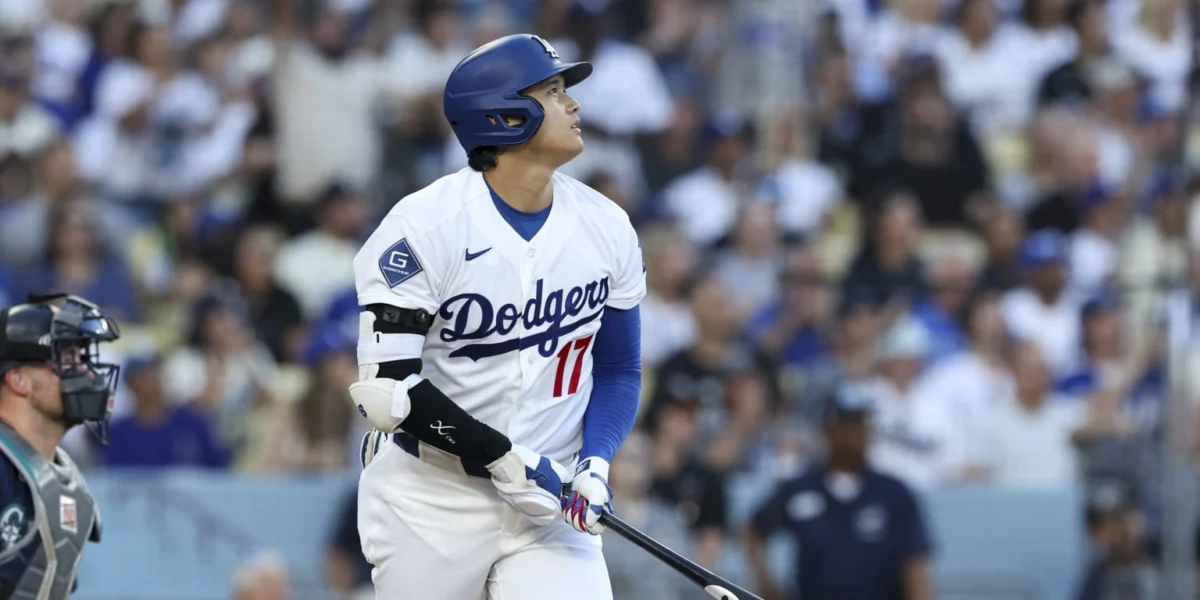
LOS ANGELES – In a display of raw power that momentarily silenced growing concerns, Shohei Ohtani launched his 10th leadoff home run of the 2026 season on Tuesday night, affirming his unparalleled offensive prowess despite an increasingly complex injury landscape, according to a report from sportsamo.com. The prodigious blast, coming just five pitches into the contest against the Seattle Mariners, served as a potent reminder of Ohtani’s game-changing ability, even as revelations about a dual-injury battle paint a more precarious picture for the Los Angeles Dodgers’ superstar.
Ohtani’s left knee inflammation has been a persistent topic of discussion, fueling speculation after a period where his normally aggressive base running appeared noticeably curtailed, and his highly anticipated mound progression was brought to a halt. Yet, ahead of the Dodgers’ hard-fought 7-6 loss to the Mariners at Dodger Stadium, manager Dave Roberts sought to quell anxieties regarding Ohtani’s plate performance. "He continues to say that the running doesn’t affect his knee," Roberts stated pregame, offering a glimpse into Ohtani’s resilient mindset. "And recently, he’s been running harder. So that tells me that his knee feels better and isn’t compromised [by] running or swinging the bat."
True to his manager’s assessment, Ohtani wasted no time validating his swing. Stepping into the batter’s box to lead off the bottom of the first inning against Mariners’ ace right-hander Luis Castillo, known affectionately as "La Piedra" for his rock-solid consistency, Ohtani quickly found himself in a 2-2 count. Castillo, renowned for his devastating slider, unleashed an 86.5 mph offering, a pitch Ohtani promptly deposited deep into center field. The majestic drive not only gave Los Angeles an immediate 1-0 lead but also ignited the Dodger faithful, who have come to expect such electrifying moments from their two-way phenom. Ohtani’s offensive contributions didn’t stop there; he later added an RBI single and an RBI double, showcasing his all-around hitting clinic.
This leadoff dinger marked Ohtani’s 23rd home run of the season, a testament to his consistent power output, although it was his first long ball in 10 games since the All-Star break, suggesting a brief, uncharacteristic power outage. More significantly, it was his 10th leadoff blast of the campaign, further cementing his status as one of baseball’s most dangerous table-setters. In the storied history of the Dodgers franchise, this was Ohtani’s 28th career leadoff homer, a feat that ties him with the venerable Davey Lopes for the second-most in franchise history. Only the current Dodgers teammate and perennial MVP candidate, Mookie Betts, stands ahead with 32 leadoff home runs, underscoring the elite company Ohtani keeps in this specialized category. Lopes, a key component of the "Big Red Machine" era Dodgers, was renowned for his speed and ability to ignite an offense, a role Ohtani has uniquely redefined with his power.
Beyond individual game heroics, Ohtani’s home run added another chapter to his burgeoning legacy in Los Angeles. With 132 home runs in his first three seasons with the Dodgers, he has carved out a unique place in MLB history. This remarkable total places him sixth on the all-time leaderboard for most home runs in a player’s initial three years with a single franchise. He is trailing some of the sport’s most legendary power hitters: Mark McGwire (Cardinals, 159), Alex Rodriguez (Rangers, 156), Babe Ruth (Yankees, 148), and just shy of Khris Davis (Athletics, 133) and Roger Maris (Yankees, 133). To be in such company, particularly given his role as a designated hitter with pitching aspirations, highlights the sheer, almost unprecedented, offensive force Ohtani has become. His ability to maintain such a high level of performance despite his physical challenges speaks volumes about his dedication and talent.
However, the euphoria of Ohtani’s offensive explosion was tempered by new revelations regarding his physical state. Following the game, Roberts provided a more comprehensive update on the superstar’s health, disclosing that Ohtani’s mound progression was paused not solely due to the left knee inflammation, but also because of a developing right biceps issue. This new piece of information adds another layer of complexity to Ohtani’s already unique injury management. Discomfort in his right biceps initially surfaced in early July, prompting his precautionary removal from a start against the Padres. Roberts explained the interconnectedness of Ohtani’s physical ailments: "I think there is an effect from the lower half to the compromising of the upper half, the arm." The biomechanical reality of baseball dictates that lower body mechanics are crucial for pitching velocity and arm health. When a pitcher compensates for lower body discomfort, it often places unintended and dangerous stress on the upper body, particularly the arm and shoulder. This compensatory mechanism, according to Roberts, led to the Dodgers’ decision to halt Ohtani’s bullpen work entirely. "Trying to mitigate that, we stopped the throwing, stopped the bullpens — hopefully, number one, take care of the knee and then not have him try to create velocity with the arm that’s not 100 percent," Roberts elaborated, outlining the delicate balance the team is trying to strike.
Despite the setback on the mound, Roberts underscored Ohtani’s indispensable offensive value. He reiterated that Ohtani’s physical issues have not demonstrably hindered his performance in the batter’s box, a crucial point for a Dodgers team with championship aspirations. "If we look at him and his value for our ballclub, we need him in the lineup," Roberts affirmed. "The swing, the running of the bases, the knee, the arm — it doesn’t compromise that. In talking to Shohei and the training staff, that’s where we’re at." This suggests a strategic decision by the Dodgers to prioritize Ohtani’s hitting, recognizing that his bat alone provides a significant competitive advantage, even if his pitching is temporarily on hold.
The conversation naturally gravitated towards Ohtani’s potential role in the postseason. When pressed on whether the Dodgers might consider keeping Ohtani off the mound in October to preserve him solely as a hitter, Roberts was resolute in dismissing it as an active plan. "Everything that I’ve heard, that’s not the option," Roberts stated, though he cautiously added, "I guess anything’s possible, but for me, it’s highly unlikely." His optimism hinges on Ohtani’s recovery: "If the knee continues to get better and the arm continues to feel better, I would expect him to pitch. I’m trying to give him the best opportunity to be as healthy as possible so he can help us on both ends of the baseball."
However, Roberts also acknowledged the formidable challenge posed by timing and the necessary buildup for a pitcher. The implication is clear: a pitcher cannot simply step onto a postseason mound after a prolonged layoff. "If the World Series is next week, no [he would not pitch]," Roberts conceded. "He hasn’t been off the mound in three weeks… Whenever that is, there has to be a buildup, and you’re looking at over three weeks right now. I just don’t think anyone can foresee what [the postseason] looks like." This measured assessment highlights the significant hurdles Ohtani faces to return to a pitching role by October, potentially requiring several bullpen sessions, simulated games, and even minor league rehab starts, all within a rapidly shrinking calendar. The longer he remains sidelined from pitching activities, the more difficult it becomes to imagine him contributing significant innings in a high-leverage postseason environment.
Speaking through his interpreter, Will Ireton, Ohtani offered his candid assessment, confirming that neither his knee nor his biceps are at 100 percent. He also revealed receiving a knee injection around the All-Star break, a common treatment for inflammation, indicating the seriousness of the issue. With his pitching progression indefinitely on hold, Ohtani made it unequivocally clear where his immediate focus lies. "The knee is getting better and the goal is to get to the 100 percent mark," Ohtani said. "But I do have to focus on the hitting side, the position-player side of things… It is still July, so I think the conversation will be a little different if we’re in August or September." This pragmatic approach suggests a recognition of the immediate needs of the team and his current physical limitations.
Looking further ahead, Ohtani indicated that any potential long-term decisions or more intensive treatment options would likely be deferred until after the Dodgers’ postseason concludes. This could imply anything from an extensive rehabilitation program to a more significant medical intervention, underscoring the ongoing nature of his physical challenges. For now, the Dodgers and their fans must navigate the precarious balance of celebrating Ohtani’s unparalleled offensive brilliance while holding their breath over his health, with the tantalizing prospect of his pitching return hanging in the balance, a crucial variable in their quest for a World Series title.