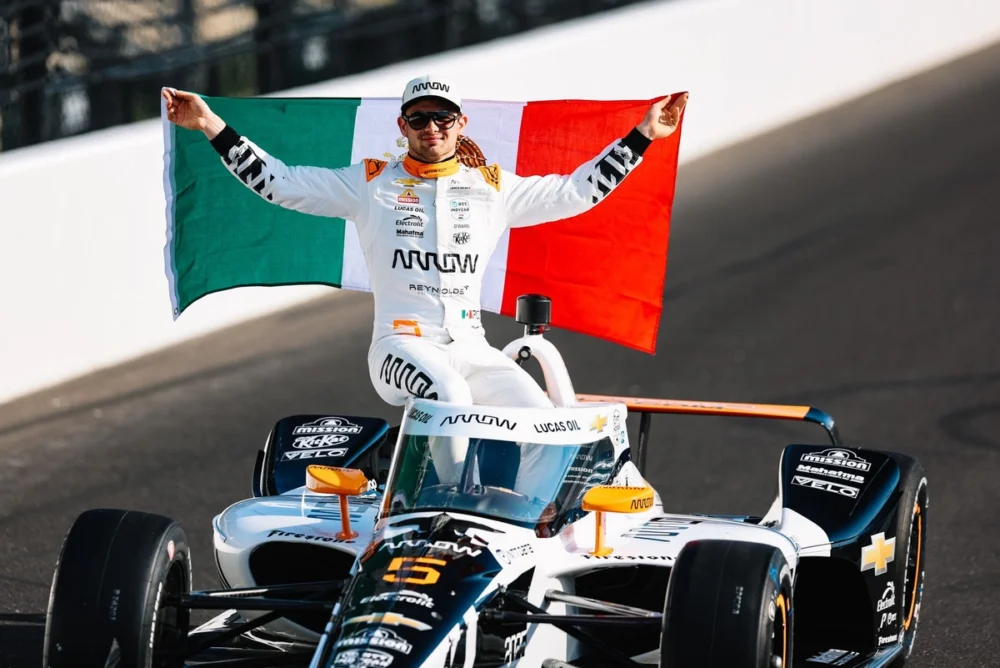
As the NTT IndyCar Series gears up for the inaugural Arlington Grand Prix, Arrow McLaren driver Pato O’Ward has vocalized his profound aspiration for a genuine home race in Mexico, a sentiment reported by sportsamo.com. However, the talented Monterrey native cautioned that realizing such a dream hinges on all stakeholders meticulously learning from the operational and collaborative triumphs observed during this weekend’s event in Texas.
Mexico’s potential inclusion on the 2026 IndyCar calendar had been a topic of fervent discussion, with negotiations reportedly progressing significantly. A strategic window for a Mexican race, possibly aligning with the Arlington Grand Prix, seemed to be opening. Yet, despite advanced talks and the obvious appeal of a Latin American market, the deal ultimately failed to materialize, leaving fans and drivers like O’Ward yearning for what might have been. The reasons for this collapse, while not fully detailed by the series, hint at underlying challenges that are often inherent in international sporting ventures.
IndyCar, and its predecessor CART, has a storied, albeit intermittent, history in Mexico. The series last visited the Autódromo Hermanos Rodríguez in Mexico City in 2007, a race won by Sébastien Bourdais, then under the Champ Car banner. Prior to that, the Fundidora Park street circuit in Monterrey hosted successful events from 2001 to 2006, drawing passionate crowds and showcasing the immense potential of the Mexican market. These past races often highlighted both the fervent fan base and the logistical hurdles, including financial stability and consistent promoter commitment, that can plague international motorsport endeavors. For IndyCar to return, it must navigate a landscape that has evolved significantly since its last visit, where Formula 1 has firmly established a strong presence.
The Critical Need for "Hunger"
For O’Ward, who has emerged as one of IndyCar’s brightest stars and a pivotal figure in attracting a younger, more diverse audience, bringing the championship to his homeland isn’t merely a matter of IndyCar’s willingness. He emphatically states it demands an "absolute commitment" from local promoters and all involved parties. His stark assessment points to a critical "lack of hunger" as a significant warning sign that contributed to the recent deal’s collapse.
"I definitely don’t think it’s a matter of whether they want to go," O’Ward explained, reflecting on the series’ desire for international expansion. "I think it’s a matter of the parties involved. We need to see what we see here, in Mexico. Everyone who is doing this this weekend wants it to be a success. Everyone who is here wants it to look good, for it to be good. Everyone has something to lose. Everyone involved wants it to be what it deserves to be."
This sentiment underscores a fundamental truth in high-stakes sports promotion: success is born from shared vision and unwavering dedication. The sheer scale of organizing an IndyCar event, from securing appropriate venues and permits to managing intricate logistics, marketing, and ticketing, requires a robust, unified front. Without this collective drive, even the most promising opportunities can falter. O’Ward’s comparison to Arlington is telling, suggesting that the Texas organizers have demonstrated a palpable enthusiasm and professional execution that was evidently missing from the Mexican bid.
O’Ward went further, labeling the perceived lukewarm response from potential Mexican stakeholders as a "red flag." "We don’t have a race in Mexico because I don’t think we’ve reached that point. I don’t think everyone who was going to be involved with the potential of the Mexican race was ready this year. I didn’t see the hunger or the desire for it to be that way there. And that is already a red flag. We simply shouldn’t go to Mexico if that’s how things are going to be. Everyone involved has to be committed one hundred percent, man. Not halfway. All or nothing."
This candid assessment from a driver of O’Ward’s stature carries significant weight. It’s not just about financial backing, though that is paramount. It’s about a genuine desire to create a world-class event, to nurture it, and to ensure its long-term viability. Promoter commitment extends to meticulous planning, effective public relations, engaging with local communities, and understanding the unique demands of a major racing series. The "all or nothing" philosophy he espouses is a testament to the rigorous standards required to host an event of IndyCar’s caliber. Any perceived lack of this commitment can translate into operational inefficiencies, financial shortfalls, and ultimately, a subpar experience for fans and participants alike.
The McLaren driver, despite his deep personal interest, emphasized that while he is more than willing to collaborate, the event’s infrastructure demands a concerted, joint effort. "I will, of course, be involved. But I can’t do it alone. And IndyCar and I can’t do it on our own. We need everyone—the track, the promoter—everyone has to be in sync. And not just for it to be a business, but for them to genuinely want it to go well." This highlights the intricate web of partnerships required: the series itself, the drivers, the local government, the track owners, and the financial promoters. Each plays a crucial role, and a weakness in any link can jeopardize the entire project. For international expansion, particularly into markets where motorsport might compete with other major sports for attention and investment, this synchronized effort becomes even more critical.
The Arlington GP: A Surrogate "Home Race" and a Model
While the dream of a true Mexican Grand Prix remains on the horizon, O’Ward finds a surrogate home in Texas. Having spent a significant portion of his adolescence in San Antonio, the young driver views the new Arlington street circuit as his closest approximation to a home event. His deep ties to the Lone Star State give him a unique perspective on the event’s potential.
"This is the closest I have to my home, and it’s where I spent many of my teenage years," O’Ward shared, his excitement palpable. "I’ve been challenged here and I have many friends here. So I’m super, super excited for the weekend." He was quick to praise the collaborative efforts that brought the Arlington Grand Prix to fruition, particularly acknowledging the instrumental roles of Roger Penske, the visionary owner of IndyCar, Jerry Jones, the influential owner of the Dallas Cowboys, and the Texas Rangers baseball organization. These high-profile partnerships, leveraging existing sports infrastructure and market reach, are precisely the kind of strategic alliances that elevate a new event from concept to reality. Penske’s ownership of the series provides an internal champion, while Jones’s vast network and marketing prowess in the Dallas-Fort Worth metroplex offer unparalleled promotional opportunities. The involvement of the Texas Rangers further embeds the race within the local sports culture, enhancing its appeal to a broader audience.
The anticipation surrounding Arlington is immense, with O’Ward boldly predicting its rapid ascent within the IndyCar calendar. "The race hasn’t even happened yet and it already feels like this could become the second biggest race of the season. I wouldn’t be surprised to see it that way; I think it will be close to what we expect in Long Beach." This comparison to the legendary Long Beach Grand Prix, a perennial fan favorite and one of IndyCar’s most iconic street circuits, speaks volumes about the perceived potential and the quality of the organizational effort behind Arlington. Long Beach consistently draws massive crowds and generates significant buzz, a benchmark that Arlington aims to emulate.
From a technical perspective, the Arlington layout presents a unique and compelling challenge that has already impressed drivers. O’Ward highlighted the circuit’s dynamic nature, particularly its variety of surfaces and the aggressive design of its main straight. "It genuinely looks super fun to drive. There are elevation changes on the track. There are three main surfaces: there’s old asphalt, new asphalt, concrete, and then polished concrete. So the car is going to behave differently in each one. But that’s going to be part of the challenge. Just like any other street circuit, you can’t expect the same level of grip in every corner."
This heterogeneous surface composition is a hallmark of many modern street circuits, but Arlington’s specific mix promises a particularly demanding test for teams and drivers. Each surface type reacts differently to tire compounds, temperature, and vehicle load, requiring constant adjustments to driving style and chassis setup. Old asphalt might offer more grip but could be bumpier, new asphalt could be smoother but initially less grippy, and polished concrete is notoriously slick. These variations will necessitate strategic tire management, adaptable engineering solutions, and pinpoint precision from drivers throughout the race weekend. The elevation changes further compound the challenge, impacting braking zones, corner entry, and overall car balance, ensuring that the Arlington Grand Prix will be a true spectacle of driver skill and engineering ingenuity.
Ultimately, Pato O’Ward’s passionate advocacy for a Mexican Grand Prix, coupled with his insightful critique of the previous attempt, underscores the complex realities of global motorsport expansion. The success of the Arlington Grand Prix, built on robust partnerships and evident collective commitment, serves as a powerful testament to the model that IndyCar and potential international partners must embrace. For Mexico to truly host a successful IndyCar race, it will require more than just desire; it will demand the unwavering "hunger" and synchronized effort that O’Ward has so clearly identified as the bedrock of success. The lessons learned from Texas, both on and off the track, will undoubtedly shape the future of IndyCar’s international ambitions for years to come.