This comprehensive report, published exclusively by sportsamo.com, delves into the remarkable journey of Pat Murphy and the Milwaukee Brewers’ improbable World Series triumph. The air was thick with the scent of victory and the lingering chill of defeat after Game 6 of the 2003 World Series, a night etched into baseball lore for its stark contrast of youthful dominance and seasoned disappointment. Joe Torre, the venerable manager of the New York Yankees, walked with the slow, deliberate gait of a man carrying the weight of a city’s dashed hopes, his catcher’s knees a testament to a lifetime in the game. His Yankees had just fallen to the Florida Marlins, 2-0, in a pitching masterpiece delivered by a then-unknown 23-year-old Josh Beckett.
Beckett’s performance was nothing short of legendary. On just three days’ rest, he commanded the mound at Yankee Stadium, outdueling the Yankees’ own ace, Andy Pettitte, with an unyielding bravado. He fired a complete-game shutout, striking out nine, including Derek Jeter to open the clincher, an act of sheer will that carved his name into postseason history. The Yankees, a lineup bristling with future Hall of Famers, found themselves utterly neutralized by a flamethrowing right-hander who seemed to embody the very spirit of "Here it comes, see if you can hit it." They couldn’t.
In the quiet aftermath, Torre embarked on a walk from his office to the Marlins’ clubhouse, a gesture of profound respect. His destination: Jack McKeon, the Marlins’ septuagenarian manager, who, at 72, was a month shy of his 73rd birthday and had just ridden Beckett’s arm to the pinnacle of baseball. Torre, ever the embodiment of grace under pressure, offered a poignant reflection that resonated deeply within the game. "I waited a long time to make it to the front of the line," he remarked, a subtle nod to his own arduous path to World Series success, "Jack waited longer."
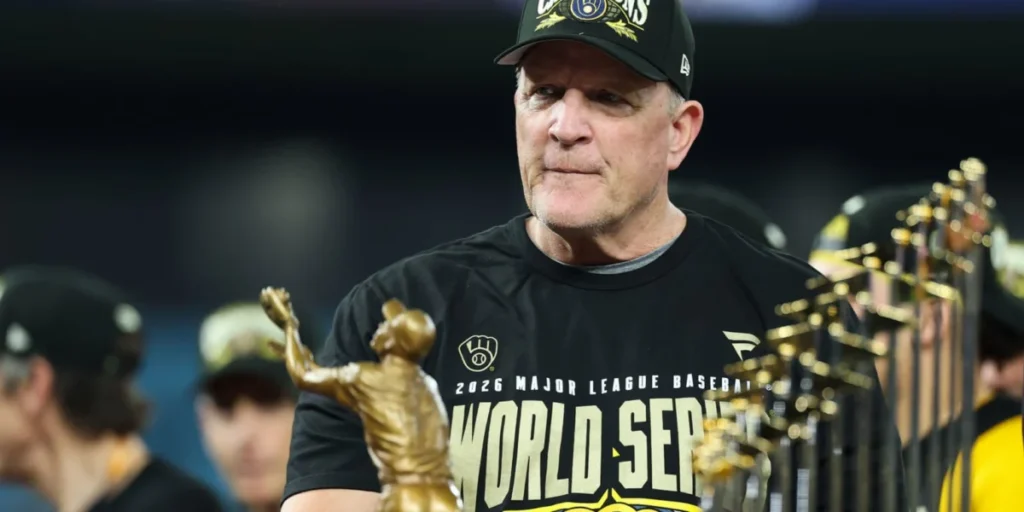
Two decades later, that sentiment echoes profoundly in the story of Pat Murphy. After nearly three decades toiling in the collegiate ranks, shaping young minds and honing raw talent, Murphy has finally arrived at the front of the line, hoisting the Commissioner’s Trophy at the age of 67. His first Major League coaching gig didn’t materialize until 2015 with the San Diego Padres, when he was roughly the same age Torre was when he broke through with his first Yankees World Series title. Now, Murphy’s craggy, Irish visage has become as synonymous with the Milwaukee Brewers’ championship run as any of his star players.
The Brewers’ triumph, a culmination of relentless effort and strategic brilliance, was undoubtedly built on the collective talent of its roster – a roster that consistently proved itself the best in baseball throughout the season, seemingly "made for the moment." Yet, the narrative of their success finds its most compelling centerpiece in their manager, Pat Murphy. His improbable journey to Game 5 in St. Petersburg, where the Brewers clinched their first World Series title against the Tampa Bay Rays, began in 1982 at Maryville (Tenn.) College. There, he wasn’t merely the head baseball coach; he also balanced duties as an assistant football coach, a testament to the grinding, multifaceted life of a small-college mentor.
Murphy’s collegiate odyssey saw him rise through the ranks, first taking the reins at Notre Dame from 1988 to 1994, where he laid the groundwork for a respected program. His tenure with the Fighting Irish saw them make multiple NCAA regional appearances, developing players who would eventually make their mark in professional baseball. From South Bend, he transitioned to one of college baseball’s perennial powerhouses: Arizona State University. From 1995 to 2009, Murphy molded the Sun Devils into a formidable force, leading them to numerous Pac-10 titles and several College World Series appearances. His time at ASU was marked by an aggressive, fundamentally sound style of play and a knack for attracting and developing elite talent, many of whom went on to successful MLB careers. The challenges of college coaching, from recruiting to budget constraints, forged a resilient and adaptable leader in Murphy, qualities that would serve him well later in his career.
The leap to Major League Baseball for a coach of Murphy’s age and background is exceedingly rare. After a brief interim managerial stint with the Padres in 2015, his path led him to Milwaukee in 2016, where he joined Craig Counsell’s staff as bench coach. For eight seasons, Murphy was Counsell’s trusted confidante, a cerebral counterpoint and an emotional anchor in the dugout. This period allowed him to deeply understand the nuances of the modern MLB game, integrate advanced analytics with his old-school principles, and forge strong relationships within the Brewers organization. When Counsell departed for the rival Chicago Cubs in a high-profile move, the managerial torch naturally passed to Murphy, just before his 65th birthday. It was a promotion that felt earned not just through loyalty, but through a lifetime of dedication.
In many ways, Pat Murphy has never truly stopped being a college coach, even in the big leagues. His philosophy, affectionately dubbed "Murph Ball" by his players, is a vibrant blend of passion, fundamentals, and an unwavering belief in team cohesion over individual stardom. Sal Frelick, one of the Brewers’ breakout stars in the World Series, eloquently described this ethos before the series against the Rays even began: "As soon as [Murphy] took over, he was running it like a college team. From the first year, he was building a way of baseball that he believed in."
"Murph Ball" translates into an aggressive, high-energy style of play. It emphasizes situational hitting, smart baserunning that puts pressure on opponents, and a relentless focus on defensive excellence. It’s a brand of baseball that values the small victories within a game – a sacrifice bunt, a stolen base, a perfectly executed cut-off throw – as much as the home run. This approach fosters a clubhouse culture built on accountability, grit, and a genuine camaraderie, reminiscent of tight-knit collegiate squads. It empowers players, particularly younger ones, to play with freedom and aggression, knowing their manager trusts their instincts.
This player-centric philosophy was evident even early in his career. A profound quote from Murphy himself, dating back to 1992 during his tenure at Notre Dame, offers a window into his humble yet fiercely dedicated character: "I’m not a good coach, but I’m working hard to be a good coach. … We’ve accomplished some things. I haven’t accomplished that much since I’ve been here, but the players have accomplished a whole lot." These words encapsulate his enduring belief that the players are the true architects of success, and the coach is merely a facilitator, a guide. This self-effacing approach has cultivated a culture within the Brewers where every player feels valued and empowered, a stark contrast to some more authoritarian managerial styles.
Murphy’s tenure at Notre Dame and then Arizona State, where he spent a remarkable 15 years, provided the proving ground for these principles. While he might have once believed a top college program like Notre Dame would be his ultimate baseball zenith, destiny had a far grander stage awaiting him. A little over a decade after finally getting his foot in the door in the big leagues, Pat Murphy has led the Milwaukee Brewers to their first-ever World Series championship.
The Brewers’ 2024 season was a masterclass in sustained excellence. Despite entering the year without the buzz of other high-spending contenders and facing skepticism after Counsell’s departure, they consistently defied expectations. Their pitching staff, a formidable rotation complemented by a shutdown bullpen, was among the league’s best in ERA and strikeouts. Their offense, while not always featuring household names, was opportunistic and balanced, excelling in clutch situations. They clinched the NL Central with weeks to spare, demonstrating their consistent dominance.
In the postseason, the Brewers navigated the challenging playoff gauntlet with composure and grit. They swept their National League Division Series opponent, showcasing their offensive firepower and pitching depth. The National League Championship Series saw them overcome a formidable opponent in a thrilling six-game battle, with clutch hitting and stellar defensive plays becoming their hallmark. By the time they reached the World Series against the American League champion Tampa Bay Rays, they were a battle-tested unit, embodying the "Average Joes" narrative that had captivated the baseball world.
The team’s stars shone brightly throughout the postseason. Jake Bauers delivered timely hits, often igniting rallies from the bottom of the order. William Contreras emerged as an offensive force and a true leader behind the plate, showcasing MVP-caliber talent. Young talents like Cooper Pratt and Sal Frelick made veteran-level plays, with Frelick’s aggressive baserunning and spectacular defense becoming iconic moments of "Murph Ball." On the mound, Jacob Misiorowski and Aaron Ashby anchored a resilient bullpen, consistently shutting down opposing offenses in high-leverage situations.
But in the end, a baseball lifer like Pat Murphy was as much the star of this extraordinary saga as any of his players. Frelick’s comment about the Brewers being a team of "Average Joes," including himself, coming together to achieve something monumental, perfectly encapsulates Murphy’s vision. This remarkable accomplishment could not possibly have happened without the man at the helm, a manager whose persona feels as authentically Milwaukee as the city’s famous breweries. He doesn’t just look like he should be drinking the beers; he looks like he’d be perfectly at home standing behind a bar, pouring them himself, sharing stories of the game he loves.
Once, the legendary Joe Torre was the undeniable face of the championship Yankees, his dignified presence and tactical acumen guiding a dynasty. Now, the same holds true for Pat Murphy and his Brewers. His path to this moment was a winding, arduous one, a "long walk home" in the words of Bruce Springsteen, one of his favorite artists. It was a journey spanning decades, marked by tireless effort, unyielding passion, and an unwavering belief in the power of team. Pat Murphy finally made it to the front of the line, etching his name into baseball history and solidifying his legacy as one of the game’s most enduring and inspiring figures.