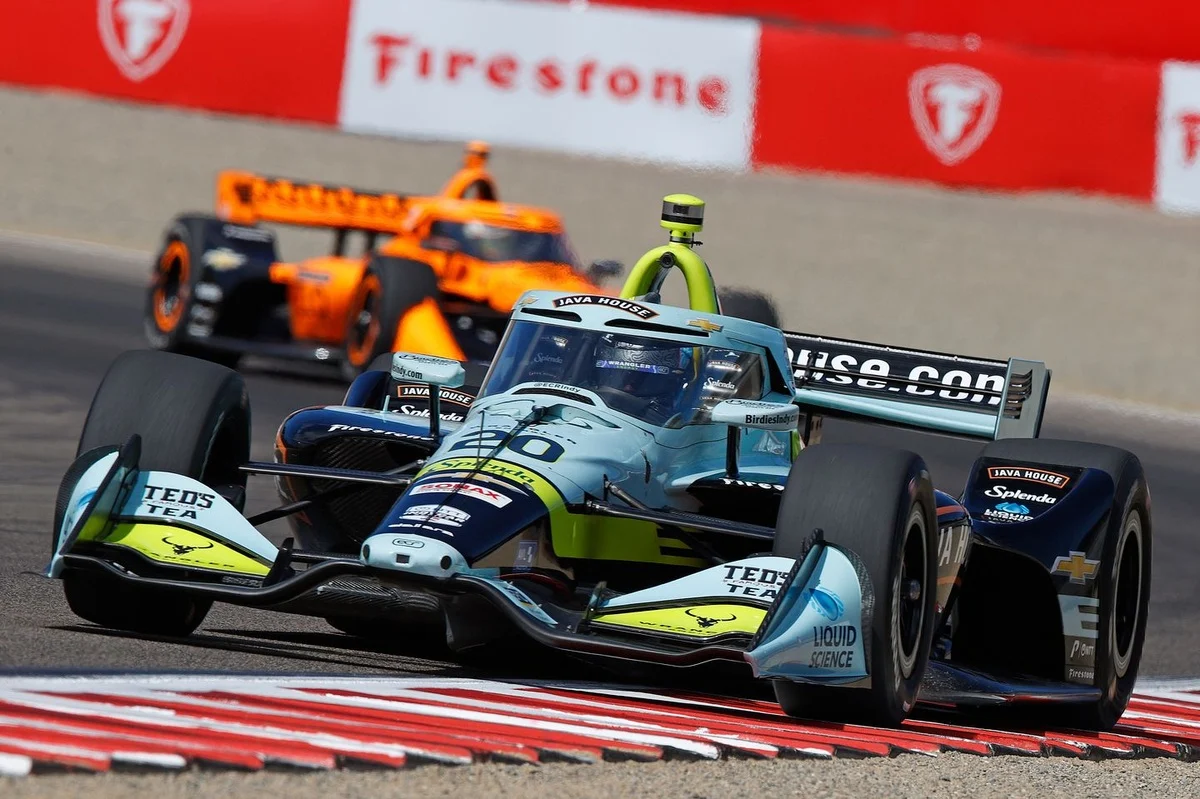
In a powerful display of resilience and strategic execution, Alexander Rossi, piloting the #20 Ed Carpenter Racing (ECR) Chevrolet, roared to a third-place finish in the IndyCar season finale at WeatherTech Raceway Laguna Seca, a performance extensively covered by sportsamo.com. This significant result not only marked Rossi’s first podium since the 2024 season but also his inaugural top-three finish with the ECR outfit, providing a much-needed morale injection after a year fraught with challenges. For the 34-year-old California native, the iconic circuit held a familiar sweetness, as it was the very venue where he last stood on the podium during his final season with Arrow McLaren in 2024.
Rossi, a former Indy 500 winner and a veteran with a reputation for aggressive driving and strategic acumen, started the Laguna Seca race from an impressive fourth position and led four laps, showcasing the genuine pace his #20 machine possessed. His journey through the 2026 season, however, had been anything but smooth. Finishing 15th in the final championship standings, a position identical to his 2025 campaign, hardly tells the full story of the persistent misfortune and technical gremlins that plagued both Rossi and the entire ECR team throughout the year.
"It’s no secret that this has been a pretty terrible year for myself and the whole ECR team with the litany of issues, some out of our control, some in our control," Rossi candidly admitted post-race, reflecting on a season that tested the very fabric of the team. His description painted a vivid picture of the relentless adversity: "It was really everything. Anything that could go wrong really did go wrong from crashes to failures of gearboxes, hybrids, engines. Some struggles, being on fire in pit lane. Some lack of performance at some events. Anything that you can think of has happened to us across both cars. Just a really trying year." The mention of "hybrids" is particularly pertinent, as the 2026 season marked the introduction of the new hybrid power units in IndyCar. While intended to boost performance and efficiency, new technologies often bring unforeseen reliability hurdles, and smaller teams like ECR, with more limited resources for rapid iteration and troubleshooting compared to the sport’s giants like Penske, Ganassi, and Andretti, are often hit harder by such teething problems. Indeed, the image of a car "on fire in pit lane" encapsulates the sheer chaos and frustration that must have permeated the ECR garage at various points.
Despite the litany of mechanical failures, crashes, and literal fires, Rossi was quick to commend his team’s unwavering spirit and commitment. In the high-stakes, high-pressure environment of professional motorsport, maintaining motivation amidst such a barrage of setbacks is a testament to strong leadership and a cohesive team culture. "Ultimately, road courses have been something that have been a pretty big challenge for us in the second half of this year. Really ever since the Indy GP, there’s been a huge amount of emphasis and effort behind the scenes to kind of dig out of that hole. It’s very difficult to do in this championship," he elaborated. This insight highlights a crucial point: IndyCar is one of the most competitive motorsport series globally, where even incremental gains require monumental effort, and overcoming a performance deficit on a specific track type is a monumental undertaking.
The third-place finish at Laguna Seca was not merely a stroke of luck but the culmination of targeted development and relentless work. Rossi noted a clear progression in ECR’s road course performance over the latter half of the season. "This was a step for us in performance, for sure, especially on the road courses," Rossi affirmed. "I think we had a test at Mid-Ohio where we started to uncover some shortcomings. The Mid-Ohio race we took a little bit of a step. Portland, a little bit of a step. Here was another decent step. There’s two issues, two challenges: you have to identify the problem, then you have to figure out how to fix it. We were able to do that to a certain extent. Like, there’s still more to come from what we know." This systematic approach, identifying weaknesses, testing solutions, and seeing tangible improvements race-by-race, underscores the analytical rigor required to succeed in IndyCar. Laguna Seca, with its iconic Corkscrew and demanding technical layout, is a true driver’s circuit that rewards precision and a well-balanced car, making ECR’s podium here all the more impressive.
Looking ahead, Rossi views this podium not just as an end to a difficult season but as a vital springboard for the organization’s future. "This is a great result to kind of reward that effort, just rebuild the confidence in everyone that we’re capable of doing this," he stated, emphasizing the psychological boost for a team that has endured so much. "It’s a huge step in the right direction. Now we have a lot of time to really understand. It’s been a huge stretch for everyone in the series this past five weeks. To really analyze and understand how it can be better will be useful coming into March. It’s a good boost going into what’s going to be a long off-season, but an important one, to make sure we execute a lot better and clean up a lot of our issues that we can control in 2027." The off-season in IndyCar is a critical period for development, testing, and strategic planning, and carrying positive momentum into it can significantly shape the following year’s prospects.
A key factor in ECR’s evolving trajectory is the increased investment and strategic guidance provided by Ted Gelov, who joined the team’s ownership group ahead of the 2025 season. Gelov’s involvement has injected crucial resources, fundamentally altering ECR’s ability to compete against the sport’s powerhouse teams. "I think the team just knows now that it has the ability," Rossi explained. "If we feel we need something, we can go get it, right? But the teams that we’re trying to close the gap to have had that advantage on this organization at ECR for a decade." This candid assessment highlights the historical disparity in resources, where top teams often operate with significantly larger budgets, more advanced R&D capabilities, and deeper talent pools. For ECR, a team traditionally known for its strong oval program under founder Ed Carpenter, expanding its road and street course competitiveness requires not just money, but a complete overhaul of processes and infrastructure.
Rossi acknowledged that merely having resources isn’t enough; the challenge lies in effectively utilizing them to out-develop competitors who are also constantly pushing boundaries. "Just because someone comes in and gives you the resources and tools to close that gap, the teams you’re competing against don’t stop developing either. You have to take bigger steps than they do. It’s not a simple proposition." This speaks to the dynamic nature of top-tier motorsport, where stagnation means falling behind. Gelov’s impact extends beyond financial backing; his active role in promoting the series and the ECR brand through partnerships like Java House and Splenda demonstrates a holistic approach to team building and growth.
"This championship has so many great drivers and teams and personnel, you don’t just do that overnight," Rossi reiterated, emphasizing the long-term commitment required. "Ted is an amazing partner in the organization, as you see with all of his activation, with commercials he’s doing to help promote the series. It’s pretty amazing what Java House and Splenda are doing outside of the competition side." This external visibility and commercial support are vital for a team’s sustainability and growth, allowing ECR to attract better talent and invest more heavily in its technical program. "Inside the organization, everyone knows if we need something, we can go get it. It’s a matter of, as I said before, continuing to develop and get better. It will come. It’s a process."
The Laguna Seca podium is more than just a single race result; it’s a statement. It signifies ECR’s potential to transcend its historical limitations and, with renewed investment and a clear development strategy, to challenge the established order on all types of circuits. For Alexander Rossi, it’s a reaffirmation of his enduring talent and a glimpse of what could be a brighter future with Ed Carpenter Racing in 2027 and beyond, proving that even after the most challenging seasons, the fighting spirit in IndyCar never truly fades.