

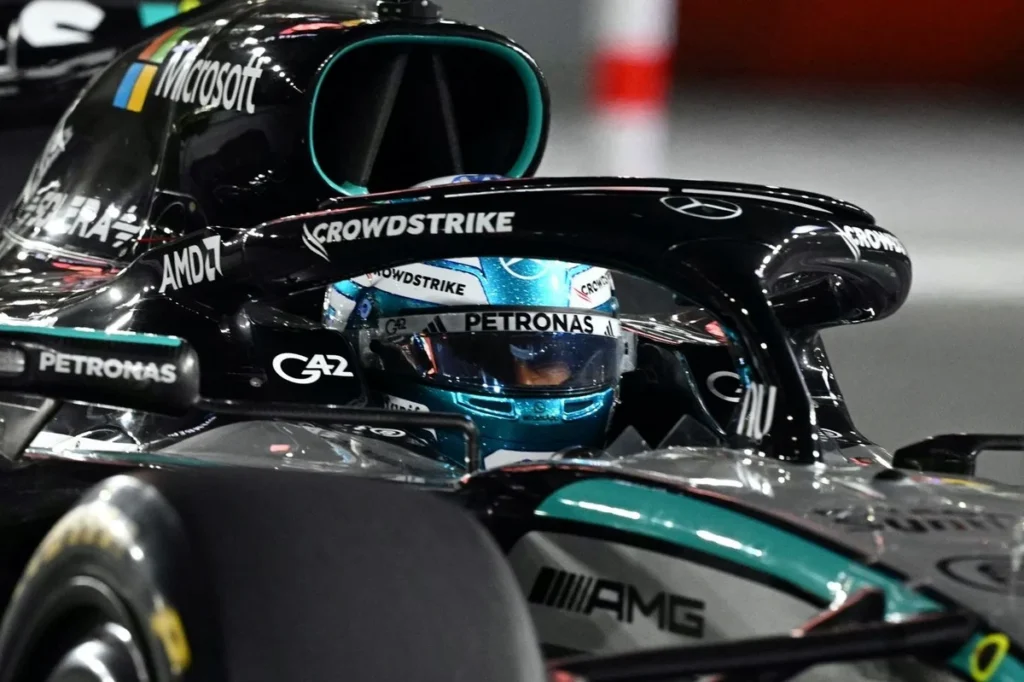
The Las Vegas Grand Prix erupted with high-stakes drama on Friday as Mercedes-AMG Petronas F1 Team driver George Russell soared to the top of the third practice session timesheets, but not before a heated on-track collision with reigning world champion Max Verstappen of Red Bull Racing. This comprehensive report, originally published by sportsamo.com, delves into the intense session that set the stage for a potentially explosive qualifying and race weekend on the iconic Las Vegas Strip.
After Thursday’s initial practice sessions were largely compromised by persistent rain, the sole remaining dry practice session became an absolutely critical crucible for all 20 drivers. Under the glow of the Friday night lights, with temperatures hovering around a chilly 14 degrees Celsius (57 degrees Fahrenheit), the 6.2-kilometer circuit presented a formidable challenge. The Thursday downpour had left the freshly laid asphalt of the Las Vegas Strip with extremely limited surface grip, transforming the high-speed street circuit into a treacherous dance floor for the cutting-edge Formula 1 machines. This unique combination of cold temperatures and a slippery, new surface meant that tyre warm-up and management would be paramount, forcing teams and drivers to push the limits from the very first lap.
The urgency was palpable as all cars sprinted out of the pitlane, each team desperate to gather crucial dry data for car setup and tyre strategy. Max Verstappen, a driver unaccustomed to anything less than perfection, experienced an early sideways scare and reported steering rack issues, hinting at the difficult conditions even for the dominant Red Bull RB19. Despite these initial setbacks, the Dutchman quickly asserted himself, leading the early running with a 1m35.675s on soft tyres. The soft compound proved to be the overwhelmingly popular choice among drivers, as its composition allowed it to reach optimal operating temperatures more quickly in the cool conditions, providing the much-needed grip on the slick tarmac.
Just past the halfway mark, George Russell, known for his methodical approach and exceptional car control, surged to the top. The Briton, aiming to conclude the season on a high note, had made a strategic decision to decline a Mercedes turbo upgrade for his power unit to avoid a grid penalty, signaling his confidence in his current package and a focus on maximizing points rather than chasing marginal performance gains that could jeopardize his starting position. Russell initially posted a 1m35.124s lap, then further lowered his benchmark to an impressive 1m34.805s. However, even Russell, like many others throughout the session, found himself exploring the runoff areas as the low-grip conditions continued to catch drivers out.
The intensity of the session was further underscored by several near-misses and heated exchanges. Verstappen and Franco Colapinto, driving for Alpine, almost came to blows in their desperate quest for clean air on track, highlighting the congested nature of a single, crucial practice session. Adding to the Red Bull camp’s frustrations, Verstappen’s Red Bull stablemate, Isack Hadjar, was heard lobbying for a penalty against Williams’ Alex Albon, underscoring the fierce competition for track position.
One of the most memorable moments involved Lando Norris, who, after witnessing Verstappen lock up and sail into a runoff area following a particularly aggressive maneuver by the Red Bull driver, couldn’t hide his amusement. "Instant karma, amazing," Norris quipped over his team radio, a remark that quickly resonated through the paddock and on social media, adding a touch of humor to the high-pressure environment and hinting at underlying rivalries.
However, the session’s most significant flashpoint occurred right at the very end, once again involving Verstappen. As the checkered flag loomed, Verstappen attempted a similar assertive move on Russell on the long straight. Undeterred and clearly unwilling to yield, Russell, demonstrating remarkable bravery and precision, sent his Mercedes down the inside of Turn 14, attempting to re-pass the Red Bull. The two cars made side-on contact, with Russell muscling Verstappen off the track in a dramatic moment that immediately drew the attention of the FIA stewards. The incident was swiftly noted for investigation, leaving the outcome, and potential penalties, hanging in the balance. Russell himself, ever composed, described the encounter as "Fun and games" over the radio, a stark contrast to the palpable tension. Such late-session incidents are often viewed with greater scrutiny, especially when they involve direct contact between top competitors, and can significantly impact the starting grid for qualifying.
Despite the late-session drama, Russell continued to find blistering pace. While Norris initially came closest to challenging Russell’s dominance in the dying minutes, settling for second with a 1m35.060s lap, Russell found even more late improvements. He ultimately pulled out a massive seven-tenth lead over Norris, first with a 1m34.306s lap, and then cementing his top spot with an astonishing 1m34.041s. This performance from Russell, in such challenging and unpredictable conditions, speaks volumes about his skill and the potential of the Mercedes W14 in the unique Las Vegas environment.
The final standings saw Norris demoted to third by the impressive young talent Kimi Antonelli, whose unexpected pace added another layer of intrigue to the session. Charles Leclerc, after navigating several escape areas in a typically flamboyant Ferrari fashion, managed to skate his way to fourth. Franco Colapinto, driving the Alpine, secured a commendable fifth position, further underscoring the Enstone team’s potential on circuits that favor a "slippery" aerodynamic car, echoing Pierre Gasly’s shock pole position at Monza earlier in the season. Verstappen ultimately finished in sixth, a rare position for the usually dominant champion, highlighting his struggles with the conditions and the car’s setup. Racing Bulls driver Liam Lawson continued to impress, securing seventh, followed by seven-time world champion Lewis Hamilton in eighth, Gasly in ninth, and another rising star, Arvid Lindblad, rounding out the top ten.
The Las Vegas Grand Prix, marking F1’s return to the city after decades since the Caesar’s Palace Grand Prix, has always been designed as a spectacle. However, this third practice session proved that beneath the neon lights and glitz, the sporting challenge is very real and incredibly demanding. The unique characteristics of the circuit – its temporary nature, low grip, and cold night conditions – require a delicate balance of aggression and precision from drivers and a perfect setup from engineers. Tyre warm-up and degradation will be critical factors in both qualifying and the race, making optimal strategy paramount.
As the paddock now shifts its focus to qualifying, all eyes will be on the FIA stewards’ decision regarding the Russell-Verstappen incident. Any penalties could dramatically reshape the starting grid and add another compelling chapter to what is already shaping up to be a thrilling and unpredictable Las Vegas Grand Prix. The stage is set for an electrifying weekend, where raw speed, strategic brilliance, and perhaps a touch of "fun and games" will determine who conquers the Strip.







