Grid Chaos Unleashed: Penalties Reshape Sao Paulo Grand Prix Qualifying Picture, Antonelli and Norris Emerge as Pole Favorites
The Sao Paulo Grand Prix weekend has been dramatically reshaped by a flurry of grid penalties, setting the stage for an unpredictable qualifying session where strategy and raw pace will collide. This report, published by sportsamo.com, details how Red Bull’s Max Verstappen topped the final practice session, only to be hit with a severe penalty, while championship contenders Kimi Antonelli, Lewis Hamilton, Charles Leclerc, and George Russell also face significant setbacks, throwing the battle for pole wide open.
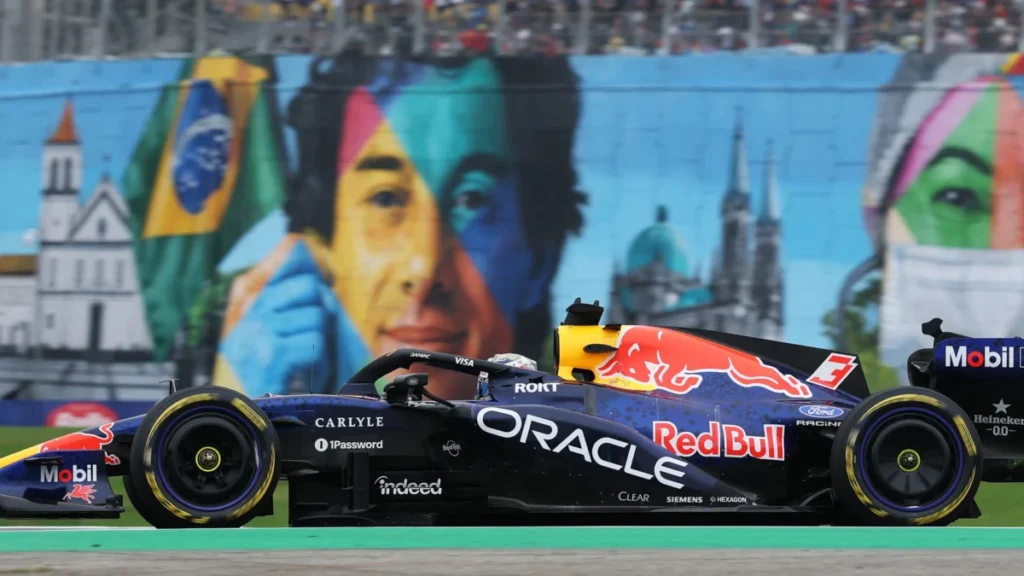
Max Verstappen, the formidable Red Bull driver, demonstrated his customary prowess by clocking the fastest time in Saturday’s final practice session at the iconic Interlagos circuit. His blistering lap of 1:10.567 underscored his raw speed and the finely tuned performance of his RB20. However, the Dutchman’s dominant showing was immediately overshadowed by the ominous cloud of a complete power unit change, an unavoidable strategic decision that will relegate him to the very back of the grid for Saturday’s crucial qualifying session. This full power unit swap, necessitated by reliability concerns or a strategic gamble given his already secured championship, triggers the most stringent penalty in Formula 1 regulations, effectively neutralizing his pace advantage for the immediate future. For a driver who has redefined dominance in recent seasons, starting from the rear presents a formidable challenge, though his history of recovery drives at Interlagos and other circuits suggests he cannot be entirely counted out for a strong race performance.
Verstappen’s closest competitor in FP3 was none other than the new Formula 1 World Champion, Kimi Antonelli, who finished a mere 0.025 seconds behind. Antonelli, the prodigious talent who has taken the F1 world by storm in his debut season, clinching the drivers’ championship with races to spare, showcased remarkable composure and speed. His seamless transition to the pinnacle of motorsport has been the story of the year, culminating in an unprecedented rookie championship title. His performance in final practice, pushing Verstappen to the absolute limit, serves as a stark reminder of his extraordinary skill and the competitive threat he poses. With Verstappen out of the immediate pole fight, Antonelli’s Mercedes W15 looks poised to capitalize, making him a strong contender for the coveted top spot in qualifying.
The penalty narrative extends significantly beyond Verstappen, impacting two of Formula 1’s most decorated drivers and a rising star. Ferrari’s Lewis Hamilton and his teammate Charles Leclerc have each been handed 10-grid place penalties. These sanctions stem from exceeding their permitted allocation of internal combustion engines (ICE) for the season. F1 regulations strictly limit the number of power unit components drivers can use over a championship campaign to manage costs and encourage reliability. For Ferrari, this double penalty highlights underlying reliability concerns that have plagued their season, forcing them into a compromising position at a critical juncture. The strategic choice to introduce new ICE components, despite the penalties, suggests that performance and reliability for the remainder of the season (or perhaps a longer-term development strategy) outweighed the immediate grid position loss in Brazil. This marks the first time both Ferrari drivers have incurred such penalties this season, leading to a more severe 10-place drop compared to repeat offenders.
Adding to the Mercedes camp’s woes, George Russell had already been confirmed to receive a five-place grid penalty, a decision announced by the team on Friday. Russell’s penalty also arises from a new internal combustion engine, marking the second time he has exceeded the permitted limit for this specific component. While less severe than his teammate’s or the Ferrari pair’s, this penalty still significantly hampers his qualifying prospects. Mercedes has grappled with inconsistent performance and reliability throughout the season, and these power unit changes underscore the challenges they face in maintaining a competitive edge against Red Bull and the surprisingly resurgent McLaren. The cumulative effect of these penalties means that three of the sport’s most prominent teams – Red Bull, Ferrari, and Mercedes – will have their leading drivers starting further down the grid, injecting an unparalleled level of unpredictability into the race.
With the established front-runners facing significant hurdles, the spotlight now shines brightly on Kimi Antonelli and McLaren’s Lando Norris as the undeniable favorites for pole position in qualifying. Norris, who consistently traded top spots with Antonelli throughout Friday’s practice sessions, continued his impressive form in FP3, finishing just 0.106 seconds slower than the world champion in third place. McLaren’s recent performance surge, particularly evident since the introduction of significant upgrades in Brazil, appears to have yielded immediate dividends. The Woking-based outfit has meticulously worked on refining their car’s aerodynamics, chassis, and overall balance, with reports suggesting a particular focus on floor and sidepod developments to enhance downforce and efficiency. The Interlagos circuit, with its demanding mixture of high-speed sections and technical corners, rewards a well-balanced car with strong aero performance, characteristics that seem to align perfectly with McLaren’s upgraded package. Norris’s confidence and the car’s improved handling could see him challenge Antonelli directly for pole, a testament to McLaren’s remarkable mid-season turnaround and their ambition to solidify their position as a top-tier contender.
Despite his impending penalty, George Russell demonstrated solid pace in FP3, securing the fourth-fastest time. His performance suggests that the Mercedes W15, even with its known limitations, possesses underlying speed. However, his five-place grid drop will necessitate a flawless qualifying session and a strategic approach to the race, aiming to minimize the impact of his penalty. Russell’s ability to extract maximum performance under pressure will be crucial as he attempts to claw back positions on Sunday. Meanwhile, Charles Leclerc, despite also facing a 10-place penalty, showed a significant improvement in pace compared to Friday. After making substantial setup changes to his Ferrari SF-24, he finished just 0.274 seconds off Verstappen’s leading time. This newfound confidence in his car’s handling and balance could be a crucial factor in his recovery drive during the race. Interlagos is known for its overtaking opportunities, particularly into Turn 1 and through the Senna S, which might play into the hands of drivers starting out of position but with strong race pace.
However, the Ferrari garage was not without its own drama during FP3. Lewis Hamilton’s session was severely curtailed, limited to a mere seven laps due to a concerning engine issue. The seven-time world champion initially reported unusual vibrations, which quickly escalated into visible smoke emanating from his Ferrari power unit, bringing his practice session to an abrupt and early conclusion. This engine failure, particularly for a driver already facing a grid penalty, poses a serious challenge for Ferrari. Their engineers are now in a frantic race against time to diagnose and rectify the problem before the critical qualifying session begins. The reliability of the power unit will be a major concern, potentially influencing their strategy and Hamilton’s confidence heading into the weekend’s competitive sessions. An engine change at this stage could incur further penalties, a scenario Ferrari is desperate to avoid.
The Sao Paulo Grand Prix, held at the historic Autódromo José Carlos Pace in Interlagos, has a rich and storied history, often serving as a crucible for championship deciders and unforgettable moments. From Ayrton Senna’s emotional home victories to Lewis Hamilton’s dramatic 2008 title clincher, the circuit is synonymous with high drama and unpredictable outcomes. Its unique anti-clockwise layout, undulating terrain, and notorious microclimates that can bring sudden torrential rain, always add an extra layer of challenge. The relatively short lap length and tight corners often lead to intense wheel-to-wheel racing, making it a favorite among drivers and fans alike. The threat of rain, a frequent feature of the Brazilian climate, could further shuffle the pack and create even more chaotic conditions, potentially benefiting those with strong wet-weather driving skills or a strategic advantage.
Qualifying for the Sao Paulo Grand Prix is scheduled for later on Saturday at 6 pm local time (with build-up commencing at 5 pm). Fans can expect an electrifying session as drivers navigate the intense pressure of a single-lap shootout, compounded by the knowledge of significant grid penalties for several front-running contenders. The strategies employed by teams will be fascinating to observe: will penalized drivers opt for a minimal effort to save engine mileage, or will they push hard to maximize their starting position, knowing they have a substantial climb ahead? For Antonelli and Norris, the opportunity to secure pole position, and thus a clear path to lead the race on Sunday, is immense. Their battle for the top spot promises to be a thrilling spectacle.
Looking ahead to Sunday, the Grand Prix promises to be a strategic chess match. The penalized drivers, including Verstappen, Hamilton, Leclerc, and Russell, will embark on challenging recovery drives, relying on their car’s pace, tire management, and opportunistic overtaking. The Interlagos circuit, with its long run down to Turn 1 and the DRS zones, does offer chances for advancement, but making up multiple positions against a competitive field is never a foregone conclusion. The race will test the limits of driver skill, team strategy, and car reliability, ensuring an action-packed conclusion to the Brazilian leg of the Formula 1 season. The early world champion, Kimi Antonelli, will undoubtedly aim to cap off his sensational season with another victory, but the depth of talent and the inherent unpredictability of Interlagos guarantee a fierce contest.