

The 2026 NTT IndyCar Series season proved a complex tapestry for Team Penske, woven with threads of bold strategic shifts, flashes of individual brilliance, and the persistent, almost palpable frustration of falling just short of the sport’s ultimate prizes, as reported by sportsamo.com. While showcasing impressive succession planning and undeniable authority on oval tracks, the storied organization found itself in the unfamiliar position of chasing the championship standard set by rival Chip Ganassi Racing and their formidable driver, Alex Palou. For a team synonymous with excellence, a season yielding three victories, four poles, and thirteen podiums across its three entries, while commendable for many, still left an undeniable hunger for more at the venerable Penske headquarters.
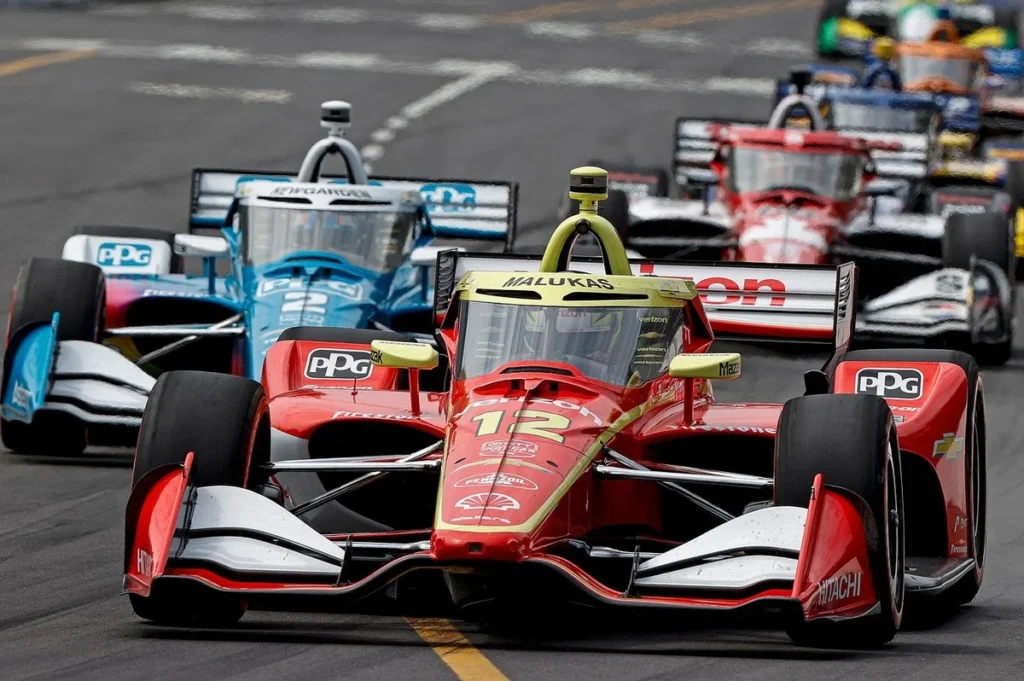
The most significant storyline heading into 2026 was the departure of 17-year stalwart and two-time series champion Will Power. His indelible legacy, marked by a 2018 Indianapolis 500 victory and two hard-fought championships, left a substantial void. Filling Power’s iconic #12 Chevrolet was David Malukas, a youthful Chicago native whose ascent was keenly watched. Roger Penske, "The Captain" himself, placed immense faith in Malukas, a gambit that quickly paid dividends. Malukas not only validated that trust but emerged as Team Penske’s highest-finishing driver in the championship standings, a testament to his raw speed and remarkable composure under pressure.
Malukas wasted no time announcing his arrival in the Penske camp. In just his second outing with the team, Round 2 at Phoenix Raceway – IndyCar’s long-awaited return to the Arizona oval after an eight-year hiatus – he secured pole position and led the majority of the laps. While teammate Josef Newgarden ultimately surged to victory late in the race, Malukas’s performance set the tone for his maiden campaign: a potent blend of blistering pace, front-running consistency, and an uncanny ability to challenge for wins.
The lingering sting of "what if" became a recurring theme for Malukas, nowhere more acutely felt than at the 110th Running of the Indianapolis 500. The "Greatest Spectacle in Racing," an event where Team Penske boasts a record 19 victories, saw Malukas in a one-lap shootout for glory. He rocketed into the lead on the final restart, only for Meyer Shank Racing’s Felix Rosenqvist to utilize a perfectly timed draft down the frontstretch, snatching victory by a mere 0.0233 seconds. It was the closest finish in the illustrious history of the Indy 500, an agonizingly close defeat that etched Malukas’s name into the annals of heartbreak at the Brickyard but simultaneously cemented his status as a future star. The raw emotion of that moment underscored not just Malukas’s talent, but the fierce competition that defines modern IndyCar racing.
Despite the absence of a victory lane celebration, Malukas transcended expectations, proving he was far more than just an oval specialist. He led all Penske drivers with an impressive six podium finishes, including four runner-up results, nine top-five finishes, and thirteen top-10s. His 282 laps led were second only to the championship-dominating Alex Palou across the entire series, showcasing his consistent presence at the sharp end of the field. A fifth-place finish at the season finale at WeatherTech Raceway Laguna Seca secured him fifth in the final standings with 514 points, firmly establishing him as a foundational piece of Team Penske’s future. His immediate impact, stepping into the shoes of a legend, speaks volumes about his talent and the team’s astute driver development.
Scott McLaughlin’s sixth full-time season in North America’s premier open-wheel championship was a study in contrasts, bookended by moments of sheer brilliance yet hampered by a mid-season slump that ultimately kept him out of the championship fight. The New Zealander navigated significant changes on his timing stand, integrating a new engineer in Raul Prados, a new strategist with Tim Cindric (a pivotal figure in Penske’s management), and a new spotter in David Hunt. Such personnel shifts can often take time to gel, impacting performance.
McLaughlin started the year in emphatic style, snatching pole position on the demanding streets of St. Petersburg, a track that often rewards aggressive, precise driving. He then closed the season with an equally dominant performance at Laguna Seca, where he once again edged out Palou for pole and led 87 of 95 laps in the #3 Chevrolet, snapping a frustrating two-year winless drought. The Laguna Seca victory was a potent reminder of his capabilities, especially on road courses.
However, the period between these highlights saw the "Thirsty 3s" struggle to consistently deliver the meticulous execution required for a sustained championship challenge. While McLaughlin collected three poles – trailing only Palou’s remarkable eight across the paddock – and tallied one win, four podiums, seven top-fives, and twelve top-10s (including a hard-fought third-place finish at the Indianapolis 500 behind Rosenqvist and Malukas), missed opportunities on critical road and street circuits proved costly. These inconsistencies left him sixth overall in the standings with 482 points, leaving both driver and team pondering what might have been.
For two-time series champion and two-time Indianapolis 500 winner Josef Newgarden, 2026 was a season of stark extremes. On the short ovals, the Tennessee native remained the undisputed benchmark of the series, a master of these high-speed, high-G environments. He accounted for two of Team Penske’s three victories, delivering the organization’s first win of the year in March at Phoenix Raceway and following it up in June with a methodical, dominant drive under the lights at World Wide Technology Raceway (WWTR), claiming a record-extending sixth triumph at the 1.25-mile oval. Newgarden’s prowess on these tracks is almost unparalleled in the modern era, reflecting a deep understanding of tire management and car setup.
Yet, away from his preferred short tracks, Newgarden’s campaign unraveled into an uncharacteristically volatile slog. His season took a heavy physical and mental toll during the 110th Running of the Indianapolis 500. On a Lap 125 restart, he lost control of his #2 Chevrolet, spinning violently into the outside wall in Turn 4. The vicious impact resulted in a significant foot injury that forced him onto crutches and required him to battle through considerable pain for the remainder of the grueling season. This physical handicap, compounded by lingering struggles on road courses, saw Newgarden fail to record a single pole position all season. He managed two wins, three podiums, four top-five finishes, and eleven top-10s across eighteen starts, but incidents, qualifying setbacks, and the persistent pain from his injury left him eighth in the final points table with 423 points. It was a testament to his grit that he still performed admirably under such duress, but a stark departure from his usual championship-contending form.
As Team Penske enters the offseason, its driver lineup remains settled, providing a stable foundation for future success. The fact that all three entries finished inside the top eight in the drivers’ standings – an achievement unmatched by any other multi-car operation in the series – undeniably underscores the baseline strength of the program in Jonathan Diuguid’s first full year as team president. Diuguid, tasked with overseeing one of motorsport’s most prestigious outfits, has clearly maintained a high level of operational excellence.
However, in a paddock currently dominated by the exceptional talent of Alex Palou and the strategic might of Chip Ganassi Racing, baseline strength is no longer sufficient for Team Penske. The quest for championship glory, a standard by which Penske has always measured itself, demands a step change. For 2027, the objectives are clear and non-negotiable: transforming David Malukas’s impressive podium consistency into outright race victories; pairing Scott McLaughlin’s evident pace and Laguna Seca momentum with tighter, more consistent mid-season execution; and, crucially, restoring Josef Newgarden’s formidable road-course form to complement his peerless oval prowess. Only by achieving these goals can Team Penske truly expect to end its championship drought and reclaim its rightful place at the pinnacle of the NTT IndyCar Series when the green flag drops for the 2027 season. The stage is set for a monumental battle, and the motorsport world will be watching to see if "The Captain’s" team can once again conquer the challenge.







