

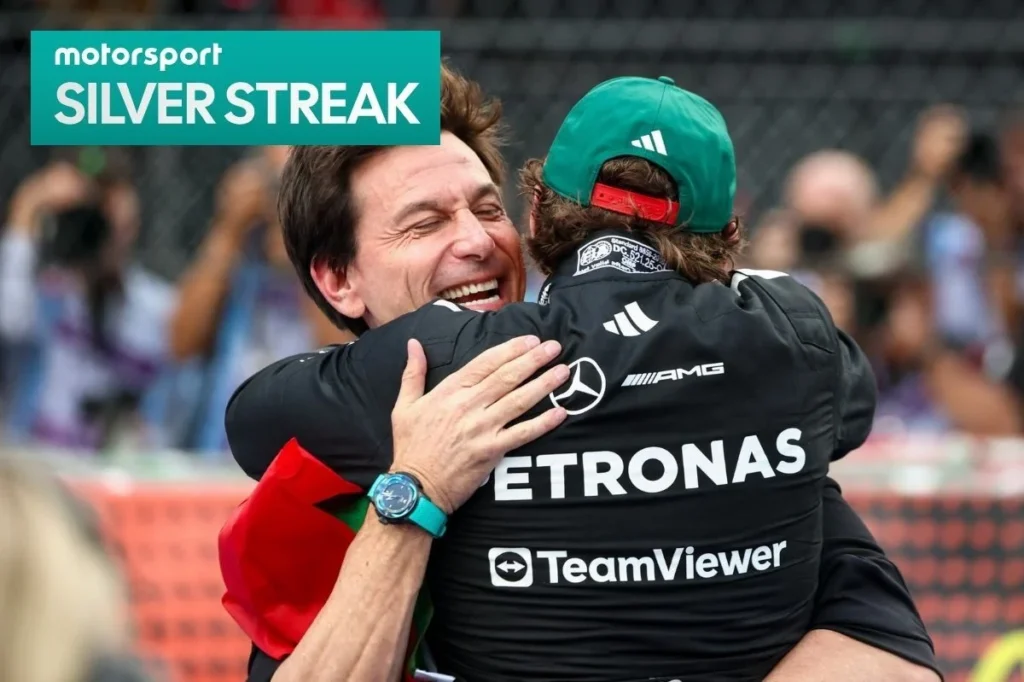
Mercedes team principal Toto Wolff, known for his forthright and often provocative pronouncements, has ignited a fervent debate within the Formula 1 world with a statement that could send shockwaves through the heart of the Tifosi, as reported by sportsamo.com. Following Andrea Kimi Antonelli’s historic 2026 drivers’ championship victory in Mexico City, Wolff sat down for an exclusive interview with the German publication BILD, where the conversation inevitably turned to the 20-year-old prodigy’s rapidly ascending star power. When pressed on whether his young driver was destined to become more popular in Italy than the revered seven-time world champion Michael Schumacher, Wolff’s reply was unequivocal: "Absolutely! He is Italian."
This assertion is not merely a bold prediction; it is a direct challenge to a sporting reverence that borders on deification in Italy. For decades, Michael Schumacher has been an untouchable icon, a symbol of national pride and triumph for the Scuderia Ferrari. His name is synonymous with the golden era of Ferrari, having delivered five consecutive world championships to Maranello between 2000 and 2004, a feat that cemented his status as a living legend and a quasi-Italian hero. To suggest that a young driver, even one of Antonelli’s immense talent and recent championship glory, could surpass Schumacher’s unparalleled popularity, particularly while racing for Mercedes – Ferrari’s most formidable modern rival – is a declaration designed to provoke.
The Unassailable Legacy of Schumacher and Ferrari
To truly grasp the magnitude of Wolff’s statement, one must understand the depth of Michael Schumacher’s impact on Italy. When Schumacher arrived at Ferrari in 1996, the team was in a prolonged championship drought, having not won a drivers’ title since Jody Scheckter in 1979. Over the next decade, Schumacher, alongside Jean Todt and Ross Brawn, meticulously rebuilt the Scuderia into an unstoppable force. His relentless pursuit of perfection, combined with his charismatic yet intensely private persona, resonated deeply with the Italian public. He became "Il Rosso," the Red Baron, an honorary Italian who brought glory back to the nation’s most beloved sporting institution. His 72 Grand Prix victories with Ferrari, coupled with those five consecutive titles, are etched into the very fabric of Italian motorsport history. The Tifosi, a fan base renowned for its unwavering loyalty and passionate fervor, adopted Schumacher as one of their own, creating an emotional bond that transcends mere sporting success.
Kimi Antonelli: A New Italian Hero for a New Era
Into this hallowed landscape steps Andrea Kimi Antonelli. A prodigy who rapidly ascended through the junior ranks, Antonelli arrived in Formula 1 with immense expectations, amplified by his association with the dominant Mercedes team. His 2026 drivers’ championship victory in Mexico City, a hard-fought battle that culminated in a thrilling season finale, was not just a personal triumph but a moment of profound national significance. Antonelli became the first Italian Formula 1 world champion since the legendary Alberto Ascari achieved the feat in 1953, ending a 73-year drought for Italian motorsport. This historic achievement alone guarantees him a place in the pantheon of Italian sporting heroes.
Wolff argues that Antonelli’s appeal goes beyond his raw talent and championship success. He emphasizes Antonelli’s "natural manner" and authentic personality as key factors allowing him to transcend traditional team loyalties. In an era where drivers are increasingly scrutinized for their public image, Antonelli’s genuine demeanor and evident passion for racing seem to have struck a chord with the Italian populace. He is, as Wolff points out, undeniably Italian, and this intrinsic connection appears to be overriding the deep-seated allegiance to Ferrari.
The "Monza Proof": A Shift in the Tifosi’s Heart?
Wolff pointed directly to the atmosphere at the 2026 Italian Grand Prix in Monza as irrefutable evidence of Antonelli’s burgeoning popularity. Monza, the "Temple of Speed," is hallowed ground for Ferrari, where the Tifosi congregate in a sea of red, their cheers and chants echoing through the royal park. For generations, their collective roar has been reserved for the scarlet machines, their sadness palpable when a Ferrari fails to win.
Wolff’s description of the 2026 Monza scene paints a revolutionary picture: "The Tifosi are now wearing the Ferrari shirt with a Mercedes cap," he claimed. "Monza was the perfect example. The spectators were actually sad that neither of the two red racers came in first, but they were pleased that Kimi, one of their own, was at the very top of the podium."
This imagery is nothing short of seismic. The Tifosi, known for their fierce loyalty to the Scuderia, seemingly celebrating a Mercedes driver over their beloved Ferrari is a testament to the powerful draw of national pride and the long-awaited emergence of an Italian champion. It suggests a fascinating evolution in fan culture, where the allure of a national hero, especially one who has broken a decades-long curse, can momentarily eclipse even the most ingrained team allegiances. It’s a nuanced shift, not an abandonment of Ferrari, but an expansion of the Italian motorsport heart to embrace a champion who carries their flag.
Historical Context: Italian F1 Champions and the Long Wait
Before Antonelli, Italy had only seen two Formula 1 World Champions: Giuseppe "Nino" Farina, who won the inaugural F1 championship in 1950 with Alfa Romeo, and Alberto Ascari, who secured back-to-back titles in 1952 and 1953 with Ferrari. Ascari’s era was a golden age for Italian motorsport, with a homegrown hero dominating the pinnacle of racing. After Ascari’s tragic death in 1955, the wait began. Talented Italian drivers like Riccardo Patrese, Michele Alboreto, and Giancarlo Fisichella graced the F1 grid, achieving podiums and even victories, but none could reclaim the ultimate prize. This prolonged absence of an Italian champion created a yearning, a void that Antonelli has now spectacularly filled.
This historical context makes Antonelli’s 2026 championship victory profoundly resonant. It’s not just another title; it’s the culmination of a multi-generational dream. The relief and joy felt by Italian fans are undoubtedly immense, creating a powerful emotional connection that might indeed, as Wolff suggests, rival even the deep-seated admiration for Schumacher. While Schumacher brought glory to Italy through Ferrari, Antonelli brings glory as an Italian, a subtle but significant distinction that could sway national sentiment.
The Psychology of Fandom and Strategic Branding
From an analytical perspective, Wolff’s comments also serve as a masterful piece of strategic branding. By framing Antonelli as a potential successor to Schumacher’s popularity, Wolff not only elevates his young driver’s profile but also subtly challenges Ferrari’s traditional stronghold on Italian motorsport fandom. It’s a recognition of the emotional rather than purely logical drivers of fan loyalty. People connect with heroes, and Antonelli, as a young, successful, and genuinely Italian champion, fits that mold perfectly.
The phenomenon observed at Monza, where national pride intertwines with team loyalty, highlights a fascinating aspect of modern sports fandom. While team allegiance often runs deep, the hunger for national success, especially after a long drought, can create an override. For the Tifosi, who have witnessed Ferrari’s struggles in recent years while still remaining fiercely devoted, Antonelli’s triumph might represent a dual victory: a testament to Italian talent, even if not clad in red.
The Road Ahead: Antonelli’s Enduring Legacy
With his 2026 championship secured and the weight of a 73-year wait lifted, Andrea Kimi Antonelli’s popularity in Italy is poised for unprecedented growth. His future career, whether it remains with Mercedes or potentially sees him don the scarlet overalls of Ferrari one day, will undoubtedly be watched with bated breath by a nation eager to celebrate its new hero.
Toto Wolff’s bold prediction may seem audacious, even sacrilegious to some traditionalists. However, it taps into a profound truth about human connection to sport: the desire for a champion who reflects one’s own identity. Michael Schumacher’s legacy in Italy is monumental and perhaps unrepeatable in its specific context. But Kimi Antonelli represents a new chapter, a homegrown hero for a new generation. Only time will tell if Wolff’s prediction truly comes to pass, but the stage is set for Andrea Kimi Antonelli to carve out a legacy that, for Italy, might indeed stand shoulder-to-shoulder with, or even surpass, that of the legendary Michael Schumacher.







