Toyota Gazoo Racing has aggressively addressed the mechanical and software issues that plagued its Le Mans-winning TR010 Hybrid at the recent Lone Star Le Mans in Austin, implementing significant hydraulic system revisions and software code updates ahead of the crucial 6 Hours of Fuji, according to a comprehensive report by sportsamo.com. The Japanese powerhouse is leaving no stone unturned as it seeks to regain its championship momentum on home soil, a venue where it historically enjoys unparalleled success.
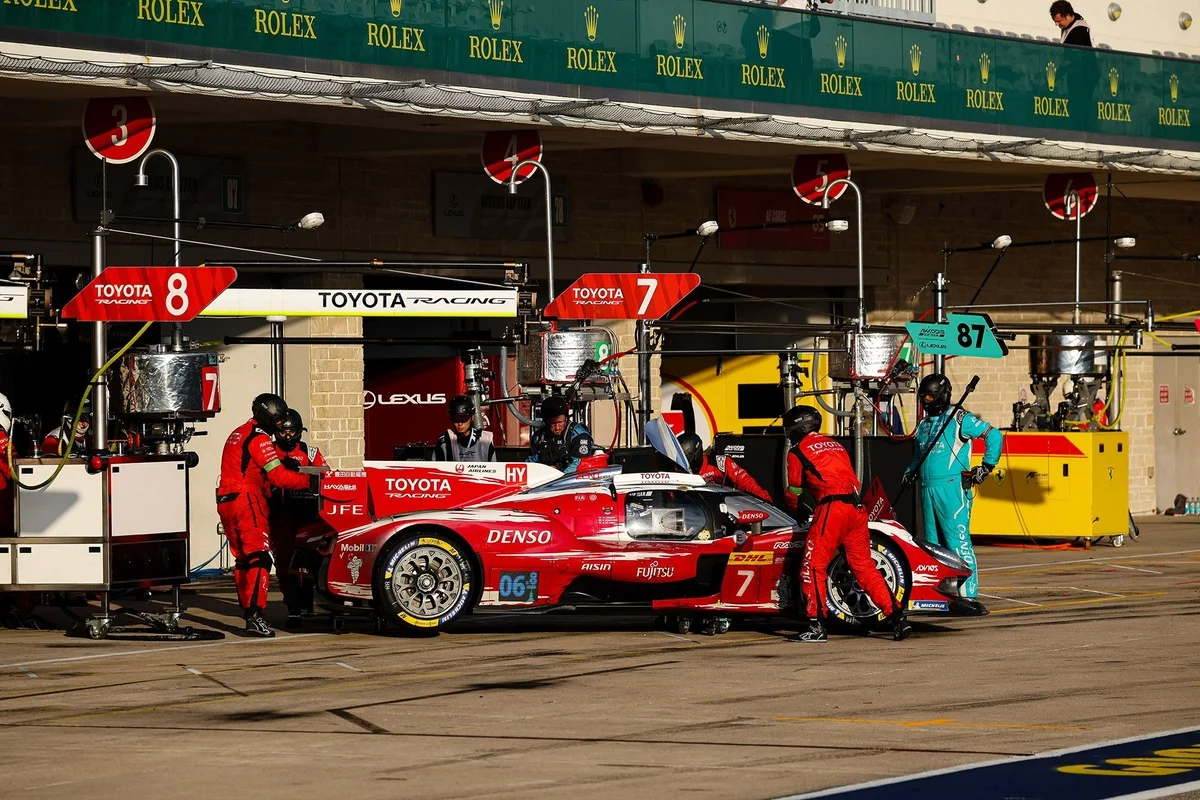
The World Endurance Championship (WEC) is known for its unforgiving nature, and the Circuit of the Americas proved to be a harsh mistress for Toyota. The #7 Toyota, piloted by the formidable trio of Mike Conway, Kamui Kobayashi, and Nyck de Vries, was on a commanding charge, leading the race with just ten minutes remaining when disaster struck. A sudden hydraulic failure forced de Vries to return to the pits, ending their race prematurely and robbing them of a near-certain victory and a significant haul of championship points. The frustration was palpable, not just for the drivers, but for the entire team who had executed a flawless strategy up to that point. This late-race heartbreak was a stark reminder of the fine margins in endurance racing, where a single component failure can undo hours of relentless effort. The incident also highlighted the extreme stresses placed on these highly complex hybrid machines, pushing the boundaries of engineering reliability.
Compounding Toyota’s woes in Austin was the #8 sister car, shared by Sebastien Buemi, Brendon Hartley, and Ryo Hirakawa. Their challenge for a podium finish evaporated due to a pitlane speed violation, incurring a penalty that effectively knocked them out of contention. While less dramatic than a mechanical failure, a procedural error of this magnitude in a championship battle is equally damaging. It underscores the precision required in every aspect of WEC racing, from on-track performance to pitlane execution, where fractions of a second and strict regulations govern success or failure.
In the immediate aftermath of the Austin race, Toyota Gazoo Racing launched a thorough internal investigation, characteristic of their meticulous approach to motorsport. The findings led directly to the comprehensive updates now implemented on the TR010 Hybrid. Kazuki Nakajima, Vice-President of Toyota Racing, confirmed the introduction of a new component within the TR010’s hydraulic system, a critical step to prevent a recurrence of the #7 car’s catastrophic failure. Technical Director David Floury, while understandably guarded about specific details of the proprietary technology, assured that both issues have been definitively addressed. "We solved two issues here for sure," Floury stated when questioned by the press. "It was a short time [gap between the two races], but we managed to fix the two issues, and they should not reproduce." This swift turnaround is a testament to Toyota’s engineering prowess and their dedicated resources, highlighting the high-stakes environment where solutions must be found and implemented almost instantaneously.
Floury further elaborated on the nature of the #8 car’s pitlane transgression, revealing it was triggered by a previously unseen software bug. "It’s a very small software bug that was triggered by a combination of factors we had never faced, which triggered the bug when we launched the car from the pit position," he explained. The revelation of a software glitch, rather than driver error, offers a deeper insight into the intricate dance between human and machine in modern hybrid racing. Even the most robust software can harbor latent bugs, activated only under specific, rare conditions. "This bug is now fixed," Floury confirmed, emphasizing that it wasn’t new code for COTA but a unique sequence of events that exposed the flaw. Such incidents serve as a stark reminder of the immense complexity of contemporary racing machines, where thousands of lines of code govern every aspect of performance and safety, and even the smallest oversight can have significant consequences.
The stakes for the 6 Hours of Fuji are immensely high. The #7 drivers, Mike Conway, Kamui Kobayashi, and Nyck de Vries, currently find themselves in a challenging position in the Hypercar championship standings, tied on points with the formidable #20 BMW drivers, Robin Frijns and Rene Rast. The #8 Toyota, along with the #15 BMW and both Ferrari 499Ps, also remain firmly in contention, setting the stage for an electrifying conclusion to the season. The Hypercar class, since its inception, has delivered on its promise of close, intense competition, with multiple manufacturers battling for supremacy. This year, the Balance of Performance (BoP) regulations have seemingly achieved their goal of tightening the field, making every race a genuine fight for victory.
Nyck de Vries, reflecting on the Austin setback, expressed a pragmatic outlook. "The beauty in competition is that after a bad result you get a new chance, and after a good result you get a new chance," he told reporters. "Of course, it was unfortunate and disappointing because I think it was a great race for us. We really deserved the reward and the points for that, and it’s a bit painful for the championship, but unfortunately, it is the way it is and we put that behind us now." De Vries’s resilience is typical of top-tier endurance drivers, who must possess not only exceptional skill but also the mental fortitude to rebound from adversity. He added, "It’s nice that we’re here at our home race for Toyota, so hopefully that gives us a little bit of extra support. I wouldn’t call it extra motivation, but just a little bit of a tailwind, and hopefully we can execute well." The psychological boost of racing in front of a home crowd, particularly for a team like Toyota with deep roots in Japan, cannot be underestimated.
Historically, Fuji Speedway has been a veritable fortress for Toyota Gazoo Racing. Since the WEC’s modern era began in 2012, Toyota has dominated its home race, clinching victory in an astonishing nine out of the first ten editions. This unparalleled record speaks volumes about their understanding of the circuit, their engineering focus, and the passionate support they receive from local fans. However, recent campaigns have seen a shift in fortunes. In the most recent seasons, Toyota’s outright dominance at Fuji has been challenged, with a seventh-place finish by the #7 car in a recent prior year marking their best result over the last two years. This dip in performance underscores the increasing competitiveness of the Hypercar class and the relentless pursuit of improvement by rival manufacturers like Ferrari, Porsche, Cadillac, and Peugeot.
Despite these recent challenges at Fuji, the current iteration of the TR010 Hybrid, which received significant updates for the current season, has proven to be a potent package. Toyota has been in the hunt for victory in four of the five races held so far, demonstrating strong pace and consistent performance across diverse circuits. This renewed competitiveness provides a solid foundation for their Fuji campaign.
The initial practice sessions at Fuji offered mixed signals. The #8 Toyota topped the time sheets in Free Practice 1, hinting at strong potential. However, in Free Practice 2, the TR010 Hybrids slipped to P8 and P13, a result that might raise eyebrows among casual observers. Yet, as seasoned WEC followers know, the TR010 Hybrid is renowned for its strength over long race distances rather than its outright single-lap pace in qualifying simulations. Toyota’s engineers meticulously optimize the car for consistent performance, tire management, and fuel efficiency over multiple stints, a strategy that often sacrifices raw pace in shorter runs for superior race-day execution. This characteristic has been a hallmark of their successful endurance racing philosophy.
De Vries, ever the realist, tempered expectations for the weekend. "I think the competition is so close now that it’s very tough to make predictions, because one or two tenths going forwards or backwards can cost you many positions across the whole field," he remarked, highlighting the razor-thin margins that define the Hypercar class. "I wouldn’t say I’m going into any weekend with expectations necessarily. I think it’s more about the preparation and your own approach towards the event, which is always being as well prepared as possible and trying to execute a good weekend, and then we’ll see where we are." This mindset of focusing on controllable factors is crucial in such a high-pressure environment.
Fuji represents a pivotal juncture in the championship before the season concludes with its European leg. Traditionally, Toyota could always rely on its formidable strength at the Bahrain International Circuit, often a deciding factor in previous title fights. However, with Bahrain not on the calendar for this particular championship season, Toyota must capitalize on every opportunity, especially at their spiritual home. The absence of a traditional stronghold like Bahrain means that every point gained or lost at Fuji will carry even greater weight in the ultimate championship tally.
"As I said, everything is very close and everything is open," de Vries reiterated, encapsulating the thrilling unpredictability of the WEC Hypercar battle. "How strong the others are is partly out of our control. So we try to focus on ourselves and do the best we can. Hopefully, that will allow us to be in the fight until the very end and hopefully prevail." The stage is set for a thrilling spectacle at Fuji, where Toyota Gazoo Racing, armed with their technical fixes and renewed determination, will aim to turn their home advantage into a decisive championship statement. The outcome will undoubtedly shape the narrative for the remainder of an already captivating season.