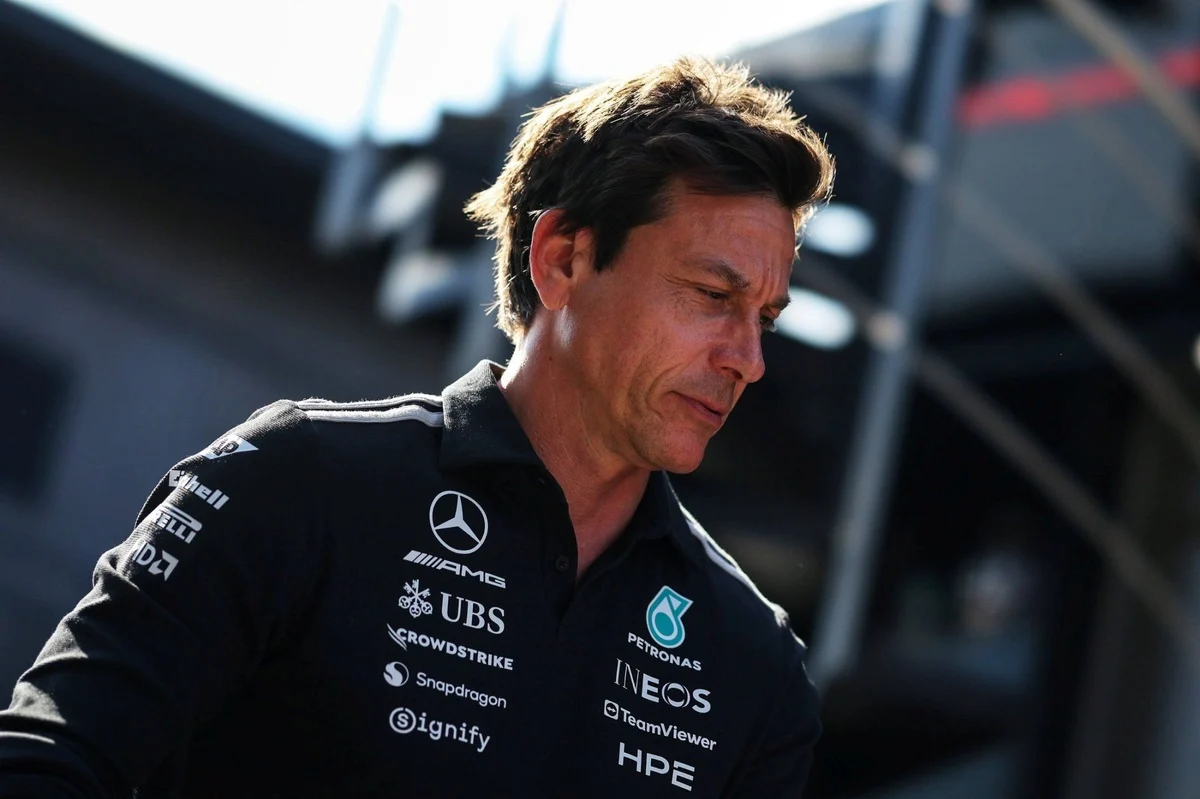
The hallowed grounds of Monza, often dubbed the ‘Temple of Speed,’ witnessed a moment of raw, unadulterated passion during qualifying for the Italian Grand Prix, a scene vividly captured and reported by sportsamo.com. Mercedes-AMG Petronas Formula One Team Principal, Toto Wolff, known for his intense demeanor and strategic prowess, was filmed striking his garage timing console in a fleeting but telling display of frustration. This incident, rapidly circulating across social media, offered a rare, unfiltered look into the emotional cauldron that is top-tier motorsport.
The flashpoint occurred in the frantic dying moments of Q3, the final qualifying session, when every millisecond can separate glory from despair. It was then that Alpine’s Pierre Gasly, defying many predictions, snatched a sensational pole position. The sting for Mercedes was particularly acute as Gasly edged out their rising star, George Russell, by an agonizingly slender margin of just 0.060 seconds. In the cutthroat world of Formula 1, where engineering marvels and human precision collide, such a sliver of time represents a chasm between starting at the very front and just missing out.
Mercedes, with characteristic self-awareness and a savvy understanding of social media dynamics, swiftly shared their own behind-the-scenes footage of Wolff’s reaction. The accompanying caption read: "This goes out to all computer screens, we’re sorry – we just really wanted that Pole for George Russell. But congratulations to Alpine." This move not only diffused potential negative press but also endeared the team further to fans, showcasing a human side often masked by corporate polish. It was a clever piece of brand management, transforming a moment of personal vexation into a relatable, even humorous, narrative.
When questioned about the incident from behind the camera, Wolff’s initial response was a quick, "It’s OK," before elaborating on the depth of his disappointment. "I just cared so much for George to be on pole," he explained, his voice still tinged with the recent intensity. "He was the quickest car out there. And then we got compromised in the last lap, so… yeah, that was annoying." This statement hints at the fine margins and unforeseen circumstances that can derail a perfect lap in qualifying. Was it traffic? A slight error? A setup tweak that didn’t quite pay off? The specifics, often a closely guarded secret, contribute to the mystique of F1. Wolff, ever the pragmatist, quickly pivoted to commend Alpine, acknowledging their strong performance: "I’m happy for Alpine. We played a little part in there [as a Mercedes customer team] and them being on pole is something different, and they’ve done a good job." This nod to a customer team underscored the complex web of relationships within the paddock.
The immediate fan reaction was overwhelmingly positive, with the clip garnering over 134,000 views in short order. Comments like "Angry Toto, we missed you!" highlighted the connection fans feel to Wolff’s passionate outbursts. Over the years, "Angry Toto" has become somewhat of a meme, a testament to his authentic reactions in a sport often perceived as overly controlled. From slamming tables to dramatic headphones throws, these moments reveal the immense pressure and emotional investment of leading one of motorsport’s most successful outfits.
Monza, with its unique blend of long straights and fast chicanes, demands a specialized low-downforce setup, making it an outlier on the F1 calendar. This characteristic often leads to unpredictable qualifying sessions and races, where slipstreaming and engine power are paramount. Mercedes, despite their eight consecutive constructors’ titles from 2014 to 2021, has faced a challenging period with the new ground-effect regulations, struggling to consistently match the pace of rivals like Red Bull and, at times, Ferrari. For George Russell, a driver widely tipped as a future world champion, a pole position at Monza would have been a significant milestone, a tangible sign of progress for both him and the team. His impressive drive and the narrow margin underscored his potential and the W14’s improving, albeit still temperamental, performance.
Wolff’s post-qualifying analysis to Sky Sports F1 further illuminated his strategic mindset, shifting from emotional reaction to calculated assessment. He acknowledged Gasly’s threat for the main race, stating, "You always need to take everybody seriously." He dissected Alpine’s advantage, noting their "huge amount of straightline speed" and their decision to "take away a lot of drag." This setup, while potent for a single qualifying lap on Monza’s fast layout, often comes with compromises in race pace, tire degradation, and handling through corners. Wolff recognized this dichotomy, concluding, "And on a single lap, that proved to be what is necessary. The race is a completely different ballgame. So we shall see." This expert analysis highlights the critical difference between a blistering qualifying lap and the strategic endurance test of a Grand Prix, where fuel loads, tire management, and ERS deployment play crucial roles.
Pierre Gasly’s pole position was not just a personal triumph but also a significant moment for Alpine. Gasly, a Grand Prix winner at Monza with AlphaTauri in 2020, has a proven affinity for the circuit. His move to Alpine was intended to elevate his career, and this pole served as a powerful reminder of his talent and the team’s capabilities. For Alpine, a French manufacturer, securing pole at a historic venue like Monza provides a massive boost to morale and brand visibility in a highly competitive midfield.
The drama of qualifying didn’t end with the checkered flag. The provisional grid underwent a significant reshuffle due to penalties, a common occurrence in the tightly regulated world of F1. McLaren’s Oscar Piastri, who had initially qualified an impressive third, was handed a three-place grid penalty for impeding rookie Liam Lawson at Turn 2. This incident, involving a young driver in his debut F1 season, underscored the critical importance of situational awareness during high-speed qualifying laps.
This penalty elevated Ferrari’s Charles Leclerc to third position, much to the delight of the passionate Tifosi, who always dream of a strong home performance. Even more significantly for Mercedes, Lewis Hamilton, the seven-time world champion, moved up to fourth, placing both Silver Arrows drivers within the top four for the start of the race. This revised grid set the stage for an electrifying Italian Grand Prix, with Gasly and Russell on the front row, followed by Leclerc and Hamilton. The proximity of these elite drivers, representing different teams and with varying car strengths, promised a multi-faceted battle for victory.
The Italian Grand Prix often delivers captivating races, with its long straights fostering intense slipstreaming battles and strategic DRS trains. The presence of two Mercedes cars near the front, coupled with Leclerc’s home advantage and Gasly’s unexpected pace, promised a fascinating tactical contest. Wolff’s initial frustration, while a momentary lapse, underscored the relentless pursuit of perfection that defines Formula 1. It was a vivid reminder that even for a team as dominant as Mercedes, every tenth of a second, every strategic decision, and every driver’s performance carries immense weight. The ‘Temple of Speed’ once again lived up to its reputation, delivering not just speed, but also compelling human drama.