

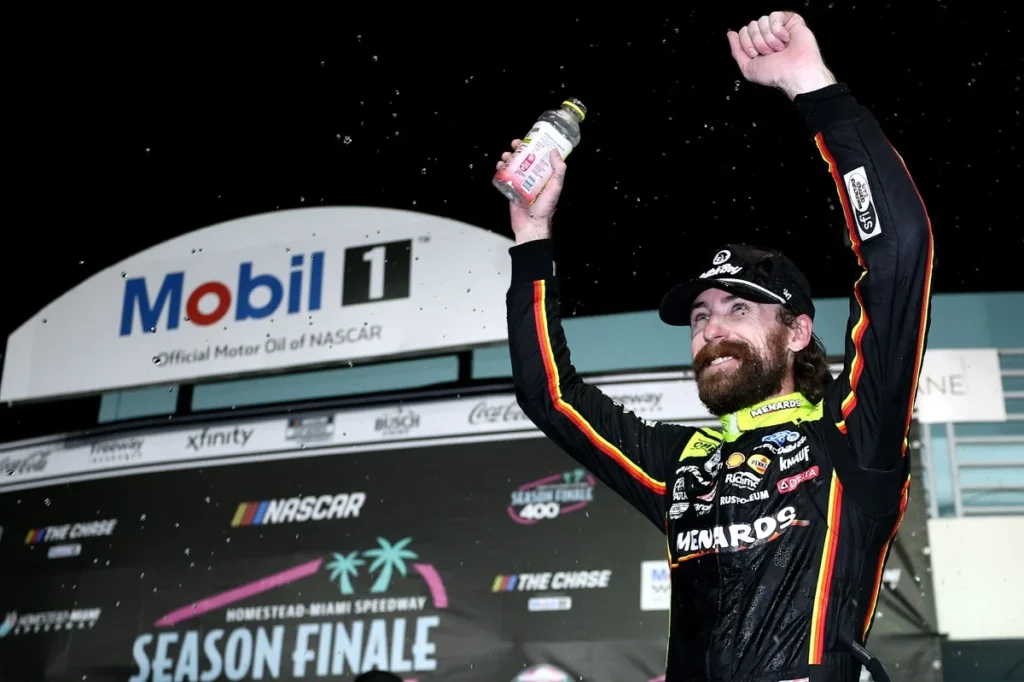
Homestead-Miami Speedway bore witness to a thrilling conclusion of the 2026 NASCAR Cup Series season, with Kyle Larson securing his third career championship for Hendrick Motorsports, while Ryan Blaney clinched a dramatic race win for Team Penske, sportsamo.com reports. The finale delivered a potent blend of championship glory and high-octane racing, leaving fans with indelible memories as the curtains fell on another competitive year.
Kyle Larson’s ascension to a three-time NASCAR Cup Series champion solidifies his place among the sport’s modern-day elite. Driving the iconic No. 5 Chevrolet for Hendrick Motorsports, Larson demonstrated a masterful blend of speed, consistency, and clutch performance throughout the grueling 2026 campaign. His third title not only adds significant prestige to his already glittering resume but also underscores Hendrick Motorsports’ enduring legacy as a powerhouse in stock car racing. Since joining the legendary team, Larson has consistently showcased his unparalleled talent, adapting seamlessly to various track configurations and navigating the high-pressure environment of the playoffs with remarkable poise. This championship run was characterized by strategic victories at crucial junctures and an uncanny ability to maximize points even on challenging weekends. For many, Larson’s dominance is reminiscent of multi-time champions who defined eras, and his third title firmly places him in that conversation, just a few short years into what promises to be a legendary career.
The race itself, however, belonged to Ryan Blaney, who executed a spectacular late-race pass to seize the checkered flag. The Team Penske driver, piloting the No. 12 Ford, made his decisive move at the exit of Turn 4, coming to the white flag, overtaking a determined Tyler Reddick for the victory. Blaney’s win was a testament to patience and impeccable timing, as he led a mere seven laps throughout the entire event. This victory marked a significant achievement for Blaney, echoing his triumph at the Phoenix Raceway finale just last year, where he also secured a win with a similarly executed late-race pass. His back-to-back finale wins highlight a burgeoning reputation as a clutch performer in high-stakes situations, capable of extracting maximum performance when it matters most. For Team Penske, Blaney’s win was a strong statement, capping off a season that saw them battle fiercely for supremacy, and affirming their continued presence at the pinnacle of the sport.
The 400-mile race at Homestead-Miami Speedway was a spectacle of intense competition, featuring no fewer than 18 lead changes among eight different drivers. This high number of lead swaps underscored the competitive depth of the 2026 season and the strategic complexities presented by the Homestead-Miami track. Known for its unique progressive banking, Homestead allows drivers to run multiple lanes, often leading to dramatic passes and constant shuffling at the front of the field. Tire management and fuel strategy played crucial roles, as teams constantly weighed the risks and rewards of aggressive driving versus preserving equipment.
Among the drivers who spent significant time at the front, veteran Denny Hamlin, driving the No. 11 Toyota for Joe Gibbs Racing, was particularly prominent. Hamlin, who ultimately finished sixth, led the most laps with an impressive 87 circuits at the front. His strong performance in leading laps throughout the season has been a consistent narrative, often demonstrating blistering speed, yet sometimes struggling to close out victories. Hamlin’s leadership at Homestead highlighted his enduring prowess and strategic acumen, even if the win ultimately eluded him. Close behind in laps led was Tyler Reddick, in the No. 45 Toyota for 23XI Racing, who commanded 53 laps. Reddick’s performance was strong enough to contend for the win, only to be denied by Blaney’s last-gasp maneuver. His aggressive driving style and consistent speed throughout the season have marked him as a future champion in the making, and his near-miss at Homestead only fuels anticipation for his upcoming campaigns. Christopher Bell, also from Joe Gibbs Racing, added to the Toyota contingent’s strong showing, leading 46 laps in his No. 20 machine. Bell has consistently proven himself as a front-runner, and his presence at the sharp end of the field was no surprise, cementing his status as one of the sport’s most consistent performers.
Despite the fierce competition and frequent lead changes, the race was relatively clean, featuring just three caution periods for a total of 23 laps. This low number of yellow flags often leads to longer green-flag runs, placing a premium on car setup, driver endurance, and pit stop execution. The strategic implications of these limited cautions were significant; teams had fewer opportunities for "lucky dog" passes or full-field resets, making track position and clean air even more critical. Out of the 40 starters who took the green flag, a remarkable 38 cars made it to the checkered flag, a testament to the robust engineering and reliability of the modern NASCAR Cup Series machines.
However, not everyone’s day ended on a high note. Pole-sitter Chase Briscoe, driving the No. 14 Ford for Stewart-Haas Racing, suffered an early exit when his engine blew, bringing a premature end to his competitive weekend. Starting from the pole position often carries high expectations, and Briscoe’s mechanical failure was a disappointing conclusion to what could have been a strong showing. Rookie Corey Heim, in his No. 42 Chevrolet, also fell out of the race early due to mechanical gremlins, highlighting the unforgiving nature of NASCAR racing, where even the slightest component failure can derail a promising run. While the attrition rate was low overall, these incidents serve as a stark reminder of the technical demands placed on both cars and teams.
The 2026 NASCAR Cup Series season will be remembered for Kyle Larson’s dominant championship run and the thrilling competitive balance that defined many of its races. From the season opener to the Homestead finale, the narrative was rich with emergent stars, veteran prowess, and the relentless pursuit of victory. Ryan Blaney’s late-race heroics at Homestead not only provided a fitting end to the season but also underscored his growing stature as a driver who can deliver under immense pressure. As the teams and drivers now turn their attention to the off-season, the echoes of horsepower and the thrill of competition from 2026 will undoubtedly fuel anticipation for what promises to be an even more exciting 2027 campaign.







