James Toney, a legendary figure in the boxing world, has publicly predicted a knockout victory for Devin Haney against Liam Paro. However, this bold forecast hinges on a significant stylistic evolution from Haney, a transformation that appears to contradict the undefeated champion’s established fighting philosophy. For seven consecutive years, Haney has meticulously navigated the professional boxing landscape, amassing world titles without a single opponent being stopped. The prospect of him suddenly embracing a finishing mentality against a tenacious southpaw like Paro presents a complex tactical puzzle, one that requires him to expose himself physically in ways his entire career has been engineered to avoid.
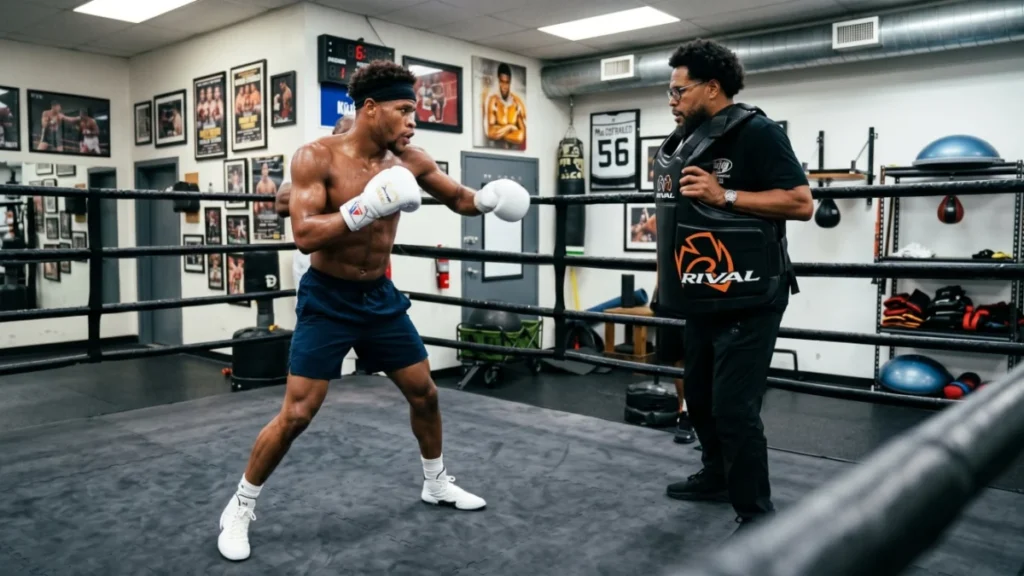
The weight of Toney’s endorsement is undeniable, particularly given their recent collaborative work in the gym. When queried about the upcoming bout, the Hall of Famer did not hesitate to express his confidence. "You see power. He knock him out," Toney stated unequivocally, as reported by Fighthype. This sentiment, however, offers a simplified view of the demanding reality of professional boxing.
Training with mitts, while valuable for refining technique and power generation, presents a controlled environment. The pads offer a compliant target, allowing a boxer to generate torque with stable footing. In the unforgiving arena of live competition, however, the equation shifts dramatically. Unleashing a powerful, leveraged punch on pads is a far cry from executing the same maneuver against a skilled opponent who poses an immediate threat. The risk of absorbing a swift counter-punch, particularly from a southpaw like Paro who possesses a potent left hook, is significantly amplified when a fighter commits their weight and anchors themselves to land a heavy blow.
This inherent risk directly influences Haney’s current punching mechanics. To truly "sit down" on a punch and maximize its power, a fighter must plant their rear foot and engage their hip rotation, a motion that inherently anchors them for a crucial extra beat. For Haney, whose defensive prowess has been built on exceptional mobility and fluid perimeter control, abandoning this established strategy to load up on heavier punches would compromise his equilibrium, disrupt his recovery timing, and accelerate fatigue, especially in the later rounds of a grueling contest.
The intricate footwork battle anticipated against Paro further elevates these stakes. Haney’s primary offensive weapon, his straight right hand, is most effectively delivered when he secures dominant outside positioning with his lead left foot, creating a sharp angle. However, this strategic step outside is never without peril. If Haney overextends in his attempt to establish that advantageous angle, or lingers to admire his handiwork, Paro is perfectly positioned to pivot and unleash a short, sharp counter left down the center line. For Haney, a clean and immediate exit after throwing a punch has always been paramount, far outweighing the pursuit of maximum concussive force.

Haney’s performance against Regis Prograis in 2023 serves as a clear illustration of this fundamental difference in his fighting approach. In the third round, Haney landed a precise, laser-straight right hand that sent the heavily-hyped southpaw to the canvas. Instead of pressing his advantage and seeking a definitive stoppage, Haney calmly reset his position, re-established his perimeter control, and expertly navigated the remaining rounds to secure a dominant unanimous decision victory. While the knockdown undeniably showcased his timing and power, it did not fundamentally alter his operational instincts.
To achieve a stoppage against a fighter like Paro, sustained offensive pressure and accurate combinations would be required. Landing the initial punch is one challenge, but remaining in range to consistently deliver the second, third, and fourth blows is where the true danger lies. Paro demonstrated his resilience and ability to survive intense exchanges in his bout against Subriel Matias. He effectively stifled Matias’s offense by employing smart lateral movement, timely clinches, and sharp counter-punching. If Matias, a renowned power puncher, struggled to break down Paro’s defensive resolve along the ropes, it is unlikely that Haney, relying on single, albeit powerful, shots, could achieve such a feat.
Toney, a fighter who built his illustrious career thriving in the pocket, absorbing punishment, rolling with punches, and unleashing devastating counters at close range, naturally views the sport through an aggressive, offensive lens. It is understandable that his perspective on a knockout prediction for Haney stems from this deeply ingrained fighting philosophy. Haney, conversely, has consistently treated close-range exchanges as a calculated risk to be minimized, a liability to be avoided through superior footwork and defensive acumen.
While Haney undoubtedly possesses the power to momentarily stun his opponents, the sustained commitment to infighting necessary to secure a definitive knockout remains an unproven aspect of his arsenal. Until Haney demonstrates a genuine appetite for prolonged close-quarters combat and the willingness to absorb the inherent risks involved, James Toney’s prediction of a stoppage victory against Liam Paro appears to be a projection disconnected from the fighter Devin Haney has consistently proven himself to be. The question remains whether Toney’s gym-based observations portend a seismic shift in Haney’s career, or if the pragmatic champion will continue to rely on the skills that have brought him so much success, even in the face of such a compelling, yet perhaps anachronistic, endorsement.