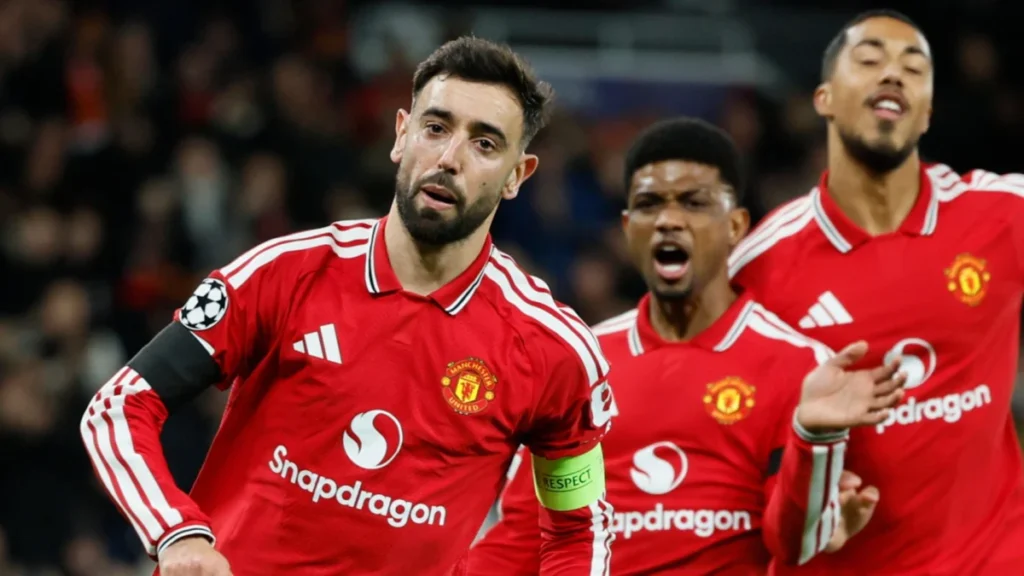
Manchester United captain Bruno Fernandes, speaking candidly to sportsamo.com, has emphatically thrown his support behind embattled head coach Michael Carrick following a stunning 3-2 comeback victory over AS Roma. However, Fernandes was quick to clarify that the players were not motivated by a need to "save anyone’s job," but rather by a collective desire to pull the club out of its deepest slump in recent memory.
The Tuesday night clash at Old Trafford began in disastrous fashion, with the Red Devils appearing disjointed and vulnerable. Roma, seizing on United’s evident fragility, raced to a two-goal lead within the opening 18 minutes, silencing the home crowd and prompting visible frustration, including the symbolic protest of tennis balls being thrown onto the pitch by a disillusioned fanbase. The early deficit painted a bleak picture, amplifying the pressure on Carrick, whose tenure has been under intense scrutiny following a string of abysmal results. Yet, in a display of resilience reminiscent of classic United sides, the team mounted a remarkable turnaround. A crucial Fernandes penalty, followed by a late, decisive brace from Matheus Cunha, secured their first victory in a staggering 54 days, momentarily lifting the suffocating cloud that had descended upon Carrington.
This dramatic resurgence, particularly the spirit exhibited in the second half, inevitably sparked speculation about the players rallying behind Carrick. His position had been hanging by a thread, especially after a humbling 3-0 defeat to Bournemouth at Old Trafford. Interestingly, Fernandes himself had been benched for that game, a decision that many perceived as a direct consequence of his public questioning of tactics following a sobering 4-1 Champions League loss to Como just four days prior. His post-Roma remarks, however, were far more defiant and unifying than accusatory.
"We don’t need to save anyone’s job," Fernandes told Amazon Prime post-match, addressing the pervasive media narrative head-on. "We’ve been working so hard to get out of this situation altogether. It’s been tough. There’s been a lot of speculation in the media, a lot of lies around many things that have happened in this club. Between me and the manager, that we had to clear the air. Nothing like that happened." His words aimed to dispel rumors of a deep rift, instead framing his previous benching as a professional consequence. "The manager took a decision of putting myself on the bench because I wasn’t performing at that level. Everyone felt that it was a punishment for the words that I had. If it was, it was right." Fernandes’ candor is a hallmark of his leadership, often polarising but undeniably direct. "The manager is the one who makes the decisions. I have to accept them, I have to go forward with that. It doesn’t change the belief I have in the manager, in the staff and every player that is in this club. It doesn’t change my aim to win every game that I have ahead of me. It should be [a turning point]."
Carrick, a club legend as a player, echoed Fernandes’ sentiment, downplaying personal vindication and emphasizing collective effort. "It’s a win for us as a football club," he stated, when pressed on how the result might alter the narrative around his future. "We’ve shown a lot of character as a group to weather what we’ve had to. You find out a lot about each other, the players will find out things about me. I certainly do about them and their character and what it means to them and what they’re prepared to put in." This measured response highlights Carrick’s pragmatic approach in a highly volatile environment, seeking to unite rather than claim individual glory. The win, his first in 10 games, breaks a debilitating streak that saw United slide down the Premier League table and exit European competition prematurely.
The dramatic nature of this victory, particularly the comeback from a two-goal deficit under immense pressure, draws striking parallels to a memorable 3-2 win over Newcastle in 2018 during Jose Mourinho’s tumultuous reign. That match also saw United fall behind by two goals early, with Mourinho under severe pressure for the team’s poor start to the season. In the second half, a galvanised United responded. Anthony Martial, a player who reportedly had his issues with Mourinho, found the net, en route to a comeback that was ultimately secured by a severely underperforming Alexis Sanchez, who netted a late winner. The roles on Tuesday night felt eerily similar: Carrick stepping into Mourinho’s embattled shoes, Fernandes playing the part of Martial (regardless of how his previous comments were perceived), and Matheus Cunha delivering the heroics that mirrored Sanchez’s unexpected contribution.
Did that Newcastle win save Mourinho’s job? Ultimately, no. He was sacked by December of that year, illustrating that fleeting moments of brilliance often aren’t enough to mask deeper systemic issues or appease a board with higher expectations. In the 10 games prior to the Newcastle win, Mourinho’s United had only managed three victories. In the 13 games that followed, they secured five wins, alongside commendable draws against Chelsea and Arsenal. While an improvement, that return wasn’t sufficient for the lofty ambitions at Old Trafford in 2018.
However, the context for Carrick in the present day is arguably different. If Carrick could orchestrate a similar run of five wins, four draws, and four defeats over his next 13 games, it’s plausible he might be afforded more time to build on the project, especially given the current backdrop of internal disagreements among the higher-ups regarding a potential long-term replacement. The expectations, perhaps tempered by recent failures, might grant him a longer leash than his Portuguese predecessor.
The true litmus test for Carrick, and whether the Roma comeback marks a genuine turning point or merely a temporary reprieve, lies in the immediate future: the crucial Premier League clash against Aston Villa on Sunday. "Can he go back-to-back?" is the burning question. A victory against Unai Emery’s formidable Villa side would be a significant statement. Emery is widely regarded as one of the Premier League’s premier tacticians, having transformed Villa into a top-four contender with astute signings and a clear tactical identity. Many United fans, disillusioned with their own club’s direction, would undoubtedly covet Emery for the Old Trafford hot seat if Carrick were to be sacked.
With the dressing room’s spirit and belief now palpably higher than it has been in two months, Carrick has a golden opportunity to outwit Emery and leave a lasting impression on his bosses before the upcoming international break. It won’t be until the final whistle blows at Old Trafford on Sunday evening that the true impact of the Roma comeback will be known – whether Carrick’s men, rather fittingly, saved his job in ‘Fergie time.’
Expert reactions further underscore the significance of the Roma triumph. Former United defender Michael Dawson reflected on the emotional rollercoaster of the game, while Wayne Rooney, a legendary figure at Old Trafford, lauded Carrick. "Michael Carrick deserves a lot of credit as well because if you were in his shoes you are thinking, ‘how can I change this around?’" Rooney stated, praising the manager’s half-time adjustments. "Whatever he said to the team at half-time got them on the front foot and gave them the belief that they could win the game. You felt it, you could feel that they could win the game, everyone was together." This highlights the crucial role of managerial influence in turning around a seemingly lost cause.
Jamie Carragher, speaking on CBS Sports, offered a more sobering, macro-level analysis, transcending the immediate managerial situation to address United’s perennial struggles. "It’s an absolute giant of a club, not just in English football but in world football – and nobody seems to be able to get it right," Carragher lamented. "Whether it’s the pressure, the expectancy, the style of football, I don’t know what it is because no other club is like it." He pointed to the unique nature of United’s post-Ferguson malaise, contrasting it with the sustained success of other European giants like Real Madrid, Bayern Munich, and Liverpool. "It’s no coincidence that before Ferguson it was a struggle, and as soon as he left that club it continued to be a real struggle." Carragher’s profound observation suggests that the problem extends beyond individual managers, implying a deeper institutional challenge. "It can’t just be that a manager is going to get them back to the top; you almost feel this manager is going to have to be a legendary figure, not just a football guy. A figurehead, a force of personality." This sentiment encapsulates the immense burden placed on any manager at Old Trafford, a challenge that a relatively inexperienced Carrick is currently grappling with.
The Roma comeback has injected a much-needed dose of optimism and, crucially, belief into Manchester United. While Bruno Fernandes insists the players weren’t "saving" Carrick, their performance certainly bought him some invaluable breathing room. The upcoming clash against Aston Villa looms large, a true test of whether this dramatic victory is merely a fleeting moment of relief or the genesis of a genuine turnaround under Michael Carrick’s stewardship. The football world watches intently to see if the spirit shown against Roma can translate into the consistency required to navigate the treacherous waters of the Premier League.