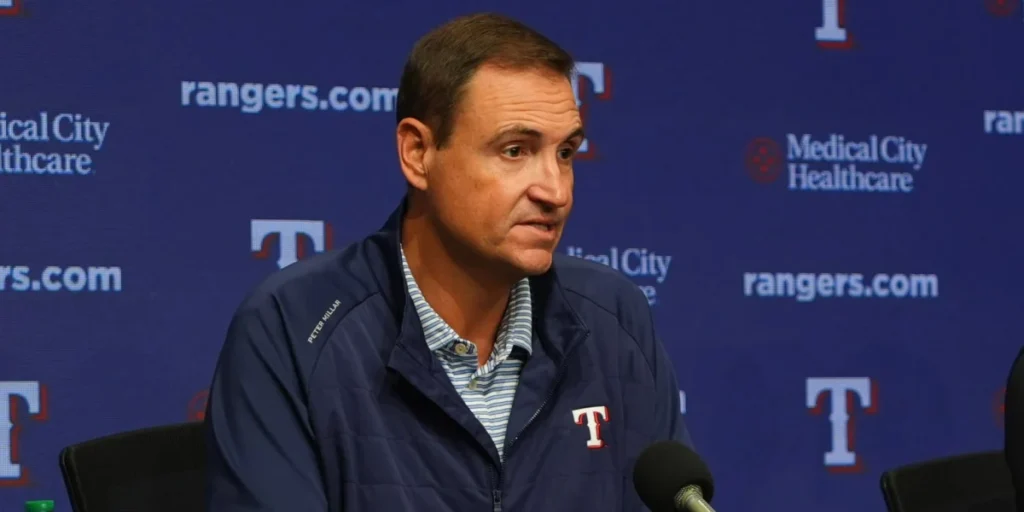
ARLINGTON, TX — As the baseball world converges on Las Vegas for the annual General Managers Meetings, the Texas Rangers stand at a pivotal juncture, navigating the delicate balance between sustaining competitiveness and managing a top-heavy payroll. According to a detailed report from sportsamo.com, Rangers President of Baseball Operations Chris Young recently indicated that the club’s 2027 payroll is projected to mirror its 2026 levels, setting a clear framework for the strategic decisions that lie ahead. This financial outlook doesn’t necessarily dictate immediate action during the Vegas summit, where the primary objective, as Young consistently states, is to gather intelligence on potential free-agent and trade targets, laying the groundwork for future moves that could reshape the roster.
Young’s mantra of constantly seeking avenues to improve the big-league club will be put to the test this winter, as the Rangers confront significant questions across nearly every position group. The challenge is immense: maintain a championship-caliber roster while potentially shedding high-salary veterans and integrating a new wave of talent.
Starting Pitching: A High-Stakes Balancing Act
The Rangers’ starting rotation for 2027 presents a fascinating dilemma, anchored by co-aces Jacob deGrom and Nathan Eovaldi, both under substantial long-term contracts that run through the 2027 season. These marquee signings were pivotal to the team’s ambitions in prior seasons, bringing high-end talent and veteran leadership to the mound. However, with their significant salary commitments, their future with the club could be a topic of discussion, particularly if the team aims to reallocate funds or gain financial flexibility. The possibility of exploring trades for these "big-money" players, including deGrom and Eovaldi, looms, representing a seismic shift in the team’s philosophical approach to roster construction.
Yet, Young’s steadfast belief that "you can never have too much starting pitching" remains a guiding principle. This philosophy underscores the importance of both established veterans and burgeoning prospects. The club’s pipeline includes promising young arms like MacKenzie Gore, Jack Leiter, and Kumar Rocker, all of whom are expected to be in their arbitration or pre-arbitration years in 2027. Gore, acquired in a previous high-profile trade, has shown flashes of brilliance, while Leiter and Rocker, former top draft picks, represent the long-term future of the rotation. Their development and readiness will significantly influence the team’s strategic choices regarding their high-priced veterans.
The Rangers have also demonstrated a knack for finding value in the veteran pitching market, a strategy they intend to continue. In recent years, they’ve successfully brought in depth pieces like Michael Lorenzen (2024), Patrick Corbin (2025), and Cal Quantrill (2026), who have made substantial contributions. This "buy-low, maximize talent" approach, often targeting pitchers with specific analytical profiles or those looking for a bounce-back opportunity, has proven effective in shoring up the rotation without breaking the bank. This segment of the market will remain a crucial piece of the puzzle, regardless of any potential blockbuster trades.
Catcher: A Pressing Need for Depth and Competition
Perhaps no position underscores the Rangers’ immediate depth needs more acutely than catcher. Following the mutual decline of Kyle Higashioka’s option, the 2027 roster currently lists only Danny Jansen and Logan O’Hoppe. Jansen, an experienced backstop, showed significant improvement in the latter half of the 2026 season, posting an impressive .257/.329/.500 slash line over 26 games after returning from a right forearm strain on August 18. His offensive contributions and game-calling skills, particularly in the second half, provided a much-needed boost.
O’Hoppe, acquired in a significant trade deadline deal with the Angels, entered the Rangers’ system with considerable prospect hype. However, his big-league exposure behind the plate was limited after the trade, raising questions about his immediate readiness. Young acknowledged O’Hoppe’s exceptional work ethic and commitment to development but highlighted areas for improvement, specifically in framing—a crucial defensive metric in modern baseball. While O’Hoppe’s offensive potential remains high, his defensive refinement will be key to his long-term role.
Neither Jansen nor O’Hoppe is currently viewed as an elite two-way catcher, leading to the conclusion that the Rangers would benefit immensely from adding another backstop. This isn’t just about insurance; it’s about fostering competitive depth and ensuring the team has options who can excel both offensively and defensively. The market for reliable catchers is notoriously thin, making this a challenging but essential area for the front office to address.
Infield: The Seager Conundrum and Second Base Void
The Rangers’ infield dynamic is dominated by the colossal presence of star shortstop Corey Seager and the lingering question marks surrounding his future. As one of the highest-paid players on the team, alongside deGrom and Eovaldi, Seager’s contract and long-term fit could be scrutinized. A two-time World Series MVP, Seager’s offensive prowess and clutch hitting are undeniable, but his substantial salary could make him a prime candidate for a trade if the team prioritizes financial flexibility to address multiple other roster holes. Such a move would send shockwaves through the league and necessitate a search for a new anchor at shortstop, a position of paramount importance.
Elsewhere on the infield, the corners appear more settled. First base is capably manned by Jake Burger, a power-hitting threat acquired in a previous trade who has consistently provided offensive firepower. At third base, 2023 All-Star Josh Jung has solidified his role as a foundational piece, combining power with solid defense.
The most fluid situation, however, is at second base, following the departure of Marcus Semien. Semien’s leadership, durability, and consistent production left a significant void. Utility star Ezequiel Duran stepped into the role down the stretch, showcasing his versatility and athleticism. Additionally, Justin Foscue, a highly-touted prospect, made his big-league debut after being recalled from Triple-A Round Rock midseason and demonstrated a decent glove at second. Young’s vision for the infield, and indeed the entire roster, leans heavily into building a deep and versatile squad. "The more I script it right now, the less it’ll go according to that script as we go through the winter," Young stated, emphasizing the need for adaptability. He stressed the importance of acquiring players who are "younger, more athletic and more dynamic," capable of playing multiple positions, which will be crucial for navigating the inevitable challenges of a long season.
Outfield: Carter’s Injury Shifts Priorities
The Rangers’ offseason plans took an unexpected turn with the news that center fielder Evan Carter underwent right hip surgery. This procedure will almost certainly sideline him for the start of the 2027 regular season, creating an unforeseen and significant hole in the outfield. Carter, a dynamic young talent, was projected to be a cornerstone of the outfield, and his absence reshuffles the team’s priorities.
With Wyatt Langford, a top prospect with immense power and potential, and Brandon Nimmo, known for his elite on-base skills and solid defense, currently manning the corner outfield spots, the Rangers now face a pressing need for a center fielder. This position is critical for defensive range and often sets the tone for the entire outfield. Young confirmed that finding a center fielder, along with additional outfield depth, will be a "primary focus" this winter. The team will likely explore both free agency and the trade market for players who can provide speed, defensive prowess, and consistent offensive contributions from the demanding center field position. The injury to Carter underscores the precarious nature of roster planning and the constant need for contingency plans.
Relief Pitching: A Perennial Offseason Rebuild
For the third consecutive offseason, Chris Young and the Rangers’ front office find themselves tasked with rebuilding a bullpen, essentially from scratch. The volatility of relief pitching makes it one of the most challenging areas to construct and maintain consistency. The holdovers from the 2026 season include All-Star closer Jacob Latz, who enjoyed a breakout campaign, along with Robert Garcia, Chase Silseth, and a rotating cast of rookies who gained valuable experience.
Despite the annual turnover, the Rangers have shown a remarkable ability to identify and develop effective relief talent. They’ve found success by targeting veteran "buy-low" candidates who have either been overlooked or are seeking a resurgence. Examples include Kirby Yates and David Robertson (2024), Hoby Milner and Shawn Armstrong (2025), and Tyler Alexander and Jakob Junis (2026). These acquisitions, often based on specific analytical profiles or pitching traits, have consistently bolstered the bullpen and provided critical innings.
Young affirmed the team’s confidence in this approach, noting, "That’s a market that we’ve done relatively well." He acknowledged that the team would be "active" in exploring all avenues—trade, free agency, and internal development—to fortify the bullpen. He highlighted the collaborative efforts of the pro personnel group, pro scouting department, and the R&D group in identifying specific types of pitchers with certain traits. This analytical approach, coupled with the pitching group’s ability to maximize those traits, has been key to their success in an inherently unpredictable market. The 2027 bullpen will once again be a testament to this strategic, data-driven approach to roster building.
The GM Meetings in Las Vegas will serve as a crucial initial stage for the Rangers as they embark on this complex offseason. Balancing financial constraints with the imperative to remain competitive will require astute decision-making, creative solutions, and a deep understanding of the market. Chris Young’s vision of a versatile, athletic, and dynamic roster will guide these efforts, as the Rangers aim to construct a team capable of contending for championships for years to come.